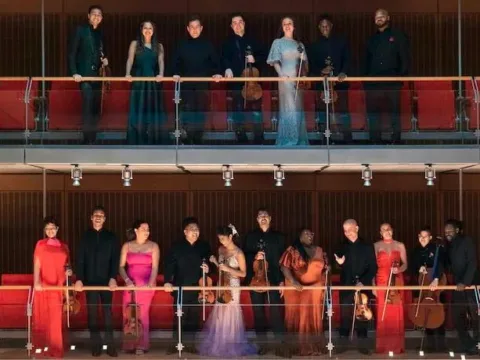
In a country fraught with massive power imbalances that favor the white and uber wealthy, it’s easy for privileged groups to forget who built the United States. American classical music institutions, largely modeled after their Western European predecessors, have historically mirrored this skewed hierarchy, leaving artists of color, women, and other marginalized groups in the shadows. With their new album, American Mirror (out on Aug. 29 on Deutsche Grammophon), Sphinx Virtuosi seek to redress this imbalance. Featuring seven works by American composers from the past 30 years, the album gives listeners the chance to consider: how do unrepresented artists perceive the United States and their place in it?
Unsurprisingly, the answer is varied. Far more diverse than most countries, shared identity in the United States is much harder to come by, and with increasing political turmoil, it’s only getting more difficult. The United States is made up of many different cultures and histories, so when artists hold up a mirror to reflect our country’s essence in their work, what do we see?
In the case of Coleridge-Taylor Perkinson, the answer is family. The four movements of his Sinfonietta No. 2, “Generations,”are dedicated to his ancestors and descendants. Infused with blues influences and bursting with character, the piece transforms existing melodies into personal tributes. For his daughter, the American folk song “Mockingbird”(“hush little baby, don’t say a word…”) is deconstructed into short motifs and passed around the ensemble before returning in a much grander fashion for the triumphant finale. The pop tune “Little Brown Jug” is the basis of the cheeky third movement written for his grandson; its playfulness stems from the resonant and full strumming from the string ensemble and the percussive taps on their instruments.

Harmonies commonly found in American folk tunes serve as a source of inspiration in Derrick Skye’s American Mirror: Part 1. Originally composed for string quartet in 2022, the reorchestrated work focuses on the beauty that comes from collaboration across cultures — something quintessentially American. Skye’s melodic influences span from West Africa to Eastern Europe, connected by folksy harmonies and the warm lower register of the strings. Despite the dramatic shifts in mood from cryptic to frenzied to hopeful, much of the piece sits atop consistent drones that give it a feeling of openness and tranquility.
Sphinx Virtuosi deliver plenty of liveliness and edge throughout the album, most notably in Habari Gani by ensemble cellist Quenton Blache. The title, a Swahili phrase commonly used as a greeting during Kwanzaa celebrations, translates to “what’s the news?” The message and the brightness of the piece are particularly successful as an album opener, announcing the ensemble with joy and flair.
This energy also permeates two compositions from GRAMMY-nominated composer and violinist Curtis Stewart. Strategically and effectively placed among the more lyrical tracks on the album, Stewart’s compositions are fiery and uninhibited, fostering an element of surprise. Drill for Prepared Drumset and Strings, which features soloist Josh Jones, is the most unexpected piece for a string album, but still quite cohesive; the pizzicato and staccato of the string accompaniment compliments the ephemeral nature of the drumset. Jones demonstrates both vigor and finesse in his performance, balancing seamlessly with the group. Invention #1: Double Down for two violins, also by Stewart, feels like listening in on a jam session between soloists Tai Murray and Njioma Chinyere Grevious, their fiddle-esque, bluesy interpretation embodying their laid back, natural collaboration.

Originally written for string quartet in 2000, Hané by Diné (Navajo) composer Juantio Becenti is arranged for the ensemble here. Lush, legato unison melodies and swelling dark harmonies form a cloud of melancholy that’s difficult to shake throughout all three movements. Although the piece begins with stillness, it develops into a chaotic scene of zippy dissonant passages, icy harmonics, and growling low strings. Considering this piece through the lens of the overall project, it’s tough not to connect this sonic unraveling to the rapid backpedaling of rights and protections so many marginalized groups have been experiencing in the United States lately.
A glimmer of hope comes in the form of Andrea Casarrubios’ Herencia, which translates to both “heritage” and “inheritance” in Spanish. Here, the ensemble delivers the elegant, sweeping melodies that make string ensembles so charming. Even in its more intense moments, the drama is delivered through creeping harmonies rather than outright bombast.
According to Casarrubios, the inspiration behind the piece is less about musical heritage and more about the personal journeys of the musicians playing it. Even the album’s cover is a collage of the performers’ faces embedded in artwork. Sphinx Virtuosi is made up of some of the most sought after talent in our industry, and yet history tells us that even a few generations ago, an ensemble like this would not have been able to exist. Conveying a universal reflection of the United States may be impossible, but American Mirror gives artists who have rarely had the opportunity to contribute their experiences the long overdue chance to be seen.
I CARE IF YOU LISTEN is an editorially-independent program of the American Composers Forum, and is made possible thanks to generous donor and institutional support. Opinions expressed are solely those of the author and may not represent the views of ICIYL or ACF.
You can support the work of ICIYL with a tax-deductible gift to ACF. For more on ACF, visit composersforum.org.