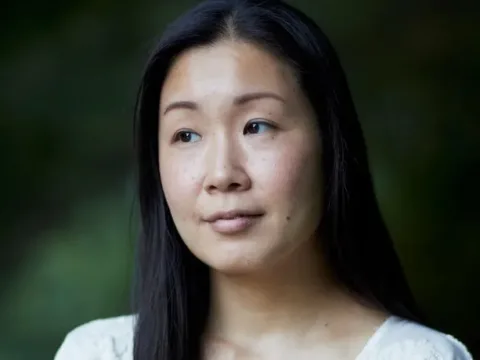
Asuka Kakitani is a Minnesota-based composer whose music asks gently for our attention with its joyful minimalism and earnest rainbow palette. A band leader for the Asuka Kakitani Jazz Orchestra and the Inatnas Orchestra, Kakitani’s musical canvases stretch from orchestra and 18-piece big bands down to works for solo marimba, vocal ensemble — and for her latest album, The Nights — solo piano. A musical memoirist, Kakitani sculpts the seasons of her life into sound, and The Nights provides a particularly deep peek into her experiences, both sonic and somatic.
Her 2022 album Twelve Months in Minnesota delves into her first year in the state after moving from Brooklyn, with one track dedicated to each month’s happenings, but The Nights is a longitudinal study — a tracing together of moments specific, general, and abstract, all illuminated in the dark. On The Scattered Night, frenetic perpetual moto is an homage to the restlessness of sleepless hours; The First Night I Held Her is about her very first moments with her daughter; and Some Purple Night is a whimsical work whose title was created serendipitously from her daughter playing with fridge magnets.
Kakitani chose to develop these moments in time into works for piano, and Shannon Wettstein performs these pieces with poise, striking a calm equilibrium between works like The Night before Flying — with its heavy, propellant power chords and asymmetrical rhythms — and The Night of the First Snow, where isolated pitches slowly, slowly gather into a snow-swarming of delight.
The album brings its audience into Kakitani’s awareness, helps us celebrate life alongside her, and helps us ponder what our own album of night memories might look like: which nights we might want to keep with us, encapsulated in music, forever.
There is so much stillness in your work, and awareness of stillness. Could you share some of your thoughts on time and the audience’s digestion of music in time?
Stillness and time, for me, are not just structural elements but deeply emotional ones. They shape how the music unfolds and create a space where the audience can breathe, reflect, and feel a quiet intimacy with the sound. For example, the pieces on my new album, The Nights, are inspired by moments from particular nights that left lasting impressions on my life. The music carries an atmosphere of dark quietness, with stillness arising naturally from that setting. Night is a time when the world slows down and inner conversations begin. In the darkness, small gestures feel amplified, and silence itself becomes more present. I wanted to capture that sense of subtlety, the spaces between sounds, and the expressive power of absence, inviting listeners to slow down, notice nuances, and experience time in a more suspended, contemplative way.
Shannon Wettstein, the incredible pianist on the album, once said my music feels anticipatory, which made me realize I often choose not to let it feel fully harmonically or melodically resolved. Instead, I focus on the way notes dissolve. A note can fade gradually or vanish suddenly into silence, and that moment of disappearance is as expressive to me as the sound itself. I hope the pacing and stillness give the audience time to absorb the music, allowing it to linger not only in the ear but also in memory, where it continues resonating internally.
The First Night I Held Her is a beautiful example of this calm loveliness found in the slower, softer moments of your work—can you talk to us more about your process of translating this particular memory into music?
Thank you! This piece is about the night my daughter was born. We were alone in the hospital room; I was holding her, looking at her face, waiting for her to open her eyes for hours. The hospital was in Brooklyn, so I know it must have been busy and noisy outside, even at night, but in my memory, it felt completely still, as if we were separated from the rest of the world.
In translating that memory into music, I wanted to capture the atmosphere of the night. I sat at the piano and tried to place myself back in that room—the darkness outside, the reflections of lights on the large windows, the quiet inside, the weight and softness of a newborn in my arms. I listened for the sound of that memory—the tenderness, the stillness, and the emotional resonance it left inside me—and played those sounds until I felt I had hold of them, then wrote them down. This is part of my usual composition process, and I always feel a little nervous, like before a race, trying to catch the sounds I hear before they vanish.
At the same time, I constantly wrestle with my inner critic, which tells me the music is too simple, too complicated, or too boring—basically all the worst things you can imagine. I’ve learned that another crucial part of composing is quieting those voices—silencing the noise of judgment—so I can really hear the essence of what wants to come through.
You describe your debut album Bloom as “a series of watercolor washed canvases”; what are other ways in which visual art has been an inspiration or guide to your work?
Color has always been a big source of inspiration for me, so visual art has a special place in my creative life. I wrote the piece Dance One after seeing Henri Matisse’s painting Dance (I), and I’ve also composed a jazz big band suite, Dark Paintings, inspired by Rothko. In both cases, the colors, textures, and emotional qualities of the paintings helped shape how the music sounded.
Sometimes a palette of colors sparks certain harmonies, timbres, or rhythms, and other times the music itself brings images or colors to mind. Because visual art and music are such different ways of experiencing the world, they feed each other in surprising ways. Even when a piece isn’t inspired by a specific painting, it often develops a sense of color in my mind as I compose.
Beyond mood and color, visual art sometimes helps guide me structurally. I usually start a piece without a fixed plan—I like to let the music unfold on its own, almost wanting to be surprised by where it goes. But I can also imagine using a painting like Gerhard Richter’s Fuji as a kind of loose map: its shapes, layers, and transitions give a sense of direction while still letting the music find its own path.
In this way, visual art isn’t just inspiration for individual pieces—it’s part of how I think about music. It helps me bridge the senses, shaping both sound and structure, and keeps my process playful, colorful, and alive.
Your new album opens with The Night of the First Snow, and while different from Twelve Months in Minnesota’s track December (First Snow), it carves a very similar emotional and sonic space for the listener. Are there any other “piece twins” in your work, or specific themes/images you find yourself returning to again and again?
I didn’t set out to create “piece twins,” but since moving to Minnesota from Brooklyn, snow has become a significant inspiration for me, and it happened naturally, much like an artist painting the ocean repeatedly in different ways. I had never lived anywhere with so much snow before, and the snow in Minnesota is beautiful. The first snowfall, or a quiet winter night, often evokes a particular stillness or sense of wonder that I feel compelled to translate into music. I don’t think any of my other works share the exact same title, but some pieces grow from similar inspirations or explore comparable emotional and sonic spaces.
My love for nature has always been a major source of inspiration, and in recent years, it has evolved to reflect concern for the impact of climate change on animals and the environment. I have composed pieces about light pollution, melting ice and polar bears, and owls facing habitat loss. These works often convey a mix of melancholy, awe, and quiet reflection, inviting listeners to contemplate the beauty, fragility, and danger of the natural world.
In that sense, even if the works aren’t literal twins, they are connected through shared sensibilities, recurring moods, or particular sonic atmospheres. Revisiting these inspirations allows me to explore them from new angles each time, finding fresh perspectives within familiar emotional or visual landscapes. Over time, this creates a subtle continuity across my work that listeners may sense, even when the pieces themselves are quite distinct. For me, these recurring themes are both personal and universal, bridging memory and imagination, and inviting listeners to share in my inner conversations.
Do you have a pre-composition ritual to help you get into the headspace of creation? Do you have any tips or hacks for the fellow creators in our audience?
I don’t have a fixed pre-composition ritual, but in recent years, journaling has become extremely helpful—not just for composing, but for many parts of my life. I’d love to follow Julia Cameron’s morning pages practice (writing three pages longhand, stream-of-consciousness, first thing each morning), but I’ve found it takes too much of my composing time. Instead, I journal whenever I can—during a spare moment, or especially when the inner voices start pulling me down. Writing helps me see what’s actually there, rather than letting things balloon in my head, and quiets those voices so I can return to the music. I also jot down all kinds of things—plans, drawings, dreams—which helps me better understand myself and keeps my creative mind open. This year, I even started a separate journal just for logging my composing process.
Another thing that has been helpful came after I had my daughter, when I had to completely rethink how I find time and space for creativity. Through trial and error, I discovered that early mornings are my most productive hours. I go to bed early with her and wake around 4 am, while the world is still dark and quiet. I feed the cats, make a cup of coffee, and dive straight into composing before anyone else is awake. My mind feels fresher, my creativity sharper, and my decisions faster than late at night when I’m drained. Finding the right rhythm makes a huge difference. For me, it’s the stillness of early mornings; for someone else, it might be late nights, which used to be mine. I try to notice when my mind feels most open and clear, and protect that time for creating whenever I can.
I CARE IF YOU LISTEN is an editorially-independent program of the American Composers Forum, and is made possible thanks to generous donor and institutional support. Opinions expressed are solely those of the author and may not represent the views of ICIYL or ACF.
You can support the work of ICIYL with a tax-deductible gift to ACF. For more on ACF, visit composersforum.org.