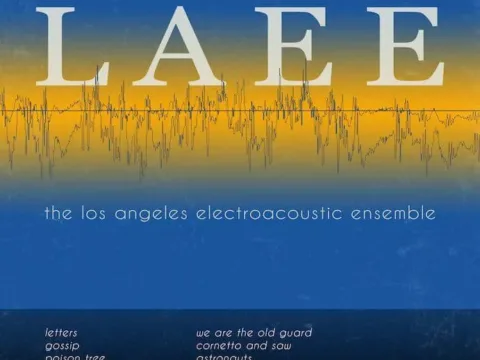
Depth and width are sometimes positioned as a dichotomy and treated as irreconcilable — however, composer and electronic musician Cristina Lord demonstrates that these ideas need not be in conflict. Her wide-ranging work directly explores concepts of cross- or multi-genre music, generating a practice with a dedicated and well-explored sense of eclecticism and experimentation. As a composer, her work spans opera, chamber music, and orchestral music, often with electronics in combination with acoustic instruments. She is active as a performer with the Los Angeles Electroacoustic Ensemble, of which she is co-founder; the Los Angeles-based artist also sings, occasionally plays the piano, and produces electronic music as Universed.
Lord’s newest album, If it All Falls, takes advantage of her diverse skills, featuring her production, singing, and laptop performance across what she describes as “a collection of genre-fluid electroacoustic works.” Released Sep. 26 on People Places Records, the album continues her long interest in the intersections and borders between “classical” and “popular” music. Here, Lord particularly focuses on density and texture across different generic modes, conventions, and practices, using them to explore the “information overload” of life. She distills this surplus into direct, short tracks that pair a plaintive, slightly nostalgic stance with punchy production; the often cutesy exteriors belie the seriousness of the questions which Lord poses. On the heels of her album release, we asked Lord five questions about balancing her multifaceted artistic practice.
With such a wide-ranging practice, could you tell us about your background and how you developed all these different aspects of your work?
My musical journey started by studying classical piano, and all my earlier compositions were focused on purely acoustic instrumentation (piano, choir, various chamber ensembles). It wasn’t until grad school that I started delving deeper into electronic music, and I quickly got hooked. I fell in love with being able to create exactly what was in my head, and a love for music production soon followed. As I delved deeper, the world of electronics seemed to me an endless playground, where you could do things – both with timbre and gestures – that just weren’t possible with acoustic instruments. I also joined the laptop ensemble while in my master’s program, which was my first exploration into visual programming languages like Max/MSP and the improvisatory practices that often accompany live electronics. I quickly got hooked on this as well.
Besides this, I’ve pretty much always had an interest in the cross-collaboration between different genres. As I became more involved with the new music community, the distinction between art and popular music often felt arbitrary to me – there is plenty of contemporary classical music that borrows from popular music conventions (like the repetitive chord cycles of post-minimalism, for instance), and there was plenty of popular music that was just as experimental and forward-thinking as new music. So something that I explore commonly in my own work is finding ways to connect these two worlds. My new album If It All Falls very much falls into this vein.
You co-founded the Los Angeles Electroacoustic Ensemble — what kinds of software and equipment do you use playing in and writing for a laptop quartet?
The Los Angeles Electroacoustic Ensemble is a laptop quartet that a few of my close friends from school and I started after we graduated and realized we missed being in our program’s laptop ensemble. It’s been a great experience being part of such a truly collaborative group – each piece we’ve written has felt like an equal effort between the four of us, which is something that can feel pretty rare and special. We mostly use Max/MSP, but we have thrown in some modular synths from time to time. We also sometimes play acoustic instruments, processed or not.
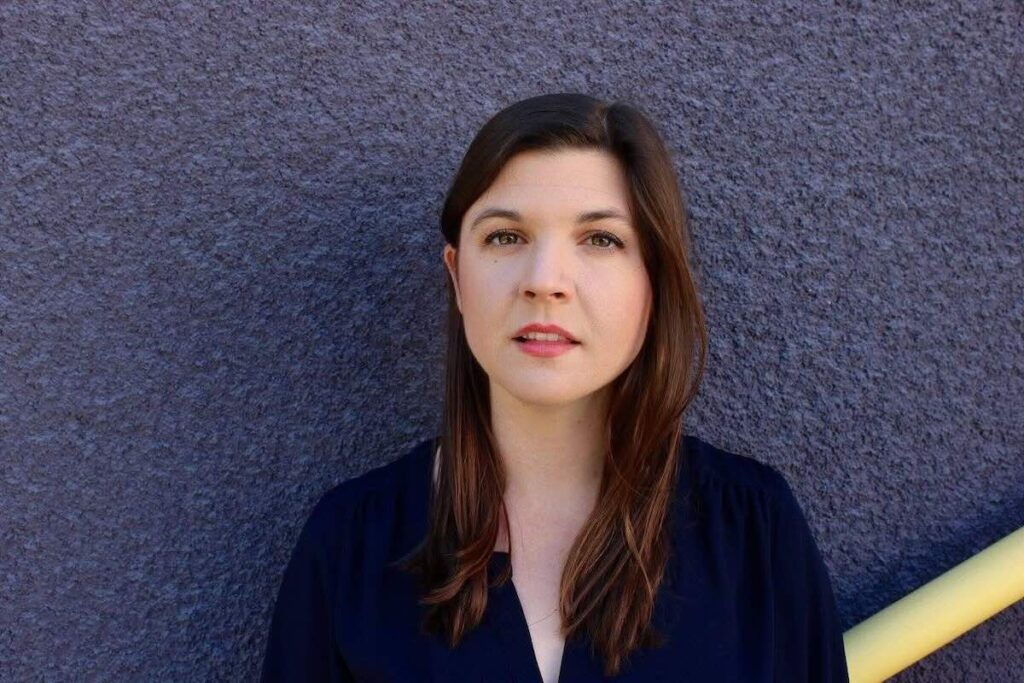
I’m curious about the role of anger and spite in your new album. In describing it, you mention a “personal vendetta” and “a rage against boredom” — what do these entail for you, and how do you view them as manifesting in the music?
At least to me, there seems to be something very unnatural about the modern human experience. I often feel like we’re chugging along, racing each other against “something”, trying and trying and for what? I don’t mean to sound nihilistic. It’s more that I’ve realized that the thing I’ve actually been chasing is simply to be still; I believe there can be meaning in just that. In stillness, you can really appreciate what it is to be alive, and you can finally find a space to connect with others and with nature.
I think the anger comes from feeling that I’m somehow not allowed to be still – we live in a society that demands constant productivity and seems to punish rest. (Or perhaps worse, we learn to punish ourselves, feeling guilty if we’re not being productive.) And if we’re not being productive, it’s expected to endlessly consume, whether it’s media or shopping or something else. It’s an endless addictive cycle that fosters a constant state of dread and unease. Even our hobbies have become monetized, and I do find that pretty upsetting.
In my music, I’ve found this recurring desire to take thick beds of sound and try to reign them in. It feels like a meditation. Like, if only I could somehow reign in all the notifications and doomscrolling, increasingly disturbing news headlines, endless to-do lists, and so on, in my own life. But it feels like something I can do in my music at least, and there is something cathartic about that.
I understand that you have started working more with generative algorithms in your work. How did this interest begin, and how have you seen it impacting your work and process?
Before I got into generative music, I’ve always been interested in aleatoric methods in composition, even before I began exploring electronics. Something about letting go, even for a little bit, feels freeing. That push and pull – between control and release – is something I’m really interested in. When I think about why, I think it’s because the active listening element of aleatory forces me to really be present. It also feels like the piece gains some organic, life-like quality. Once I began exploring the world of live electronics, I quickly realized how common it was for aleatoric elements to be present in computer instrument design. This aspect felt like a natural extension to what I’d already been interested in.
On top of this, I was also brewing interest in ambient music – composers like Brian Eno, r beny, Hiroshi Yoshimura, and Kaitlyn Aurelia Smith really inspire me. Brian Eno once described ambient music as akin to “sitting by a river…it’s always the same river, but it’s always changing”. I love this idea of blending some amount of control (I sit by this river in particular) with release (I let the subtly changing sounds of the river wash over me). Generative methods allow for the creation of a semi-controlled environment (my river) that can then unfold on its own.
On my album If It All Falls, the clearest instance of generative methods is in the final track, “If, Then.” The piece started as a Max/MSP patch which I built to have an underlying “if, then” logic system built in – random numbers are generated by a clock, and if those numbers fall within a certain value set, they trigger a particular vocal sample or sine wave envelope to play. Layered on top of that are synth chords (composed intentionally), which float around and respond to that generative bed that is the core of the piece. So in that sense, “If, Then” really encompasses this approach I’ve been taking more lately, one that explores the push and pull between taking or letting go of control.
What is your approach to managing the many different facets of your career, from composing and performing to teaching and your involvement in community organizations such as People in Electronics?
I feel just as passionate about teaching as I do about composing and performing music. I feel extremely lucky that I get to do both, and even more so that the two often get to go hand in hand. I find that my work as a composer informs my teaching, and I’m also always learning from my students. Besides teaching, I’m also associate director of People Inside Electronics, a new music collective based in LA. We put on concerts related to electronics and/or electroacoustic music, usually featuring living composers and musicians in the area, and sometimes we perform too. This too feels like a natural extension to my artistic practice, as it is a chance to connect with others, learn and grow. All in all, I think these different aspects of my career all come back towards a love for community – whether it’s composing or performing within the new music community, or connecting with my students.
I CARE IF YOU LISTEN is an editorially-independent program of the American Composers Forum, and is made possible thanks to generous donor and institutional support. Opinions expressed are solely those of the author and may not represent the views of ICIYL or ACF.
You can support the work of ICIYL with a tax-deductible gift to ACF. For more on ACF, visit composersforum.org.