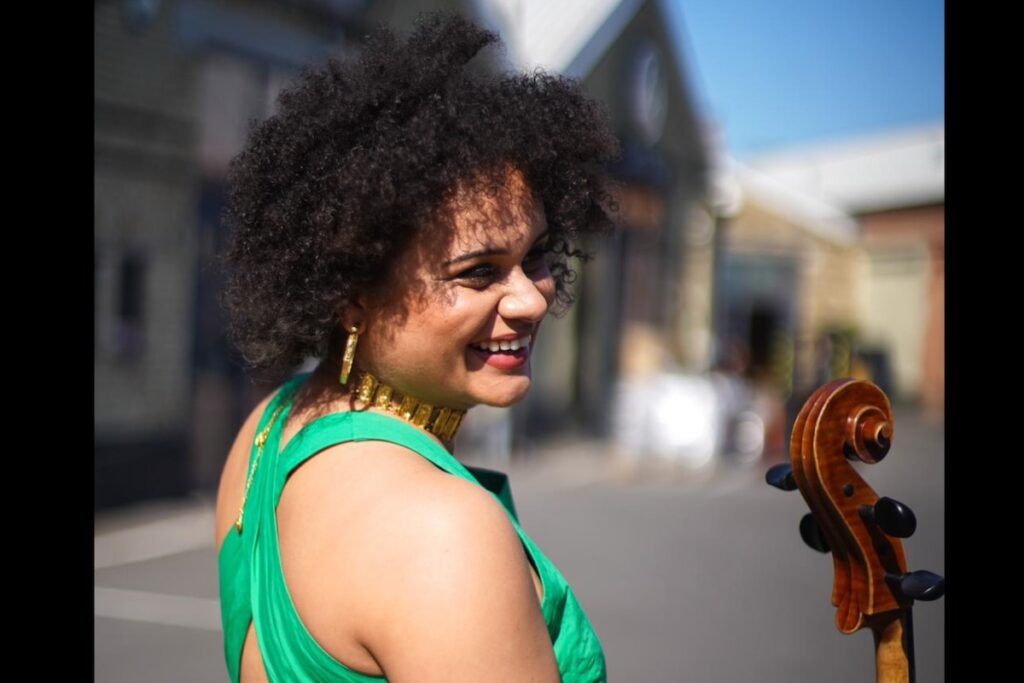
Zara Hudson-Kozdoj is no stranger to evolution. While she shares a classically trained background with many of her contemporaries, the cellist, composer, and conductor has carved out a musical niche that is uniquely her own. Throughout her career, she has deviated from the traditional path, experimenting with electronic, dub, and jungle musics in her performing and composition. And in addition to her solo endeavors, Hudson-Kozdoj is also a regular with Max Richter’s live and recording band, the Chineke! Orchestra, and the London Contemporary Orchestra.
As the classical music industry at-large strives toward accepting diverse voices and perspectives, individual artists are at the cutting edge of this shift. Recording projects have become an opportunity for artists to explore how their classical training can blend with other musical interests, influences, and — in the case of Hudson-Kozdoj — heritage.
On her new album Remember Who You Are (out Oct. 10 on Platoon), she takes inspiration from photos, poetry, text, and musical ideas from her Polish-Jamaican background, infusing dub and rave into classical music to create a portrait of her life experiences. The tenderness of “Radom” offers a loving tribute to her mother, while the laid back, reggae and dub infused “Fatherland” is inspired by her father’s Jamaican heritage. “XXs” and “Teenage Dreams” serve as polar opposite reflections on early relationships: the former somber and introspective; the latter is upbeat and clubby. Hudson-Kozdoj also recounts mental health struggles on the frantic and percussive “Anxiety Disorder.”
In addition to demonstrating her musical versatility across the album, Hudson-Kozdoj also recorded all the instrumental tracks and co-produced the project alongside Raz Olsher. The album was recorded during a single week of her residency at Studio Richter-Mahr in rural Oxfordshire. Just before the release of Remember Who You Are, we caught up with Hudson-Kozdoj to ask her five questions about drawing from many sources of inspiration.
As a cellist, composer, and conductor, what does your experience in each of these roles bring to your artistry?
The cello has always been a grounding force for me. It’s both a ritual and a daily habit: the one constant that I return to. Practising gives me a sense of familiarity and fulfilment, almost like checking in with a close friend. Because I’ve played the same instrument since I was fourteen, it feels like an extension of myself, something I’ve truly mastered and can rely on to carry me through any moment.
Conducting is a completely different energy. It’s about stepping into a leadership role and having the courage to hold an artistic vision strongly enough that others want to follow. I’ve had to learn how to earn the respect of musicians I deeply admire and that’s especially important as a woman of colour in this industry. Conducting has given me a stronger sense of authority, but also a responsibility to listen, to lead collaboratively, and to trust my instincts.
Composing opened up another dimension entirely and gave me belief in myself, in my own ideas, and in my way of seeing the world. It also changed how I experience art more broadly; I started to appreciate other artistic practices more, across visual art, film, and literature.
Now, when I’m scoring for other artists, I think beyond the notes on the page. With Celeste’s music, for example, I didn’t just focus on the rhythm or specifics, I tried to understand her wider vision, and the whole emotional picture. That has sharpened my ability to move between roles fluidly, always with the goal of serving the music as a living, breathing art form.
Your new album brings together several genres that people may not have heard combined before. How do you approach blending different musical styles?
I knew from the start that this album needed to reflect the full palette of sounds that make up my world. The soundtrack in my head as I move through life is always cinematic, rooted in classical and neoclassical music. So it felt natural that the first piece on the album would set that tone. It acts like the overture and the introduction of characters of sound, before I bring the other influences in.
I also listen to a lot of dub and bass-heavy music, so I couldn’t imagine making a record without those elements. “Sisterhood,” for example, leans into the light, pop songs I loved as a child. By contrast, “Anxiety Disorder” plays with satire and pokes fun at my own relationship with anxiety while still holding onto the pulse of dance music. Techno is funny for me because I don’t listen to it very much at home or in my headphones, but I still interact with it constantly; I hear it at festivals, in clubs, from friends. It seeps into the soundscape whether I want it to or not.
For the past five years, I’ve also listened to Marconi Union’s Weightless almost every day. That track shaped my piece “Meditation,” because its steady pulse became part of my body’s rhythm. I realised that it’s not always about what I prefer, it’s about how different styles leave imprints on my experiences. Even if my voice is the cello, it carries all of those influences with it.
The album notes mention that your mother, a musicologist, is a big inspiration for you. How has her relationship to music influenced your career?
Music wasn’t just something to enjoy for my mother, and for us growing up – it was woven into daily life. Morning, night, even in the middle of the night, music was always present in our home. She taught me to respect its sanctity, to treat it as something vital rather than optional. Having that influence meant I grew up with discipline and a strong work ethic; practising wasn’t negotiable, it was simply part of my life.
She also gave me access to a huge range of sounds. Our house was filled with everything from Classic FM to experimental jazz, reggae and dub, and the recordings of Jacqueline du Pré. My mum would also share niche Polish records from her youth, and when I visited my grandparents, church music was a constant. The piece “Radom” actually begins with the motif of the Hallelujah sung before communion in Polish church services, a direct nod to those roots.
It helped, too, that my mum knew the world of music academically, even if she wasn’t connected to the UK industry. She made sure I had a proper instrument, and she encouraged me to apply for scholarships so I could have access to the training I needed. We weren’t forced to practise or to continue with our instrument when we reached a stage that we could make that decision. But for me it was everything. I didn’t know any different, and by the time I did, the cello had already become my lifeline.
Both “Anxiety Disorder” and “Meditation” are nods to your process of managing OCD and anxiety. Did creating these pieces contribute to your journey of healing?
Writing those pieces gave me a way to look back with perspective. They helped me realise how far I’ve come, and I feel proud of that, so I wanted to celebrate and acknowledge those parts of me, almost like I could place some distance between myself and the struggles I used to face.
When I was younger, most of my teachers didn’t really notice what I was going through, which in some ways was a blessing. I don’t think I would have wanted to be treated as “ill” at that age. There are still days when anxiety is tough, but I have tools now. For me, anxiety is often a lack of self-confidence and not trusting that people will believe in me. As I’ve worked through the most challenging aspects of OCD and anxiety, I’ve learnt that it’s more important that I believe in myself. That’s something I’ve worked hard to overcome, and I still have days where I feel it more – it’s not completely gone.
I like to think of it now as a little gremlin that creeps up on me but is manageable, whereas I used to feel like this huge, looming bully, but once I learned how to handle it, it became something much smaller and less intimidating. I wish I could tell my child and teenage self that things would get better. I never imagined my twenties would be such a positive and successful time, but overcoming OCD showed me that resilience is possible. That realisation has been just as important as the music itself.
As you continue to expand your artistry to new frontiers, what are you looking forward to exploring more?
I’d love to work as a composer for film and screen, and to keep collaborating with artists across genres. I think music is most powerful when it’s shared, and when it challenges you to step outside of your comfort zone.
Beyond my own projects, I want to be an advocate for change. Diversity in the arts is often framed around race, but class is just as much of a barrier, and I’d like to help dismantle that too. When we talk about barriers in the industry, it tends to be about access and lack of opportunity, but I’ve experienced that it’s so much more than this. It is harder to get into the room and to feel heard amongst peers who have intrinsically more confident and connections due to their class status, but it’s also impossible at times to travel to that room, and to have to accept unpaid possibilities as there is no cushion of financial, emotional and physical support. Mentorship is a big part of that for me, supporting young musicians who might not otherwise see a place for themselves in this industry.
At the same time, I don’t want to lose sight of the joy. Having fun with music, playing with new ideas, and being part of cultural conversations in the UK (not just as a musician, but as someone contributing to the arts more broadly) all feel very important to me. My hope is to become an artist and composer who leads by example, and to show that music can be both serious and playful, whilst also freeing and full of opportunity.
I CARE IF YOU LISTEN is an editorially-independent program of the American Composers Forum, and is made possible thanks to generous donor and institutional support. Opinions expressed are solely those of the author and may not represent the views of ICIYL or ACF.
You can support the work of ICIYL with a tax-deductible gift to ACF. For more on ACF, visit composersforum.org.