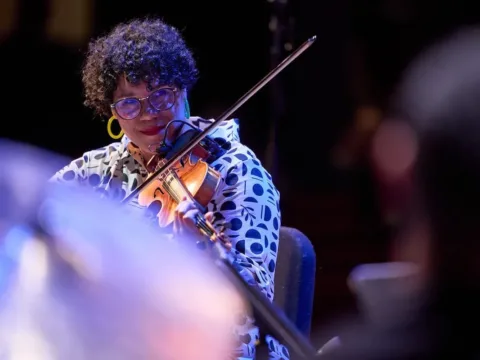
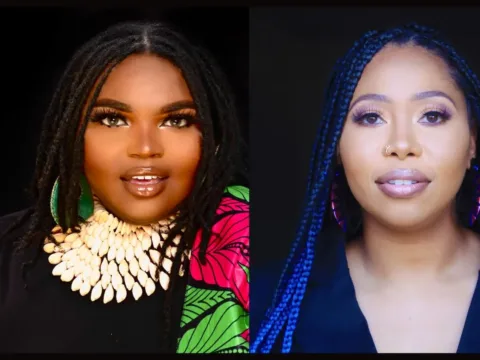
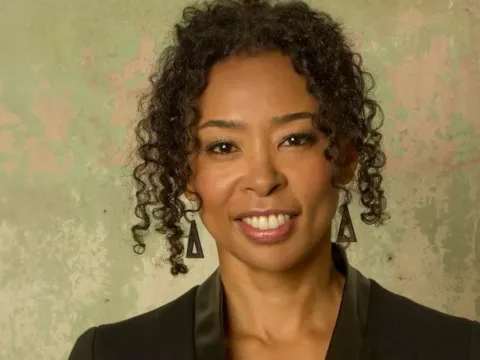
A few months ago, Jessie Montgomery was seated in the audience for the world premiere of Jasmine Barnes’ opera She Who Dared with her fellow members of the Blacknificent 7. The revolutionary Black composer collective — whose members include Montgomery, Barnes, Damien Geter, Shawn Okpebholo, Dave Ragland, Carlos Simon, and Joel Thompson — had gathered in Chicago to celebrate Barnes’ new opera about Civil Rights era women organizers. The group exists to provide one another with ideas and resources, but also to cheer each other on at significant premieres and events.
“Just knowing that you have this support around you gives a little boost of confidence,” Montgomery explained in our recent interview. “Not to mention the visibility of seven Black composers supporting and encouraging each other. We hope that [the Blacknificent 7] inspires other young composers of color, or composers from marginalized groups within our field, to get their people together… creating a cohort of friends. There’s strength in that… there’s a sense of, ‘if we have a core, then we can build out from there.’ It’s very empowering and feels like you’re going to be okay, no matter what.”
Named the 2025 Classical Woman of the Year by NPR’s Performance Today, the Grammy Award-winning composer and violinist recently completed her three-year appointment as the Chicago Symphony Orchestra’s Mead Composer-in-Residence. For the 2025-26 season, she will serve as the Kaufman Music Center’s Artist-in-Residence, her string orchestra work Chemiluminescence will be featured in the Sphinx Virtuosi’s multi-state tour, and her catalog will see performances by orchestras across the U.S. and U.K.
A founding member of PUBLIQuartet and former member of the Catalyst Quartet, Montgomery’s awards include the Civitella Ranieri Fellowship, the Sphinx Medal of Excellence and Sphinx Virtuosi Composer-in-Residence, the ASCAP Foundation’s Leonard Bernstein Award, and Musical America’s 2023 Composer of the Year. And next spring, Montgomery will receive The Sorel Organization’s Medallion Award and plans to donate half of her prize to Third Street Music School in New York City, where she studied music as a child.
Her dedication to music education is evident in her continued work leading workshops and masterclasses for young composers. She believes music schools could better meet the needs of students seeking skills beyond performance, such as composition, arranging, or music production. She recalls being unable to study both performance and composition as an undergrad violin performance major.
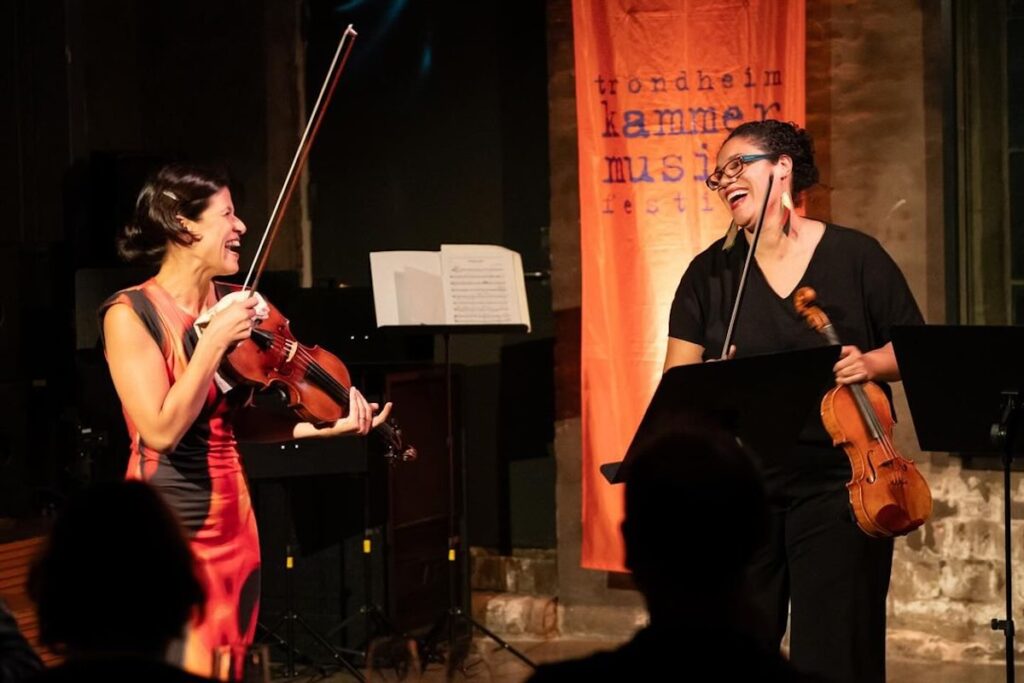
“When I was at Juilliard, I had to hide that I was a composer from everyone. I didn’t tell anyone that I was a composer. Finally, my theory teacher kind of found me out, and I tried to pursue composition. That’s my whole story with Juilliard — I tried to pursue composition there, and I was basically turned away.” Montgomery obtained a Masters degree in composition for film and multimedia at New York University and is completing a doctorate at Princeton. But the dual role of performer-composer is something she has pondered repeatedly over the years.
“My whole career, I’ve been trying to figure out where [performance and composition] come together. The next step that needs to happen is a pedagogy that actually integrates the two: not just the pedagogy of performance and the pedagogy of composition, but where do those things actually feed each other? How do you create scenarios to feed that interest, while [students are] in the rigorous study of learning how to play the viola really well?
“It almost sounds like an impossible equation to try to solve. But it needs to happen because students have been on the internet since they were in high school, watching people sing and dance and do all kinds of stuff, and they want a part of it — they want to know how to do it all. It’s strange that you can graduate from conservatory and have never written a piece before. If you can read it, and you can play it, and you can talk about it, you have to be able to also write about it. Once you enter into the freelance world, you might have a songwriter calling up saying, ‘Can you put together some charts?’ And then you say, ‘No, I can’t because I’ve never done this before.’ Then that’s a disservice to everyone.”
Critics have called Montgomery’s works “turbulent, wildly colorful and exploding with life,” and Strings magazine named her quartet Strum “one of the most significant works of the 20th century.” Her Grammy-winning composition Rounds was inspired by imagery and themes from T.S. Eliot’s epic poem, Four Quartets, but Montgomery also receives inspiration from feelings, moods, and sentiments, as well as personal experiences.
Some of her works even begin as dramatic musical sketches that involve specific characters, like her new cello concerto for Abel Selaocoe, which will receive its world premiere by the Deutsches Symphonie-Orchester Berlin in March 2026 before making its way to the Toronto Symphony and the Festival Orchestra of Lincoln Center.
“I’m writing a cello concerto right now that is very sentimental because it’s very much about mothers and about care. It’s a series of lullabies and songs that are specifically from mothers to children, or love songs of some kind. So those sentiments of love and adoration and magnetism, magnitude, those things are all wonderful inspirations.
“I do think of music as a mode of expression, obviously, but there’s a feeling of time. As the composer, you’re thinking about how the person who’s listening to it will experience it over time and that it does feel theatrical in that way. The storytelling part of it is actually physically in the timing: the stretch of time, how to manipulate the sense of time of the piece. I have heard the comment about my music that ‘I felt like I was on a journey.’ I take that as a compliment.”
Montgomery grew up in New York City as the daughter of the late Robbie McCauley, a prominent actor, playwright, director, and professor, and Ed Montgomery, a composer, jazz musician, and independent film maker. Being immersed in their creative worlds from a young age has continued to shape her approach to composition.
“I spent a lot of time at theaters watching actors work and understanding those hit points: the moments at which the story has to progress and happen in real time, making sure that the actors are where they need to be to do the thing. That whole interaction is baked into my music and the way I think about how to present the music. So I would say [my music is] theatrical in that sense. I’m not just trying to tell the stories about specific people and things — it’s also the experience of the dynamics within the music.
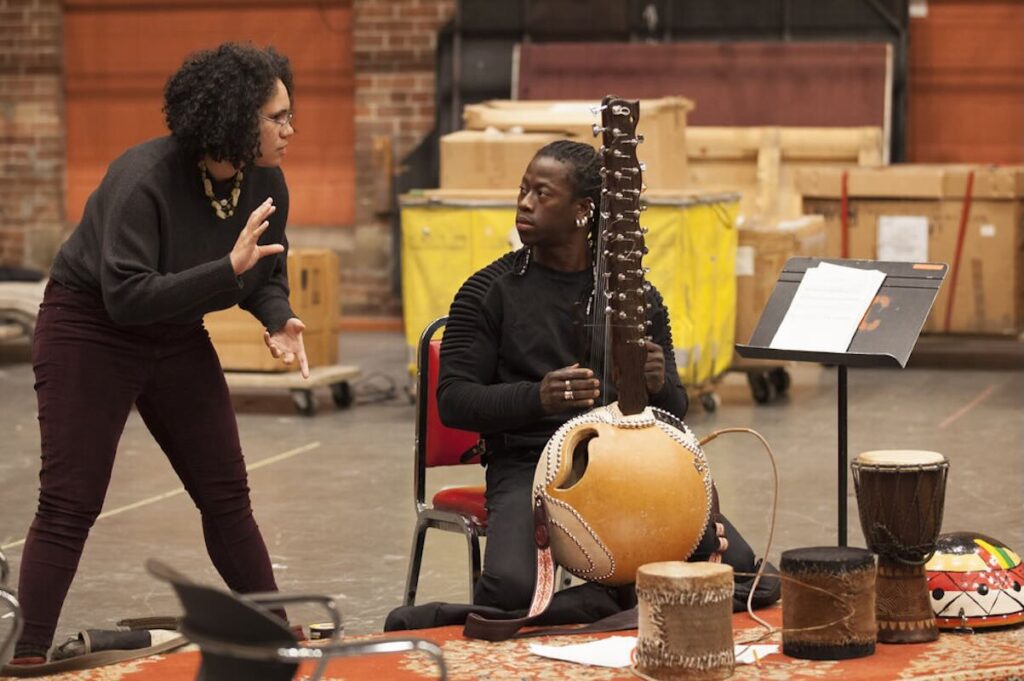
“I have several songs that I’m working on within this [one] piece. Some of them are popular songs, like ‘Que Sera Sera’ and ‘I Just Called to Say, I Love You’ by Stevie Wonder. It’s the length of the messages of each song. I’m sort of giving away my compositional process here, but I’m finding the links between the songs in terms of their messaging, but also even phrase structure wise, and in the notes themselves.”
Responding to current events or politics is a dilemma Montgomery calls “the constant problem” for artists. On one hand, artists are informed by the world they live in; on the other, they need mental space to allow creativity to flow. Artists often need to maintain a sense of optimism in order to remain curious and excited, but this can sometimes be significantly at odds with what is happening in the world.
“You have to be hopeful and you have to protect your playfulness. For me, playfulness is really important. Being able to be free and playful is, some would say, an act of resistance — to say: well, despite everything that’s going on, you’re not going to steal my joy.
“There’s a very fine line between that and being sort of dismissive about what’s going on just for the sake of self-preservation. On the other side, just holding the awareness of what’s going on requires you to maintain a constant sense of empathy towards other humans. I care about what’s going on. I think the deeper connection is: how does your own humanity translate into your art-making as a way of celebrating that empathy, that joy, that desire to care for your fellow human being?”
Montgomery explains that hope and trust help artists feel safe enough to share their work, be it vulnerable or based on personal experiences. Sometimes, even the smallest of interactions might inspire curiosity and lead to ideas that could be communicated musically.
“You do have to maintain an aspirational feeling around the people that you care about and the people you eventually hope to connect with through your art. I don’t think there’s a right way to be an artist and be politically invested or aware. I think you do different things at different times depending on what it is that you are faced with. There are points in your career where you really have to put the blinders on and just work, work, work, work, work. So it’s up to the individual to determine where you are mentally. Not having the energy to write because you’re overwhelmed by the state of the world is a crummy state to be in.
“In the United States, honestly, you can spend an entire day out and about and not encounter anything terrible. So, even in a difficult, hostile environment, people are just trying to survive and figure out how to connect or provide a service or say hello or whatever — those small acts of connection and kindness that just happen throughout the day. The actual feeling is one of regular kindness: people on the street doing their job, going into their shops, and doing the things they need to do. The regular, everyday interactions that we have as humans can actually provide a sense of peace or a sense of perspective.
“Being an artist is about being able to be present with those things and being able to say, ‘Actually, okay, for the rest of this afternoon, I’m going to think about my interaction with the guy down the street at the cafe and conjure some ideas, maybe some stories he told me,’ and just become curious and being on that for a little while.”
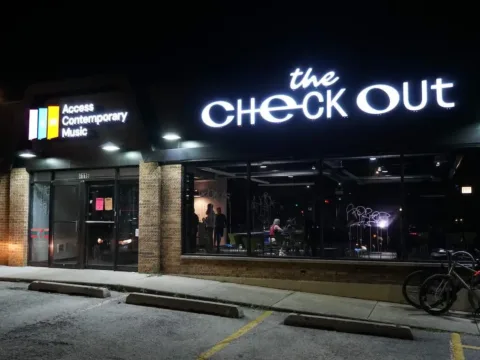
Montgomery’s day-to-day life is now in Chicago; she moved to the city in part because she witnessed deep connections between political/social life and the arts among the city’s residents. She’s also met a broad cross section of Chicagoans who seem well engaged in the arts. As she continues to seek out fellow local collaborators and venues for future projects, connection is an ever-present theme.
“One of the things I love about Chicago is it’s just so much less pretentious than New York. It’s like, ‘Let’s do this thing. Let’s just see how it goes,’ and all walks of life are going to show up just for the novelty of it. It’s fun. I’m getting into that kind of work here in Chicago because I do envision my life being less on the road and more local.”
I CARE IF YOU LISTEN is an editorially-independent program of the American Composers Forum, and is made possible thanks to generous donor and institutional support. Opinions expressed are solely those of the author and may not represent the views of ICIYL or ACF.
You can support the work of ICIYL with a tax-deductible gift to ACF. For more on ACF, visit composersforum.org.