Brooklyn-based tap percussionist, producer, and interdisciplinary artist Sandra Kluge doesn’t just hear the sound of her shoes as an extension of her movement; she treats these sounds as her drum kit. Trained in the art of tap but guided by a compositional imagination that reaches well into electronic, textural, and rhythmic terrain, Kluge is forging a path that moves tap from a sound effect to a full member of the rhythm section.
Her debut EP is built around her customized tap sample pack and offers a new perspective on the role tapping can have in contemporary music. The six tracks on i like floor to ceiling windows a lot utilize tap sounds as the foundation, incorporating recorded performances that are filtered and layered with Minilogue synth textures and subtle harmonic content. In “apparently tenderly,”the tapping blends harmoniously into the repetitive and additive harmonic groove. Meanwhile, “color field” demonstrates the flexibility of tapping, ranging from concise precision to a complex driving force. Throughout, Kluge’s blend of minimal grooves and ambient textures highlights her appreciation of simplicity. The result transforms tapping from dance into a fully realized musical instrument, creating a hybrid of rhythm and melody.
Kluge’s creative practice also extends beyond music, often blurring the lines between movement, visual art, and daily life. One of her ongoing projects, titled I’m walking every street in NYC, is an interactive map of photos taken in a collage-like fashion that showcases a deeper relationship between body, rhythm, and environment. In celebration of the recent release of i like floor to ceiling windows a lot, we asked Kluge about her creative process, the tools she developed for the album, and her other interdisciplinary projects.
When did you first begin to reimagine tap not just as movement or rhythm, but as an instrument in its own right? How did that shift influence the direction of your artistic practice?
From the moment I started tap, I was always most drawn to the sonic aspect of it. I never considered myself a dancer, but rather a musician with my feet. I never cared about looks or theatrical elements. Just about conveying emotion through sound.
In my process of developing my own voice and my own creative projects, I became more and more hardline in the way I approached it. Which, at a certain point, made me go all in and call myself a tap percussionist because “tap dance” really did not feel like it appropriately describes what I do.
And when you think about it, every instrument has a movement aspect to it, whether that’s the lifting of the arm to hit the drum at an exact time, or the inhale that takes place before blowing into a trumpet. Even though it’s more obvious in tap, it doesn’t mean that dance is the only lens through which we can view it.
In terms of my artistic practice, this process meant shifting from creating tap phrases on top of preexisting music to actually playing and composing music with tap at its core. The composing led to producing, and throughout this explorative journey I’ve experimented a lot with different conceptual and technical approaches to how tap can in fact be the center of the rhythm section and not just auxiliary percussion or a special effect.
Your new EP is built around your custom tap sample pack. Could you walk us through the process of capturing, editing, and sculpting those sounds into a usable instrument?
One of the main challenges in recording and producing tap is this: A drum set has a fairly consistent response across the kit – i.e., the snare occupies a certain part of the frequency spectrum while the kick occupies a completely different area. It’s easy to mic and treat each drum separately which gives you a lot of control over how you sculpt the sound.
Tap, on the other hand, is like having all those different elements in one drum. While I map my shoes roughly by corresponding them to a drum (e.g. left heel = kick drum, right toe = snare drum, etc.), there is still a lot of unpredictability, and the range of frequencies is narrower than that of a drum set. Which can be a big challenge for producing, especially since the kind of music I make is closer to high-production electronic music than, say, less produced music like jazz. This was the main impulse to play with tap sample packs – to make sure each time I need a “kick” I get the same sound information that makes the tap groove consistent, and therefore allows it to be the foundation rather than an added element.
In terms of my process, I basically record each part of my shoe separately, resulting in about ten different sounds per pack. Depending on the aesthetic I’m going for, I either leave the sound quite natural or do some shaping with EQs, filters, etc. Then I can trigger these sounds via midi. Generally, and also in my EP, I lay down the foundation of the groove with the samples and then add a lot of overdubs with live recorded taps to make it sound richer and more organic.
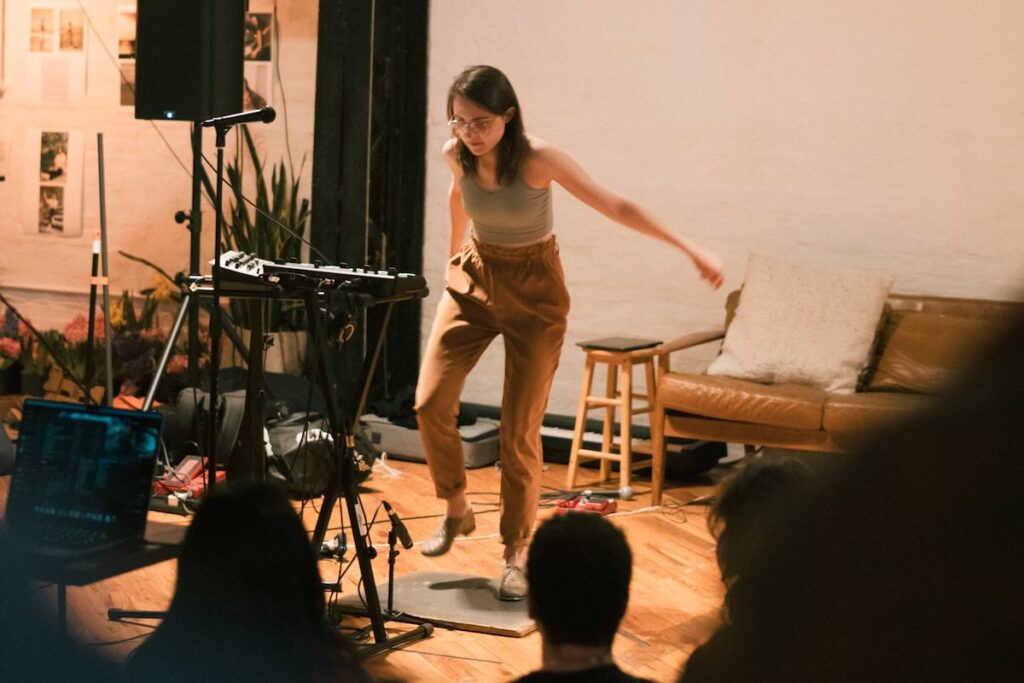
The music on i like floor to ceiling windows a lot feels both spacious and intentional, balancing rhythmic intricacy with subtle harmonic layers. How did you approach utilizing your customized tap sounds to shape each composition?
Interestingly enough, even though my main instrument is percussive, none of my compositions start with rhythm. It always starts with a chord progression. This sets the overarching emotional tone which then helps me figure out what kind of groove, and what other elements I want to add.
I wanted to make this EP with as few tools as possible – rather than scattering myself across a bunch of different pieces of gear, I used the same sample pack and the same synth for the entire thing. I wanted to explore how wide I can spread myself within these constraints, and I think that you can hear the cohesion across the EP. I was very intentional about the transitions between tracks as well, and having some degree of sonic consistency helps with that as well.
The nice thing about the sample pack is that it expands the frequency range of the taps – for example, the kick can go deeper, and the slides and scrapes can be more pronounced than in the live tracks. Which in turn allows the live taps to do what they do best without competing or cluttering the track – another challenge I’ve faced many times in my journey of producing taps.
The minimalist “About” page on your website includes just a few facts about you, including the belief that “Simplicity is beauty,” and that you love pears. How do these statements embody your music and other interdisciplinary visual work?
One of the core elements of my personality is being a minimalist. Which means so much more than not owning much, or friends and family repeatedly asking that “there’s really nothing they can gift me for my birthday this year?”
To me, being a minimalist also means being extremely intentional about the non-material side of life. I find that approaching things as straightforward and clutter-free as possible allows me to operate with maximum authenticity and integrity. After all, if there’s no fluff to hide behind, there’s full transparency about every aspect of me, so my choices better be ones I confidently stand behind.
And then the pear thing is a running joke that started years ago with me asking everyone I meet what their “spirit fruit” is. I feel strongly about pears (one could psychoanalyze why, but my guess is it comes down to feeling a kinship to their quiet confidence that makes them the sophisticated cousin to the ubiquitous basic apple). I don’t think any peardom translates to my art haha (outside of absentmindedly doodling cute pears in various scenes).
On the other hand, the sentiment that simplicity is beauty is definitely embodied in my music and art. I usually try to boil things down to their most relevant essence. This kind of veers into the more overarching conversation of “why art?”, but for me it comes down to the fact that art is the way we express abstract feelings and moods that we otherwise would not have any outlet for. This raw, specific expression is what I try to distill in my creative work.
Your feet are central to both your dance and your music. How do you think about their role across your broader creative practice, particularly in your intermedia works such as I am walking every street in NYC?
Interesting observation – I rarely think about my feet. But I guess they are a great motor (literally and conceptually) for a large chunk of my projects. After all, I thrive on activity, and being able to propel myself wherever I want to is a key factor for my happiness. I do think quite a lot about the concept of being there with myself wherever I go, no matter what’s happening around me.
One of my previously released songs, “Beholden To No One” is about being my own best friend. Because, after all, when we die we have no one but ourselves. So might as well nurture this relationship as much as we can.
Multiple of my music videos throughout the years have been centered around the element of constant walking. And truly, walking has always been a central part of my life. Not only does it help me think and feel and process, it also makes me connect with the world around me in a unique way. Whether that’s noticing the tiny things on the side of the street, or little interesting encounters with fellow humans, or observing same humans – there are infinite reasons why I love walking so much. Let alone the scientific evidence of how beneficial forward ambulation is.
I CARE IF YOU LISTEN is an editorially-independent program of the American Composers Forum, and is made possible thanks to generous donor and institutional support. You can support the work of ICIYL with a tax-deductible gift to ACF. For more on ACF, visit composersforum.org.