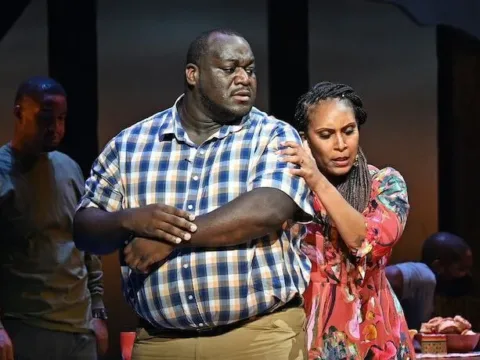
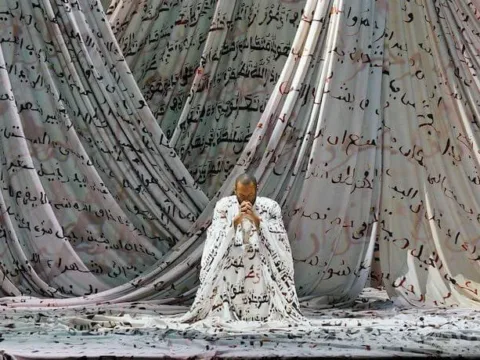
It’s no surprise that nimble and flexible chamber operas have been at the forefront of the increasingly important role of new opera in American musical culture over the past few decades. This month, Washington D.C.’s InSeries became the latest organization to join this community of commissioners. The opera-theater company has historically focused on creative updates to the existing repertoire, but Dec. 6 marked the world premiere of The Delta King’s Blues, the culmination of a three-year collaboration between the company, composer Damien Geter, and librettist Jarrod Lee.
For its first commission, InSeries presented a foundational American story that blends drama and intrigue with a sense of legacy: the legend of blues guitarist Robert Johnson. Johnson (1911-1938) was a larger-than-life figure; his 27 surviving recordings of original blues tunes, accompanied by slide guitar, have been hugely influential in shaping popular music in 20th-century America. But his real notoriety comes from the heavily mythologized tales surrounding his death under mysterious circumstances at age 27, and his supposed transformation from hack to virtuoso with a talent so staggering, he was said to have struck a deal with the devil.
Geter recognized a “Faustian” quality to this lore and felt that Johnson’s life and lasting influence made “great material for opera.” The Delta King’s Blues zooms in on this key inflection point in Johnson’s story. Portrayed with absolute clarity by the tenor Albert R. Lee, Johnson begins the opera in a state of dismay. Underscored by agile, atonal figurations in the orchestra, his fumbling efforts to perform (accompanied by stilted, diegetic guitar) inspire only mockery from his onstage audience.
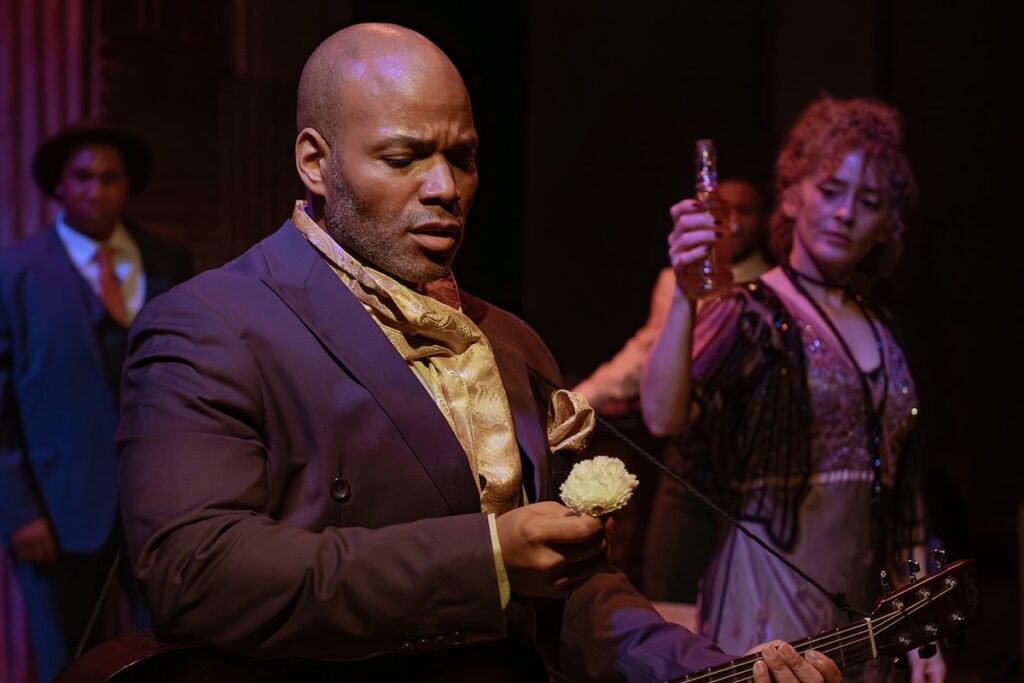
Geter’s creative use of instrumentation — a string quartet plus blues quartet of drums, bass, guitar, and saxophone — provides a wide palette through which Johnson blends or juxtaposes blues and operatic traditions. In the production’s first half, the creative team opted to intentionally make this combination feel jarring. Lee’s forthright and declamatory style depicted Johnson as perhaps a bit too somber. Geter’s effective setting of Johnson’s lines in rising arpeggios within a fairly constrained vocal range added to the image: well-meaning as he may be, Robert Johnson isn’t doing anything inspirational.
With this calculated setting of the first half by the creative team, Johnson’s transformation, played out over a nearly 20-minute continuous sequence, delivers a massive payoff musically, textually, and dramatically. The devil (the impish bass-baritone Christian Simmons), costumed in a sharp double-breasted suit and porkpie hat, finds Johnson alone and miserable in the wake of repeated and stinging musical failures. Accompanied by relatively muted and sedate strings, Lee’s precisely controlled fluctuations between straight ahead blues and harmonically complex recitative embodied Robert Johnson’s conflicted emotional state. Simmons offered cajoling rebuttals, often sharp and secco, interjecting into Lee’s rolling and mellifluous lines. The devil plays on Johnson’s sense of legacy: as Johnson keened, “I want something that’s only mine,” the devil smiled.
Geter’s scoring foregrounds the push and pull of their disagreement. In an off-kilter waltz, the strings, saxophone, and guitar develop from tutti unisons into branching, atonal clusters. Melodically legible while harmonically unstable, the orchestration supported the increasing allure of Simmons’ foreboding but enticing offer. A highlight of the section included Doug O’Connor (saxophone) and Marcus Pyle (violin) adroitly trading off dueling statements of the waltz melody: their feverish embellishments made Simmons and Lee’s onstage argument all the more piercing.
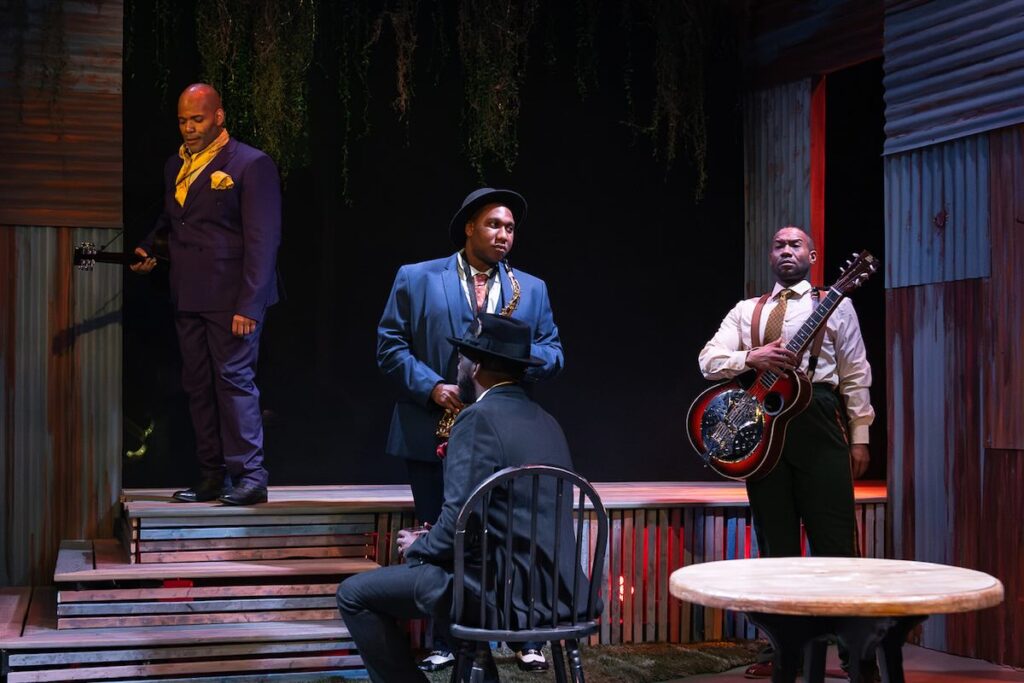
Eventually, an air of indecision and conflict gave way to determination. Transformation completed, Lee’s vocal style morphed from shy and controlled to a more explosive, confident, and improvisatory character. This section, perhaps too brief, dramatized Johnson at his height, and alluded to his demise with a cross stuck in the ground — half “crossroads,” half gravestone — leaving the consequences of Johnson’s misadventure mostly to the imagination.
The creative team, cast, and orchestra of The Delta King’s Blues dramatized Johnson’s story with great gusto and convincingly sold a new version of the legend of Robert Johnson. The production features no divine interventions; instead of a magical blossoming of virtuosic skill, Johnson takes guitar lessons from the devil, earning his newfound talent through painstaking work over six months. If the Robert Johnson of legend is an impulsive victim of the devil’s whim, Delta King’s Johnson is instead deliberate and hardworking.
As a result, this Johnson is humanized through an exploration of the emotional transformation, a treatment for which opera is so well-suited. And with efficient use of spare resources (a simple but convincing set, minimal effects and only five cast members), InSeries demonstrated that even companies without longstanding commissioning programs can contribute to an active repertoire of new works.
I CARE IF YOU LISTEN is an editorially-independent program of the American Composers Forum, and is made possible thanks to generous donor and institutional support. You can support the work of ICIYL with a tax-deductible gift to ACF. For more on ACF, visit composersforum.org.