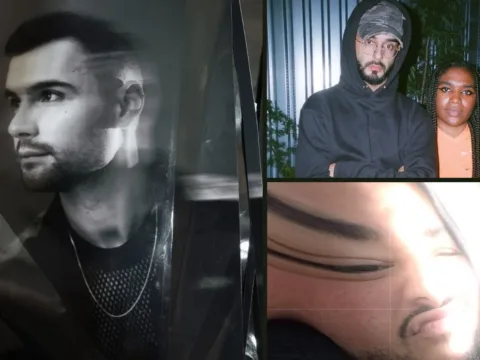
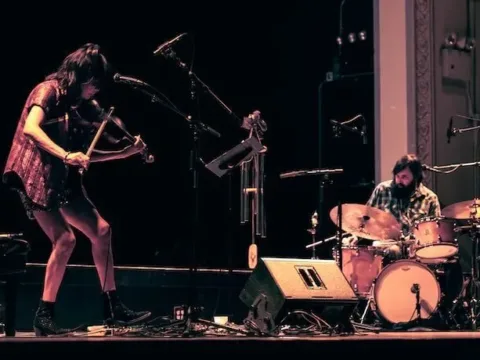
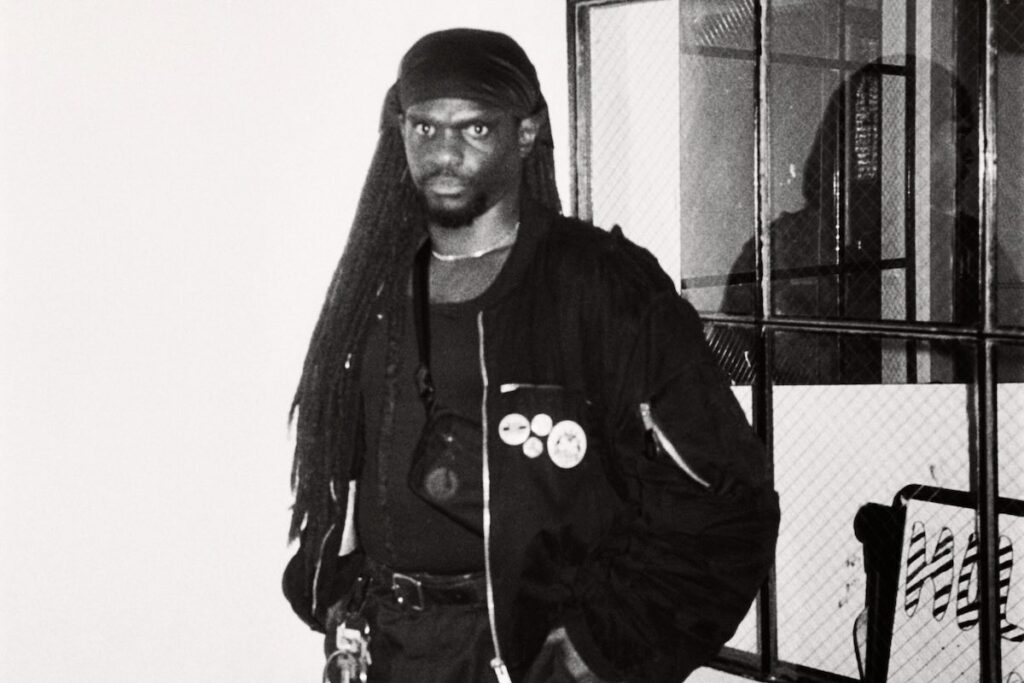
At a Dreamcrusher show, you can expect disorienting levels of fog; flustering strobe lights; the smell of burning incense; and head-splitting volumes. The high-stakes, multisensory project of Dreamcrusher is the heart of New York City’s underground noise and experimental hardcore scene. Their sets fuse droning, sound collage, and harsh vocality; they begin by playing miniature Jersey club DJ sets to reset the room, which then morph into fully blown-out distortion. Dreamcrusher also rejects performance-audience boundaries — they dip and weave through crowds while screaming into the mic, dispensing hugs, and dragging people with them across the room.
In the early 2000s, the Wichita native got their start by sharing music on Myspace and other digital spaces. Since then, they’ve racked up years of electroacoustic works and perfected their intimate DIY show experience. Their music has been featured in the Adult Swim “NOISE” compilation alongside the likes of Merzbow, Melt-Banana, and Wolf Eyes; chronicled in the PBS documentary The Untold Story of Noise and Experimental Music; and programmed by the post-genre Le Guess Who? Festival in Utrecht. In Feb. 2025, Dreamcrusher performed a singular happening at Roulette Intermedium in Brooklyn: a 50-minute song cycle-esque work titled MUSIC MAKES ME HIGH that transformed the polite seated venue into a standing room only hazy mosh-pit.
Whether performing solo, or with energetically-aligned collaborators like GENG PTP/KING VISION ULTRA, the queer noise artist has the poignant ability to facilitate a sense of intimacy and solidarity through shared discomfort, and to offer refuge to those seeking release from the oppressive structures of society. After two decades, Dreamcrusher has become a defining voice for young queer artists of color operating on the margins and outside of the institution.
You describe your work as “nihilist queer revolt musik,” and situated within the broad categorization of “noise.” Can you define these terms and their politicized meanings — and who or what the major influences were in developing your artistic voice?
NQRM was a moniker I came up with in the early days of the project, I noticed that a lot of other projects (both fringe and mainstream) had monikers of their own and I wanted something that was not only singular but visceral in its meaning. Like when you see it, it’s very clear what it means.
You cultivate a special energy at your shows – there’s a distinctive sound, volume, visual, physicality, and (good!) smell. How did you land on the multisensory Dreamcrusher experience as it exists now?
It isn’t solely based on the lack of multisensory experiences from other performers within “noise,” but that was definitely a part of it. I think it’s important to fully encompass the stage as a performer. Since I’m not really working with a budget for my stage set-up, it’s super important for me to make an impact on the audience that feels personal to me and how I want to feel when I go to a show of this kind. It also helps to take that approach in the most simple way possible, for me that’s fog/heavy strobes/loud music that you feel and hear/a room that smells good. For me it all works together simply and seamlessly.
Can you walk us through how your project MUSIC MAKES ME HIGH manifested and the decision to only perform it once?
When Roulette initially offered me this first commission, I thought it would be fun to have a record that only exists, in its full state, within the space it was commissioned in. The music itself, as it tends to do since the pandemic, was pretty driven by emotions at the time and trying to translate those feelings through harsh and interesting soundscapes. I notice more and more I use a lot of samples, and I found that especially with this project, it helped ground it in a really beautiful way. After the fact, I did consider making studio recordings (finished recordings) of the songs on the record, but I was too indecisive about the outcome.
How do you craft the layers of complex soundscapes and harmonies in your music? Does your process differ when you’re working on recorded tracks versus playing more improvisatory sets or with collaborators?
I think it’s super important to know when layers are important and when simplicity speaks louder. But I use layers that help point out the electronically-generated elements I make in each song too, it’s easy to do when you match something intense with something else intense. They create their own thing, and it becomes an interesting challenge to make those layers speak to each other in my opinion. I don’t really like collaborating very much, unless the person I’m doing something with has a clear vision that I’m being added to in order to amplify it. Music from its conception to finished record, as a process from the beginning of my career, has been very solitary, so I’m not quite adjusted to considering other opinions during the making of new music. But there are instances where it works out and the ideas we’re working within align enough to be interesting and open enough for it to make it out.
What are your hopes for the Dreamcrusher project in 2026 and beyond?
Stability, peace, a larger discerning audience that is able to find my work outside of modern music journalism. To continue to perform with and meet the young artists who are carrying the unapologetically fringe torch into the future. Ultimately I want to be one of those artists who is able to put out authentic, intense, challenging work on a more consistent basis, and my audience naturally expands because they know they can trust they will never get music like this from anywhere else. I want the same for my peers and contemporaries.
I CARE IF YOU LISTEN is an editorially-independent program of the American Composers Forum, and is made possible thanks to generous donor and institutional support. You can support the work of ICIYL with a tax-deductible gift to ACF. For more on ACF, visit composersforum.org.