Federico Llach was raised in Argentina, where he trained as both a jazz performer and a classical composer, but his artistic practice has evolved and expanded from its early foundations in Buenos Aires. Llach has enthusiastically embraced electronic music, with a particular love for synthesizers and samplers. Many of his compositions blend electronic soundscapes with acoustic instrumental performances. He has also focused heavily on multi-disciplinarity, as a way of breaking out of what he calls new music’s “excessive inward focus.” He has written music for films and documentaries in this vein, including scoring tennis star Naomi Osaka’s 2025 documentary, “The Second Set.”
Llach immigrated to the United States 15 years ago, and the depth of this experience is the emotional foundation of his latest EP, NN, self-released on Nov. 21, 2025. The title is an abbreviation of the Latin nomen nescio, which translates to “no name.” In Llach’s own words, the EP is about “belonging, invisibility, and homesickness,” and together with cellist Nick Photinos, they have created an approachable, energetic collection. As the listener moves through the EP’s four pieces, the tempo relentlessly increases.
The titular “NN” begins with destabilizing cello ostinati layered over creaking, floorboard-like sounds to evoke a feeling of trepidation. In “This Is Not Your Country,” a mournful, expansive cello melody is interspersed with spoken vocal fragments (“Don’t speak Spanish.” “Speaking your mind is forbidden.”). The propulsive “Perfect English” drives the listener towards “None of Our Names,” where Llach can be heard spitting his own words in a racing, rap-like cadence.
Following his recent EP release, we asked Llach five questions about his innovative artistic practice and his personal journey.
You’ve previously spoken about the influence of hip-hop on your work, specifically when using sampling techniques. What do you think composers could learn from hip-hop as a musical genre and political tool?
It’s hard for me to frame it in terms of what others should learn, but I can speak to where my own connections come from—and for me, they’re rooted in the emotional bonds I formed with the music I identified with.
Growing up in Argentina, I was into Illya Kuryaki and the Valderramas, who were following the path early hip-hop figures like Public Enemy and Run DMC had opened. I connected with that raw energy and that feeling of pushing against the grain—even if unaware at the time of the political depth of what PE were doing. Beck’s Odelay and what the Dust Brothers did on that record were also big for me. I didn’t yet understand how that type of music was being made—the technical side of sampling—but I was completely drawn to that patchwork aesthetic, the jump-cuts between grooves and textures that somehow still made sense.
Those were among my inspirations when I wrote The Book of Trippin’ (spanish title: El Libro de Los Flasheos). I was looking to create something that would connect to those early identity-forming experiences while also being able to imagine alternative possibilities for what was possible within the concert music space. I dreamed of a musical landscape where the qualities of conscious / alternative rapping—a disruptive energy that challenges authoritative attitudes—could coexist with a contemporary string quartet.
Within this context I saw the opportunity to work with an adaptation of the Bible to street language that my brother Santiago Llach and others had been working on. Specifically, it used lunfardo, an edgy slang vocabulary from Buenos Aires that mixes Spanish with influences of Italian and other languages. While today it is more widespread, it was historically used by the lower classes, permeating Tango and every other aspect of popular culture.
Sampling was the alchemy that enabled me to bridge these seemingly incompatible realms—combining anywhere from extended techniques like those championed by Lachenman to criollo valses and the head-nodding energy of beat-making in the style of a hip-hop producer. Feeding samplers with scratchy bow sounds or percussive gestures, spoken word, drum beats and orchestral textures opened up a new way to sketch and compose. That approach to music-making carried through to many of my projects, all the way to NN.
You are a passionate advocate for multidisciplinary composition, and have integrated video components into many of your works, as well as physical installations. Are there other modalities that you are interested in composing with?
What excites me is finding the form that best embodies the idea of the piece. If that means video, movement, or some kind of installation, I want to follow the idea and let it emerge—so long as it feels connected to the underlying concept.
For instance, I was talking before about the framing around contemporary/classical music as a topic. When I worked on Perishable Music for the Santa Barbara Museum, I asked myself: what symbols define concert music? One of them is the almost mythic status of the score. That became something I could work with. I had become familiar with Baldessari’s Cremation Project and also relating to Zen ideas of renewal, like drawing in the sand, and that’s how the idea of shredding musical scores for Perishable Music came about. Having immigrated to the U.S. and building a new path, that idea of renewal felt personal, so I leaned into it.
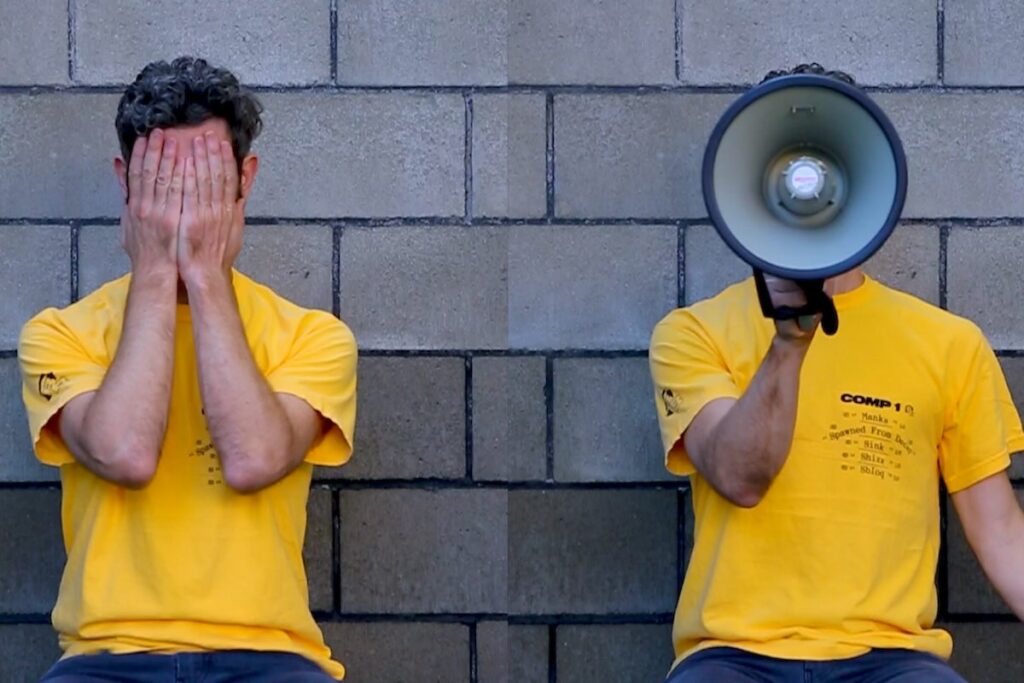
For NN, the central idea was immigrant invisibility. The lyrics point to that, but I felt the need to support those ideas visually. That’s where the blindfolded hero and the silencing gestures in marginal American spaces came from: train tracks, low-cost grocery lots, places people pass without noticing.
Your new EP is about the immigrant experience, in all its loneliness, complexity, and tension. Did the act of immigration and the process of assimilation change your relationship to composition?
I think for most creatives we explore feelings and, for a lot of us, the way we do it changes with time as we go through experiences and we evolve as a person. If I look at the way I approach composition, I see that it has gone through changes. How much of that change was due to my experience of immigration? I suppose it stems from the question that it gave me subject matter, to say the least.
For me, coming to the US was motivated by the prospects of greater opportunities for my music career, and it did open up doors, for which I’m grateful. It also came with its challenges, from having to build my networks from the ground up, to navigating the immigration system and the limitations it imposed on me at certain stages. There’s that common knowledge idea that moving is one of the higher stressors in life: that’s what people who haven’t immigrated think — I say!
I believe in the idea that what listeners pick up on the most is how connected you are to your ideas and feelings while making the work – and I’m paraphrasing a Kendrick Lamar / Rick Rubin conversation here – even if the subject matter, or sounds you use are foreign or new to them. So for me, connecting to this all-encompassing emotional state and identity marker of being an immigrant became a natural inclination and something that pushed me into an emotionally rich creative territory.
The EP is a richly layered work; underneath and alongside the melodic cello line, we hear creaking, slapping, ticking, tapping, and a wide array of scratching sounds. Can you tell us more about the instruments and technology used to create this sonic landscape?
I feel compelled to say: it’s basically all cello and vocals. The only exception is one synth that appears quietly near the end of Track 1, carries into Track 2, and shows up again briefly in Track 4. Everything else—the “creaking, slapping, ticking, tapping” as you say—comes from sound design built entirely from cello samples.
Conceptually, it’s similar to writing for a solo instrument and electronics: let’s expand the sonic sonic possibilities of this instrument. Even though it was performed live many times, the EP has more of a studio album approach than capturing a live performance. Working non-real-time opened up more possibilities for sound design and processing, but the core idea—expanding the corporeality of the cello—is still underlying the whole sonic identity. I went deep into sample design in Ableton from a producer mindset.
Your question also gives me a chance to express my gratitude to the team. Nick Photinos absolutely nailed the performance. We recorded at Panhandle Studios in Denton, and since he’d been touring the piece for a year and a half, he had it at an unreal level of ease and depth.
But the samples I used actually come from Maggie Parkins, who performed the earliest versions of NN and helped shape it during workshops. Digging deeper, the samples originated Maggie’s recording of This Time Around, a piece I first wrote for double bass and flute and later adapted for Maggie and flutist Sara Andon.
After recording NN, I passed the stems to Felix Cristiani—one of my closest musical collaborators for more than a decade. I trust him completely, so I encouraged him to follow his ears. He muted things, highlighted others, reshaped the space and brought a clarity and energy that I loved.
Beyond this EP, I’m told you’ve created custom softwares for use in composition. I’d love to hear more about your journey as a programmer. What do you see as the most exciting technological possibilities for contemporary composers?
I picked up creative coding during my Master’s and PhD and used it both to challenge the idea of imperfect automation—like adding sensors to my ping-pong–based piece 11 Points—and to open up audience participation. For example, I made an interactive version of Perishable Music where audience members could shred music scores themselves, triggering pre-recorded videos connected to the piece’s manifesto.
As far as the current music technology landscape, right now the big question is obviously AI. I’m less interested in how it makes things easier and more interested in the challenges it presents to the creative using it. If composing and producing high-quality audio can essentially be prompted, then the real question becomes: how do you make something meaningful beyond polish? How do you push the tools to create something that actually feels like you, not like the tool itself? Is that even possible?
At the same time, this landscape creates a huge space for analog resistance. With our social feeds saturated by shallow-yet-hyper-polished AI content, I think audiences are becoming hungrier for raw, expression that feels human, in which case the most exciting take might be going back to the basics, technologically speaking.
I CARE IF YOU LISTEN is an editorially-independent program of the American Composers Forum, and is made possible thanks to generous donor and institutional support. You can support the work of ICIYL with a tax-deductible gift to ACF. For more on ACF, visit composersforum.org.