Disclaimer: any given opinion does not reflect the “Lider mit Palestine” album or its contributors and organizers as a whole. As the liner notes for the album state: “Each artist here speaks for themselves, not for any of their fellow artists or for the organizers.” Some opinions are from voices in the Yiddish music community not represented on the album.
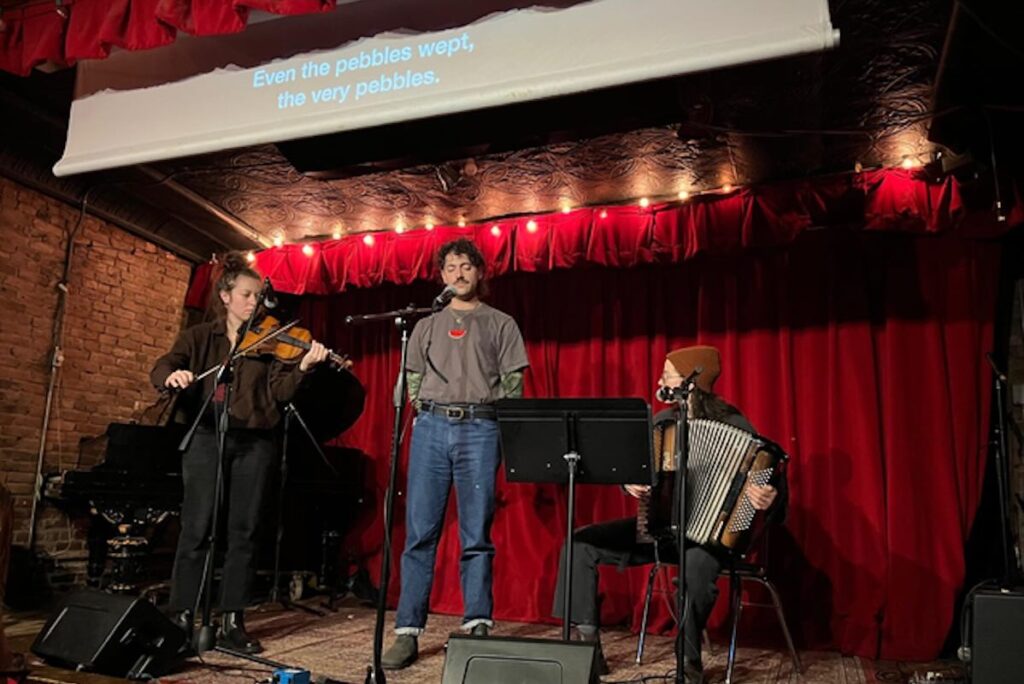
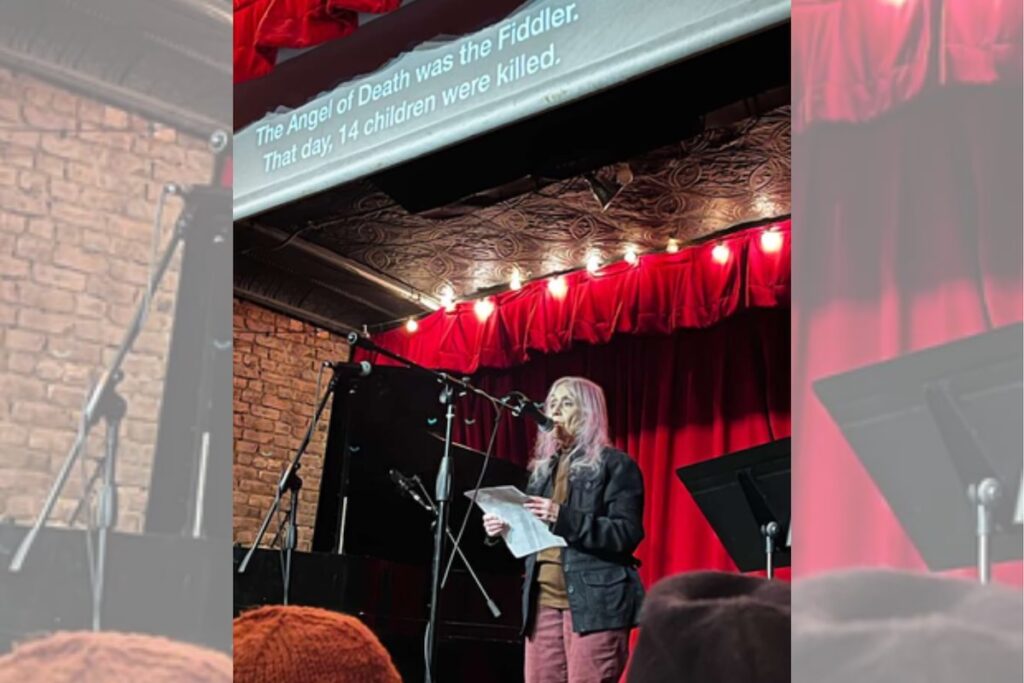
On Christmas evening, around a hundred people gathered at Jalopy, a venue well-known by members of Brooklyn’s klezmer and Yiddish music community. The packed house had come to see the first, and maybe only, concert by artists from the compilation album Lider mit Palestine: New Yiddish Songs of Grief, Fury, and Love.
Joe Dobkin, one of the organizers behind the project, has been involved in the Yiddish music community his entire life. His contribution to the album, “Falndike vent” (“falling walls”), was written in response to a video of an Israeli soldier in a tank singing “Zog nit keynmol,” a Yiddish partisan song inspired by the Warsaw Ghetto uprising. The video surfaced days after the events of Oct. 7, 2023, and the outrageous appropriation of a resistance song by the Israeli military moved him to act.
Dobkin then connected with Vienna-based activist, ethnomusicologist, and singer Isabel Frey to explore a collaboration. Together with Josh Waletzky, another familiar face in the Yiddish song world, the three of them organized what would become the Lider mit Palestine album.
The liner notes state: “[These songs] emerge at a critical moment when the relentless assault on the Palestinian people has reached a new level of devastation. Many Jews feel profoundly alienated from institutions and communities that support, loudly or silently, the ongoing atrocities and the crushing dissent worldwide.” Proceeds from the album have raised funds for Gaza Birds Singing, a music therapy and education project for children born out of the current destruction and displacement in Gaza.
The 17 songs on the album are wide-ranging in their style, structure, and messaging. Many, like Jordan Wax’s “Keler fun ash” (“Voices of Ash”), are completely original compositions. Others are lyrical settings of existing texts, such as Noam Lerman’s “Fargisn blut” (“Spilled Blood”) – which is based on a tkhine, a historical type of Yiddish prayer for women and gender non-conforming folks – and Weaver’s song “afn breg funem yam-hagodl” (“On the Shores of the Meditarranean”), which is based on a poem by Palestinian author Refaat Alareer, who was murdered by the Israeli military in December 2023. The artists on the album are united in bringing attention to the assault on the Palestinian people, but no two peoples’ political feelings or backgrounds are exactly the same.
The Yiddish cultural world has been noted by various scholars as a space where many in the Jewish community feel comfortable expressing non-normative views, including through anti-Zionist and pro-Palestinian activism. Jeffrey Shandler, a scholar of the Yiddish diaspora, states, “While imagining Yiddishland is not necessarily an anti-Zionist project, it does offer an alternative model of Jewish at-homeness, one that can exist not only instead of the State of Israel, but also alongside and even within it.”
Expressing anti-Zionist or pro-Palestinian views has long been taboo in much of the Jewish-American community, and the release of Lider mit Palestine was met with almost universally negative coverage by mainstream Jewish-American publications. The title of one misleading article even implied the album was inherently inflammatory towards Israel when in reality, the album is mostly mournful of Palestinian suffering.
This response was unsurprising to the substantial number of musicians in the community who have long been aware of institutional pushback against pro-Palestinian and anti-Zionist expression in Jewish spaces. Regardless of whether or not their music makes reference to Israel or Palestine, artists with pro-Palestinian or anti-Zionist views have experienced their proposed programming needing to be run up the ladder to donors, boards of directors, tenured faculty members, or other gatekeepers. Even with support from individual staff members and bookers, artists have still seen the explicit cancellation of gigs – or the introduction of complications and a breakdown in communication (effectively, a “quiet cancelling”).
One student organizer described their difficulty programming musical acts with known pro-Palestinian views in Jewish cultural spaces on their campus. “The first staff member I talked to asked if [the musical act] was going to say anything negative about Israel,” said the organizer. “There’s this standard of not saying anything about Israel if you want to get cool things to happen — if you want to get institutional support.“
The staff member later relayed the department’s view. “They said that they were uncomfortable with it being one-sided, and that they would want another side represented at the concert so it could be ‘educational,’” said the organizer, describing an unusual idea that concerts should be required to offer diverse political viewpoints. Eventually, the department did approve the concert without any complications, though this is not always the case.
For Lider Mit Palestine, a university faculty member felt the need to contribute to the album anonymously after witnessing hostility on their campus from both student activists and the administration towards people on all sides of the conflict. They have also struggled to find support for their other artistic projects due to a ceasefire resolution they were adjacent to. “I have applied for grants and fellowships within the Jewish community where I’m very active, but all of that began to slowly disappear,” they said.
Musicians are also worried about guilt by association and the general lack of clarity surrounding institutional policy. One musician noted their music and pro-Palestinian activism affected opportunities afforded to a family member in their Jewish community who is not involved in the same activism. Another musician noted being barred entry into a Jewish music workshop for wearing a keffiyeh despite the festival and hosting venue having no stated policy.
The obscurity surrounding policies and views held by institutions has created a chilling effect where some artists feel the need to self-censor or be incredibly careful about the language they use. As scholar Avia Moore notes in her research on the contemporary Yiddish cultural ecosystem, “The heightened sensitivity around the issue means that other expressions of anti-fascism – such as, for example, speaking about decolonialization, decrying white supremacy, or even such non-specific language as ‘freedom’ – become proxies for anti-Zionism even if they aren’t intended that way by the artists.”
On the topic of self-censorship, musicians in the community have varying views. One musician shared, “I was pleasantly surprised to see [Lider Mit Palestine] feature a number of folks, some of whom I know to have anti-Zionist views, who I had felt had been too quiet on their opposition to Zionism, especially after October 7. Since the album’s release, I’ve seen a shift in the Yiddish cultural world more broadly, particularly people feeling like they have more liberty to say certain things on stage that they were perhaps reticent to say in the last couple years.”
Others feel their lack of expression is the result of situational code-switching. “Are there certain songs that I would not choose to sing in certain circumstances, because I would be aware that those songs would be detrimental to me professionally, in terms of my relationship with the people who brought me there? Yes,” says another musician.
Many grants and opportunities for artists in the Jewish community exist on a spectrum of how directly they are connected to the State of Israel. This poses a problem for many anti-Zionist artists who prefer to do work in compliance with the Boycott, Divestment, and Sanctions movement, which asks to “[withdraw] support from Israel’s apartheid regime, complicit Israeli sporting, cultural, and academic institutions, and all Israeli and international companies engaged in violations of Palestinian human rights.”
“I had some qualms about accepting support,” said one artist describing financial support they’d received from a pro-Israel organization. “I got to this point where I decided that the money could have gone elsewhere, and I’m making pro-diasporic art with it.”
Another musician shared: “Refusing [money] can open up really good conversations. Deciding to play a place and take Zionist money so it doesn’t go to Zionist aims can, too. It’s a diversity of tactics and depends on context.”
This describes a reality for many Yiddishists: that the simple act of making diasporic (as opposed to Zionist or nationalist) art and continuing the Yiddish tradition is in itself a form of cultural resistance to Israeli hegemony. As the liner notes of Lider Mit Palestine state, “many Jews have been working in diasporic idioms — including Yiddish — that have been marginalized for the sake of the Israel state project.”
While a widespread and often unspoken taboo on pro-Palestinian and anti-Zionist expression persists in much of the Jewish arts world, the secular Yiddish cultural world is a more feasible home for these outsider views. For some artists involved, Lider mit Palestine was a statement that they hope opens up more discussions in the future.
Some recognize that even though pro-Palestinian expression in the Jewish community has become easier, it has ultimately had marginal benefit to Palestinian liberation. “It is actually much easier for all of us to take ethical stances in public, and that is not translating into improvement in the quality of life for Palestinians or an end to the genocide or colonization,” says one musician.
Weaver, one of the contributors to Lider mit Palestine, hopes the album release and conversations surrounding it will be generative to real change. “I want to think of it as an avenue through which we can direct our communities to have hard conversations about what’s happening in Gaza, what’s happening in the West Bank, and mobilize our communities to do something about it,” they said.
I CARE IF YOU LISTEN is an editorially-independent program of the American Composers Forum, and is made possible thanks to generous donor and institutional support. You can support the work of ICIYL with a tax-deductible gift to ACF. For more on ACF, visit composersforum.org.