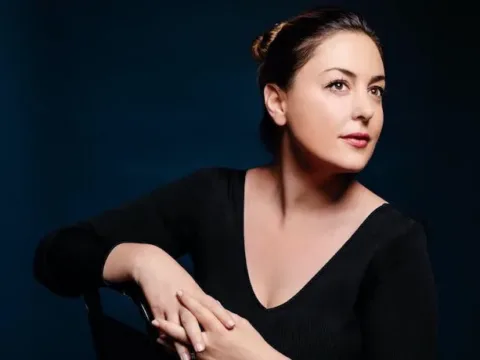
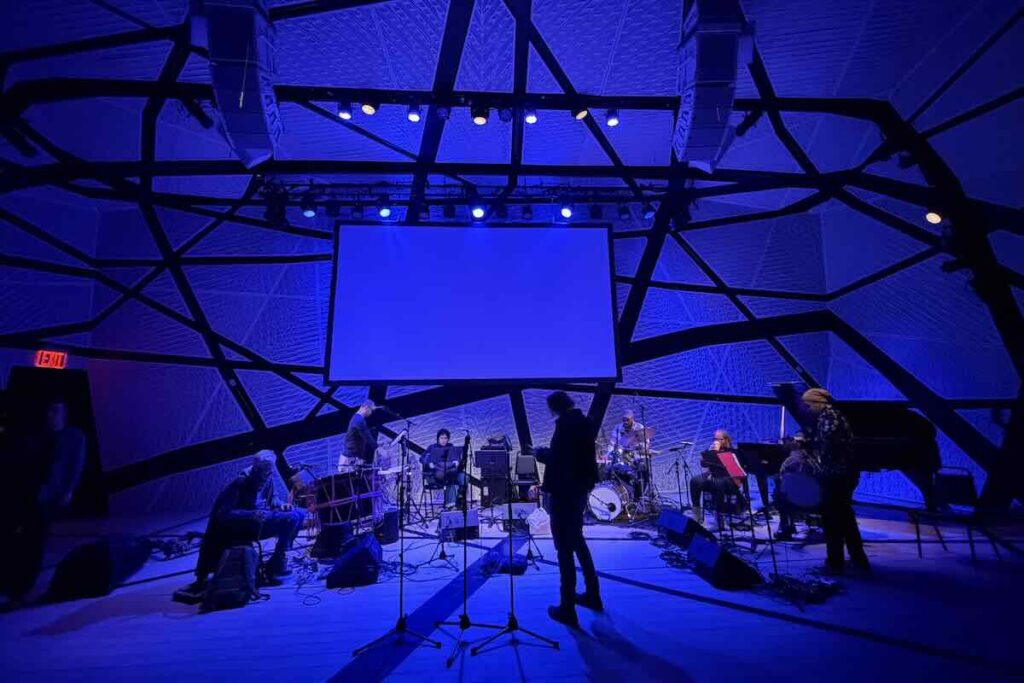
Freezing cold conditions demand collective care. Outside National Sawdust on Jan. 29th, old snow was piled into gray hills, and people inched past one another in the slush while alert and bundled. It was weather that refused isolation. Inside, Bloodlines Interwoven – an ongoing multi-year performance project commenced in 2024 – offered solace from the brunt of New York City winter. Created and directed by Japanese American multi-instrumentalist and composer Kaoru Watanabe, the project brings together artists of different backgrounds to share histories and transform personal narratives into new music. Joined by Mafer Bandola, Seamus Egan, Shahzad Ismaily, Sunny Jain, yuniya edi kwon, Kweku Sumbry, and Fay Victor, Watanabe shaped an evening of converging lineages, cultural artifacts, and memory.
The night began with an introductory video projected above the ensemble. We were shown the intensive approach of the musicians on stage in which they each shared photographs and pasts in both rehearsal settings and informal dinner tables. After each artist illuminated themselves, the entire group used songs, instrumentals, and improvisation to collectively process each other’s stories and complications of identity. These reflections were developed throughout the show, as each composition remained fluid enough to be responsive and shapeable in the moment.
Immediately after the video, quick, wispy, over-the-fingerboard bowing emanated from yuniya’s violin. Watanabe’s small flute and Jain’s double-headed dhol drum joined in to construct a tapestry of frenetic chattering, as yuniya and Watanabe dueled in high-register counterpoint. With all eight musicians playing, the room exploded with potency and rage that eventually fizzled out into a pensive percussion hocket. Bandola picked things up again with a virtuosic solo on her Venezuelan bandola llanera, the audience whooping while her fingers moved at lightning speeds. A lush mist bloomed amidst the ensemble, the rest of the performers playing more sensitively together over a groove.
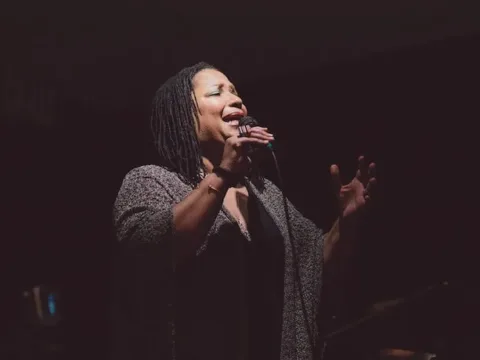
Bloodlines Interwoven is an amalgamation of traditional instruments and genres with a shared language of Western Classical idioms. At one point, Bandola charmingly stumbled through teaching us lyrics for a joyful song mimicking Venezuelan bamboo drum music’s polyrhythms, reassembled for the group’s instrumentation. Black American vocalist Fay Victor led a piece titled “Identity” wherein she took on conduction, a form of real-time musical composition and shaping through the position of the conductor – a popular vocabulary in the realm of jazz and big bands. Performers named locations – St. Louis, Japan, Pakistan, Rochester, Venezuela, Philadelphia – and Victor gestured to players to bring out their spoken parts or to pick up their instruments and build upon the cacophony. Instruments played syllabic rhythms like ekphrastic glossolalia; a work that was both thematically literal and sonically abstracted.
While interconnectedness was a major component throughout the evening, the beauty in contrast was also strikingly apparent. Pakistani American Shahzad Ismaily’s feature was particularly memorable – his electric bass solo began unamplified, the sound so precious that we held our breaths in the dim red light. Tender volume swells gradually peaked out over the hush: Watanabe rustled and rolled wire brushes against the head of his taiko drum and a fragile percussive beat emerged, twilit by metallic bandola and tinkering cymbals. On the other hand, Jain’s piece was fiery and explosive with complex drumming patterns and vocalizations halfway between laughter and birdcall.
The highest peak of the performance was a dyad of offerings led by Kweku Sumbry and Seamus Egan. Sumbry took center stage and slung a djembe on, alternating between delicately swirling his nails on the surface and slamming his left hand sharply on the edge of the drum. He looked to either side of himself to signal Watanabe and Jain to join his hearty call, then began singing. Later, we learned that the lyrics of the song come from a Northern Ghanaian coming-of-age tune for young girls that he sings with his eight year old daughter – here it was recontextualized around the pain artists bear of having to be disciplined and capable of presenting work while consecutively negotiating inner struggles.
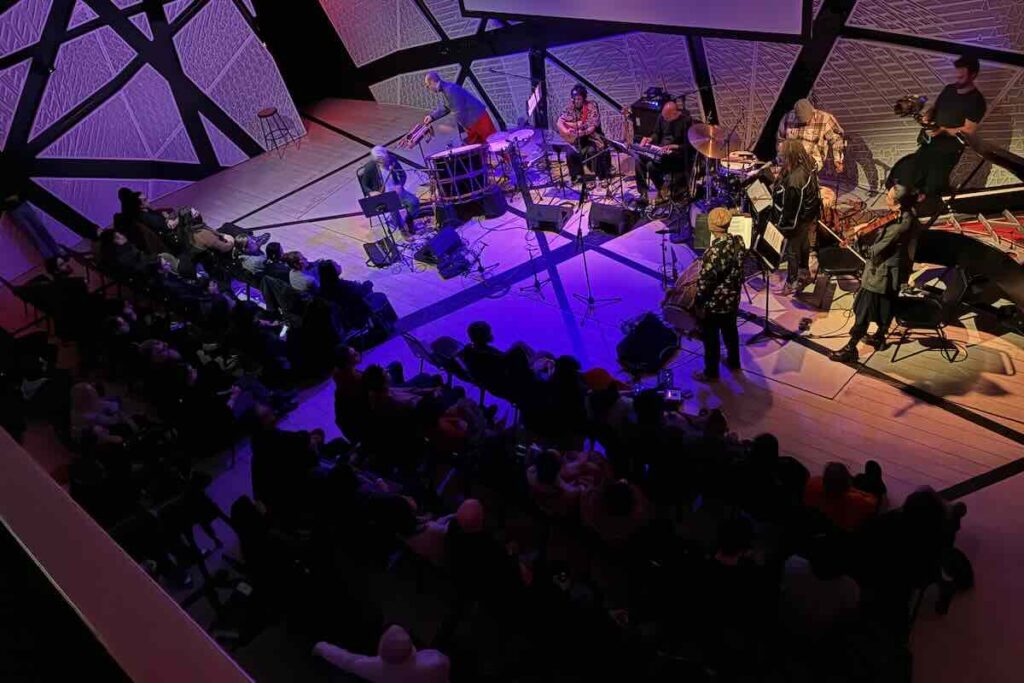
Sumbry’s fingers pattered like rainfall on the djembe, seamlessly transitioning into Egan’s feature. The Irish American musician had a troupe of seven flutes at the ready, this time playing an ethereal and bluesy solo that was reshaped into a rhythmic melody. He tapped his foot and the drummers of the band picked up the beat on their instruments. Suddenly, the music fully blossomed into traditional Irish music with Egan “fiddling” on the woodwind instrument. A wave of joy cascaded across the ensemble and crowd, smiles plastered on everyone’s faces and several audience members cheering and whistling.
There was humor involved too – Egan explained that the song was inspired by being unable to grow sunflowers on the west coast of Ireland for a Kellogg’s cornflakes contest. But even this related to his (and the group’s) diasporic experience of wanting to be a part of something while remaining on the outskirts via conditions they cannot control. The Bloodlines project unfolded as a pleasant journey – one that dissolved superficial differences and offered a space for refuge and celebration. Here in NYC with both ICE and the ruthless cold looming the streets, it was a gathering that felt urgent and grounding, and captured the formidable warming presence of humanity in unprecedented times.
I CARE IF YOU LISTEN is an editorially-independent program of the American Composers Forum, and is made possible thanks to generous donor and institutional support. You can support the work of ICIYL with a tax-deductible gift to ACF. For more on ACF, visit composersforum.org.