When I got on the plane to attend Reykjavík’s Dark Music Days festival, I expected to have plenty of new and surprising musical experiences. What I didn’t anticipate was having several concerts moved to accommodate a watch party for Iceland v. Denmark in the European Men’s Handball Championship inside the stunning Harpa concert hall and finding myself standing ten feet away from Björk.
And yet, this surreal anecdote might be the best way I could summarize the spirit of the Icelandic contemporary music scene. There is an intensely communal feel with a lack of ego and hierarchy – the whole city is on a first name basis with one another, and no one takes themselves too seriously. Festival schedules can be modified to make sure everyone gets to watch the important handball match together, and the global superstar Björk shows up to hear new music by local composers.
Like the people of Iceland, the music does not strive or rush; it takes its time to unfold knowing that it will be given a patient and careful listening — and this proved to be a common thread through much of Dark Music Days 2026. María Huld Markan Sigfúsdóttir’s orchestral work Benthos brought us to the depths of the sea with a romantic, dark academia aesthetic of thrumming low strings and icy piccolo that occasionally unfurled into moments of warm and tender strings. Haukur Þór Harðarson’s Roots, Laments for chamber orchestra also leaned into shadowy, brooding timbres; glacial clusters of sound slowly transformed into moments of near consonance, like briefly coming up for air before sinking underwater again.
Arngerður María Árnadóttir demonstrated her ability to create beautiful emotional storytelling through an attractive pair of nature-inspired works. In Skýin eru skuggar (“The Clouds are Shadows”), gossamer string quartet harmonies gradually developed into a fuller tone. It’s a true feat to capture stillness without falling into stagnation, and the tension and resistance of Siggi String Quartet’s sound sustained a sense of forward momentum through the composer’s lush, legato counterpoint. Later, Negla Piano Quartet’s performance of Arngerður’s String Quartet No. 2 featured pitch bends full of pathos and textured strums of the piano strings. The sparse use of piano in the opening brought great depth to the ensemble when the instrument was eventually used to its full extent.
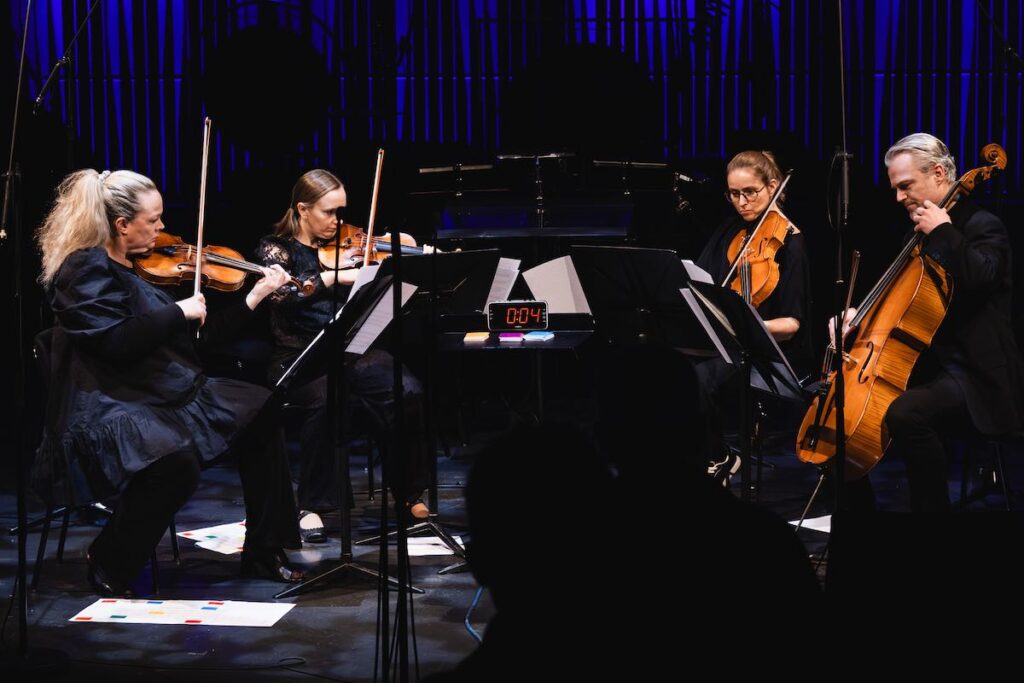
Also featured on Negla Piano Quartet’s program was the reverent Hymnopedia Sacra by Ingibjörg Ýr Skarphéðinsdóttir. Feather-light bow strokes lived on the fragile cusp of texture and tone, accompanied by the desolate rattle of a metal implement dragged across the piano strings just behind the tuning pins. A folk-inspired melody set in cello harmonics lent a sense of interiority, like quietly singing to yourself.
The superstar of this year’s festival was composer and bassist Bára Gísladóttir, and her orchestral work DÆGRIN was a standout of the weekend. A fever dream of textures and timbres, the work melts through clanging, alarm-like metallic percussion, brass players whistling through their mouthpieces, rushes of roughly textured air, throbbing wide string vibrato, and swipes along the piano strings using a glove adorned with dozens of tiny bells. In the thrilling conclusion, rumbling percussion swirled the dense, crescendoing mass of sound into a vortex that suddenly evaporated into nothing, yet its aura remained sympathetically resonating in the piano strings.
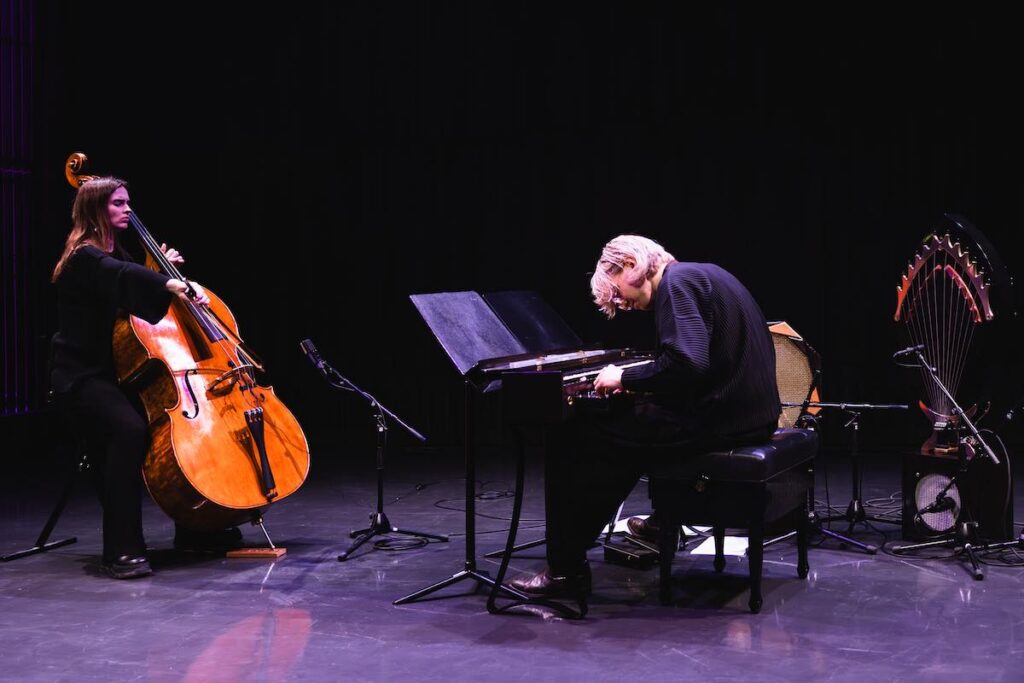
The international press delegates were later treated to a private performance at the artist-run venue Mengi, where flutist Björg Brjánsdóttir offered a blistering rendition of Bára’s ferocious and carnal bass flute work, GROWL POWER. And Bára performed as a bassist on Magnús Jóhann Ragnarsson’s concert dedicated to the Ondes Martenot. Following three new solo compositions for the century-old electronic instrument, their improvisation ranged from quiet reflection to bubbling effervescence as they explored complementary sounds on the two instruments, such as bass harmonics and the sine tone-like upper register of the Ondes Martenot.
Other timbral delights peppered throughout the festival included works by Veronique Vaka and Charles Ross. In Eyland for accordion and chamber orchestra, Veronique Vaka’s smart orchestration wove the solo instrument into the fabric of the ensemble; its clarion upper register pierced with high winds, metallic percussion, harp, and string harmonics, while its reedy lower register mingled with trombone and contrabassoon. In New Forest, Charles Ross asks the solo violist to hold the bow sideways so some wood and some bow hairs catch the strings. The wooden texture swooshed through double stops and rolling bariolage as natural and synthetic materials joined in conversation.
Many of the works featured throughout the festival could be enjoyed for their sonic innovation alone, but I was surprised by the lack of program notes for some of the performances — especially since the majority of attendees seemed completely unbothered by their absence.
In the U.S., we place significant emphasis on understanding the process and inspiration behind a new musical work, but several of the Dark Music Days programs offered little to no insight from the composer. This certainly challenged me to interrogate how the availability or lack of program notes was reshaping my listening: Was I more open-minded without a prescribed framework? Am I more critical when works don’t live up to their purported intentions?
And surely there is some cultural commentary to unearth here. I was left wondering if our expectation of program notes in the U.S. has stemmed from a need to create personal buy-in for individuals — to offer in-roads that might engender a feeling of connection to the music because our American society doesn’t inherently value the arts as essential to human culture in that same way as European nations.
Some of the most impressionable moments of the festival were experimental works that came with little context, including Bergrún Snæbjörnsdóttir’s visceral and multi-sensory Intraloper. Walking into the hall, Apparat brass ensemble was bathed in ominous red light, shrouded in mist, and enveloped in hanging sheets of metal. After the lights went down, muted trumpet emerged from the white noise of the fog machine, and sputtering thumps of articulation came from trombone and tuba mouthpieces fully inside their players’ mouths.
As the quartet began to excavate something from deep inside the earth, their growing sound activated the metallic thunder sheets, first at a low roar, then at a buzzing rattle. The strategically delayed unsheathing of unmuted brass tone brought incredible power as the players were illuminated in stark white light. Inhalations and exhalations through the instruments sonically mapped their interiors, and the return to shimmering muted brass shifted the light to a warm golden hue. As the work kept us steeped in hushed sounds for prolonged periods of time, the moments that opened up were deeply satisfying and delivered a massive pay-off.
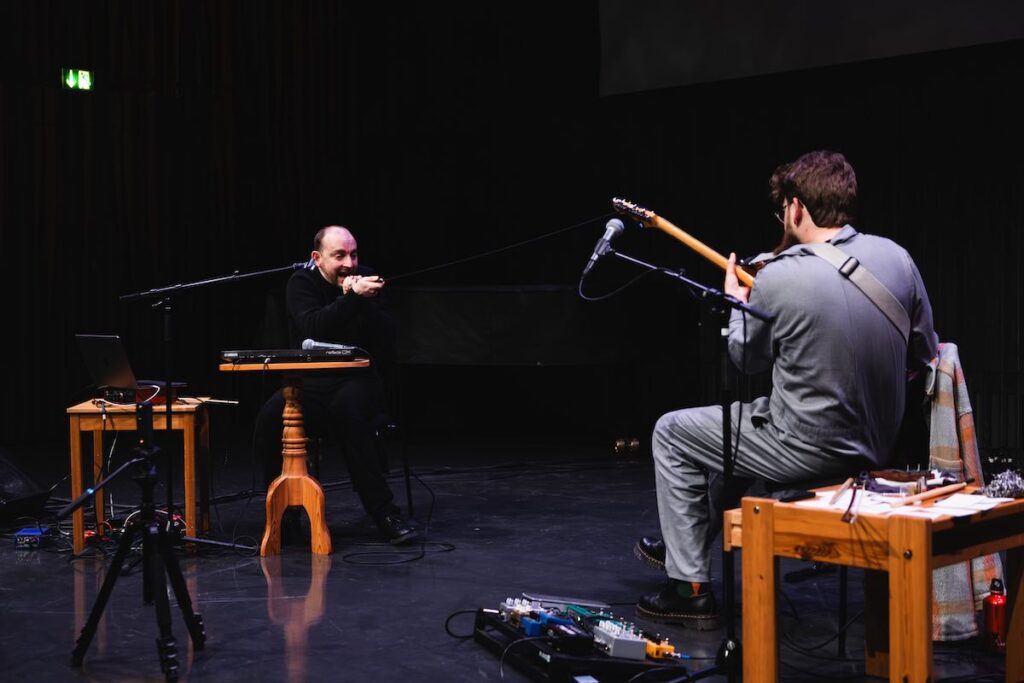
Also highly memorable was Quantongue Lessons, a “part-improvised TV show” by Luke Deane and Ragnar Árni Ólafsson. The duo’s absurdist multimedia performance brought much needed laughter and levity to a jam-packed day of listening. Structured like a university lecture-podcast hybrid, their awkward conversations, physical comedy, quick cutaways, and commitment to the bit were indeed a lesson in how to engage with experimental art.
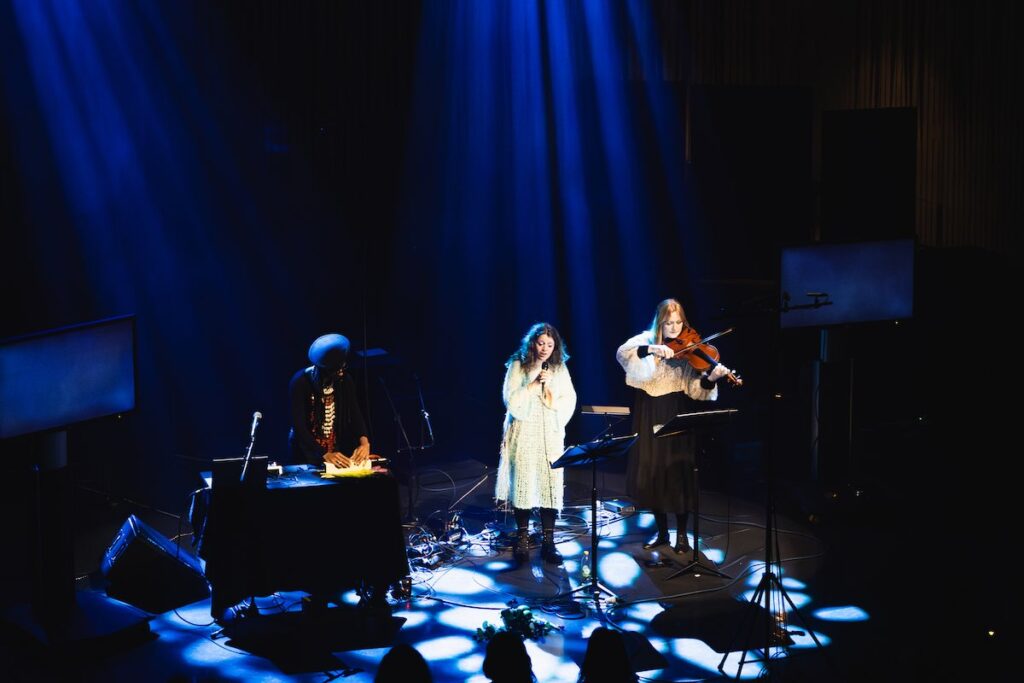
And yet, there were also outstanding works that were explicitly clear about their intentions. MIRA ZUMBI was a cross cultural collaboration between the Curaçao-based artist M Alberto and the Iceland-based Dúplum dúó. Seeking similarities between their two island cultures, their intimate nightcap spun ghost stories and wisdom from elders into reflective songs for voice, viola, and mbira-sounding electronics.
On the final day, a collaboration between composer S. Gerup and violist Þórhildur Magnúsdóttir titled How to Ruin Someone’s Career as a Violist considered the many types of disabling experiences that can prevent musicians from performing. After an introduction of double stops sliding in and out of unison, rumbling static consumed the space and Þórhildur slid out of her chair into the fetal position on the ground, staring at her instrument with a pained expression. Staged in an open exhibition space, the sounds of chattering crowds filtering in from elsewhere in Harpa was a possibly unintentional yet nevertheless powerful reminder of how isolating disability and grief can be — especially when it feels like life is going on as usual without you.
As can be expected at any contemporary or experimental music festival, there were a handful of misses. James MacMillan conducted his own Trombone Concerto on the opening night Iceland Symphony Orchestra performance, and it ultimately took up a disproportionate amount of space on a program that was otherwise dedicated to Icelandic composers. The work has some effective passages: placid, tender lyricism in the trombone on a bed of singing violins and warm low brass, or the absolutely face-melting finale. But despite Jón Arnar Einarsson’s outstanding performance, the best moments of this disjointly episodic concerto felt unearned after a string of hackneyed late-20th century compositional cliches like mixed meter angular melodies, aleatoric call and response, noodly chromatic woodwind lines, and brash dissonant outbursts.
Other works failed to convincingly realize a promising concept. Pétur Eggertsson’s Samleið, a chance music piece for string quartet, saw performers drawing cards to determine their path through various melodic, rhythmic, and textural events. Each movement began with a fully composed section before branching out into indeterminacy, but the cells of indeterminate material did not seem to explore or deconstruct the composed interludes in any way, which felt like a missed opportunity. And despite the evocative movement titles in Guðmundur Steinn Gunnarsson’s memorial for the gas station that was destroyed to build Harpa, each section sounded nearly identical with pianississimo plinks and bloops from an ensemble that included mandolin, banjo, alto flute, harmonicas. With no defining melodic, rhythmic, timbral, or textural element to grab onto and no contrast between movements, a work that had the potential to be playfully bizarre ultimately proved difficult to get through.
But on the whole, Dark Music Days was a spectacular showcase of the Icelandic contemporary and experimental music scene. The exceptionally comprehensive festival spanned concerts, educational partnerships, installations, video games, and film while still feeling like an intimate family gathering. This spirit of community was established from the outset in a performance by Huldur Chamber Choir in the resonant lobby of Harpa. Their short set featured remarkably well-realized compositions written by the youth choir’s current members and recent alumni, and their enthusiastic support for one another was truly touching. As they swayed arm-in-arm, their performance was a reminder that artmarking is a joyful and communal practice.
I CARE IF YOU LISTEN is an editorially-independent program of the American Composers Forum, and is made possible thanks to generous donor and institutional support. You can support the work of ICIYL with a tax-deductible gift to ACF. For more on ACF, visit composersforum.org.