It is easy to forget that the use of electronics in music composition was initially seen, by some, as a harbinger of machines replacing humans. Fast forward 80 years and people are still making music — and now dealing with the miraculous and unsettling potential of AI. For Julie Zhu — who, in addition to composing, runs the creative AI lab Deep Drawing — the question is less what makes us distinct from machines than it is the relationship between the two entities.
It is this relationality that she explores in TacocaT.
The work was commissioned by Beyond This Point and premiered at Chicago’s Frequency Fest in February 2025. BTP percussionists Adam Rosenblatt and John Corkill use writing, tapping, and other physical acts that directly impact or respond to the accompanying electronics and reverberation. Through rhythmic repetition and an embrace of sonic kinesthesis, Zhu explores the connection between learning with the desire to know: what one can do, where one comes from, and one’s own significance in the larger world.
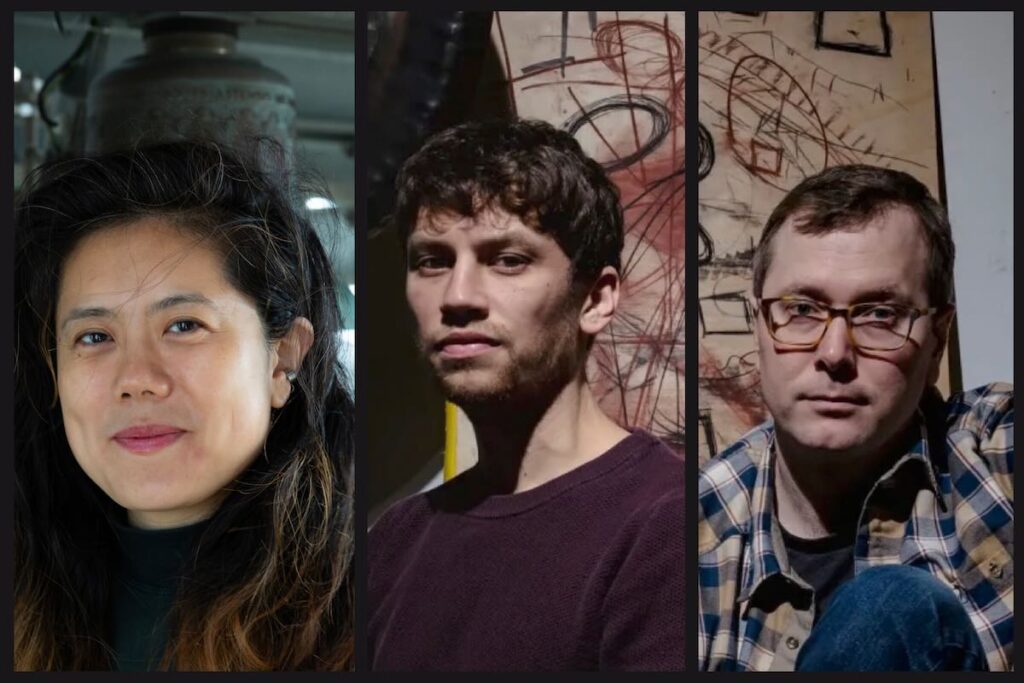
A word from Julie about the piece:
TacocaT is the piece I wanted to write without any constraints. Beyond This Point allowed me to dream and experiment to my heart’s content. I cannot imagine a better situation for a composer! TacocaT is a 22-minute gallop through various machine learnings. We start with just the raw sound of writing on a 4 foot square plywood board. But the text is generated using a GPT-2 model that I fine-tuned several years ago on Edwin Abbott Abbott’s “Flatland: A Romance of Many Dimensions.” Here are some examples:
“In the beginning, <start of line> <end of line>”
“In the beginning, the word________ G O D O G.”
“In the beginning, the word________ I, the latest.”
Then John and Adam create a raucous rhythm with various sound effects that form a chaotic world of swirls and shapes and scribblings. These sounds are all generated from the raw sound of the board through four contact mics, with the help of some magical gaussian processes in a max patch. Noise is an inherent part of our lives, our dreams, and also machine learning. It is the basis of diffusion. Must machines dream?
About Julie Zhu
Julie Zhu is a composer, artist, and carillonist. Technology—from artificial intelligence to live sound processing, sensors, and virtual reality—often support her work, which seeks to reveal and amplify underlying mathematical structures and gentle noises through innovative intermedia instrumentation and diverse chamber experiences. Her music has been featured on Radio France’s Création Mondiale and at various institutions such as GMEM Festival Propagations Marseille, IRCAM Paris, ICST Zürich, Sansusī Latvia, Tetramatyka Lviv, Carnegie Hall, among others.
Zhu’s research on music and AI focuses on the project Deep Drawing, which tests the machine’s capabilities for bringing the intricate noises of drawing and writing to visual life. She is co-editor with Constantin Basica of a forthcoming book from Routledge about musicians creating AI for themselves to be published in 2026.
Zhu teaches intermedia composition as an Assistant Professor of Performing Arts Technology at the University of Michigan.
About Beyond This Point (BTP)
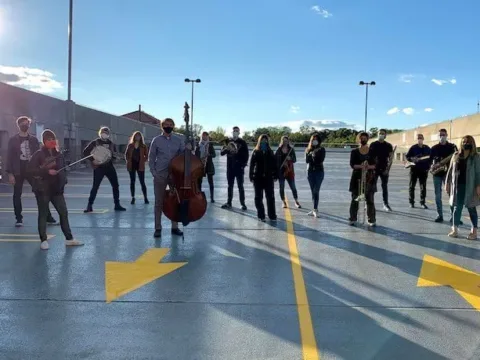
Beyond This Point is a Chicago-based collaborative music ensemble dedicated to the advancement of experimental and contemporary culture. This multifaceted collective of musicians, performers, and arts practitioners builds experimental projects that engage with written music, sound art, lighting, installation, improvisation and live electronics. From the intimate to the monumental, BTP is known for producing unique performances that offer captivating and exhilarating experiences.
Most recently, BTP has presented its community-oriented multimedia production Reclaimed Timber; immersive intermedia programs Verify You Are Human and Black Box Music; and thought-provoking theatrical performance Musician Minus Instrument at festivals such as Time:Spans, CURRENTS New Media Festival, and UChicago’s CHIMEFest; and at the Universities of Notre Dame, Michigan, Missouri, Kansas, Virginia Tech, and Northern Illinois.
I CARE IF YOU LISTEN is an editorially-independent program of the American Composers Forum, and is made possible thanks to generous donor and institutional support. You can support the work of ICIYL with a tax-deductible gift to ACF. For more on ACF, visit composersforum.org.