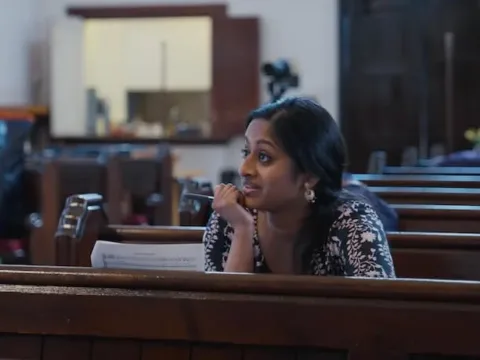
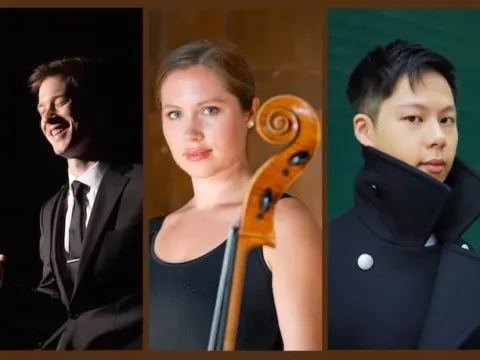
Hamed Erfani and Yasaman Seif are a formidable couple: as a composer and a cellist, respectively, they both blend Persian musical traditions with Western classical music. The couple recently settled in Oklahoma after emigrating from Iran, and Erfani currently serves as the composer-in-residence with the Oklahoma Chamber Symphony, where Seif performs as a cellist.
Together, they have collaborated on multidisciplinary projects that blend cultural traditions through music, electronics, dance, and videography. The couple co-authored an article about this very subject on I Care If You Listen in November 2025, discussing their perspectives and outlooks on how different musics brush up against each other and create spaces for cross-pollination. The essay advocates for differences as an asset and discusses how factors such as program context, audience, performer experience, and compositional visions help to inform what might come from these collaborations. Can audiences see themselves and their traditions within the music? Are performers versed in the performance practices of the traditions?
This spring, the couple has a few notable collaborations. On May 4, Seif will give a cello recital that includes Erfani’s work Detachment. The piece is a reflection on the ten months the couple spent separated; just one week after their wedding, Seif initiated their move to the U.S., but Erfani had to remain in Iran. Erfani is also working on a project in conjunction with Seif for the Oklahoma Chamber Symphony season finale on May 16. The project centers their complicated experience of being in a new country during the ongoing conflict in Iran.
We asked Erfani and Seif five questions to continue the conversation about combining musical traditions and to learn more about what they are working on this spring.
Hamed, I love the opening quote on your website that likens your music to a carpet woven from diverse artistic, cultural, and historical influences. Tell us more about your upcoming premiere with the Oklahoma Chamber Symphony; how will we see these ideas woven into the piece?
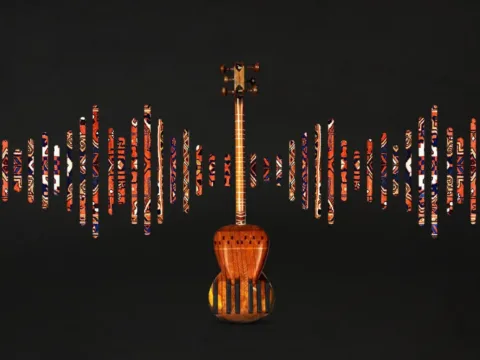
H: As an Iranian artist, I have grown up surrounded by the beauty of Persian rugs. They have always fascinated me, not only for their colors and intricate patterns, but for what they represent. Each rug is handwoven, and even when two share the same design, they are never truly identical. That uniqueness, that human touch, is what gives them life.
In my work, I try to weave together threads from my cultural and historical background with Western idioms. It is not about blending for the sake of blending. It is about creating something personal, something that carries memory, identity, and lived experience within a larger musical space.
This idea became especially meaningful in my upcoming premiere with the Oklahoma Chamber Symphony. As composer-in-residence, I am supposed to write a piece for their season finale, American Spirit. Being programmed alongside composers like Aaron Copland and Amy Beach made me reflect on belonging. Their music speaks deeply to this country. I asked myself how my voice could exist in that space, not as an outsider, but as someone whose voice has been shaped by both Iran and the United States.
I realized that I carry both. My music reflects where I come from, but it has also been transformed by the opportunities, people, and trust I have found here. It is a dialogue between two homes.
The piece, Within a Breath of a Distant Flame, speaks to my connection to Iran and the reality that distance does not create separation. Even far from home, I feel everything. Through this piece, I try to give voice not to the sound of current war in Iran, but to the quiet, human emotions of those living through it.
Yasaman, tell us more about your recital! What else is on your program, and what were you thinking about during the curation process?
Y: For my recital, I chose four pieces, including works by two contemporary composers alongside Johann Sebastian Bach and Édouard Lalo. At first, my choices were intuitive. I selected music I felt drawn to, with a suggestion from my professor. But as I spent more time living with these pieces, a deeper and very personal connection began to emerge.
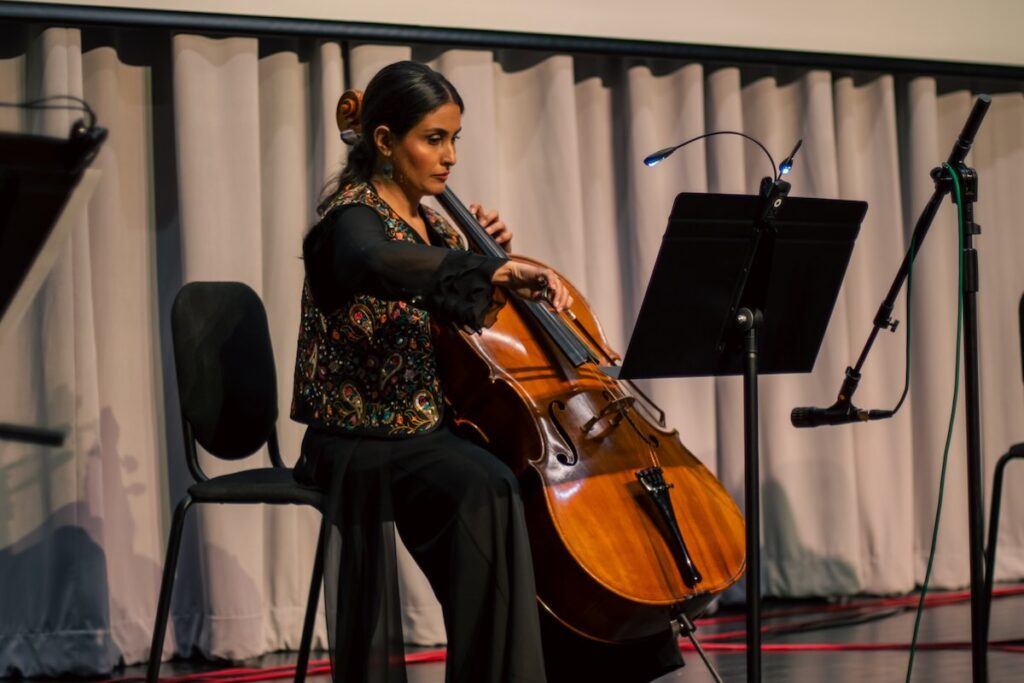
One of the central works is a solo cello piece by my husband, Hamed Erfani. The piece unfolds in four movements in Dastgāh Navā, one of the seven Iranian Dastgāhs, and reflects the emotional journey of our unexpected ten-month separation. It is deeply introspective, filled with a sense of distance, longing, and quiet resilience. I feel a profound connection to this work because it mirrors a defining moment in our lives. We were separated just one week after our wedding, and that experience lives inside every phrase of the music.
Alongside it, I will perform Prayer by Ernest Bloch. What moves me most is how closely the emotional world of these two pieces aligns. They come from very different cultural and historical backgrounds, yet they speak the same emotional language. To me, this reveals something important. The borders that separate us often create a sense of “us” and “them,” but at a deeper level, we remain connected as human beings.
As I shaped the program, it became more than a collection of pieces. It became a narrative. A space where different voices and identities meet through shared emotion. This recital is about that connection, and about expressing what words cannot.
In many genres of music, there are unspoken performance practices that are handed down generationally or environmentally. How do you communicate this in your scores or otherwise when you are working with musicians from different traditions?
H: That is a great question, and one I have been asked many times. I believe every composer approaches this differently, but for me, it comes down to responsibility. Most of my music is performed in the United States by musicians and ensembles who may not be familiar with Iranian or Persian musical traditions.
At the same time, I have a clear mindset when my piece leaves my hands. Once it is with a conductor and performers, I try not to interfere with their interpretation. I truly value what they bring to the music, and many times their perspective has added something meaningful to my work. I only offer input if I am asked. Because of this, it becomes even more important for me to communicate clearly from the beginning.
I usually think of my approach in two stages. The first stage is the most challenging for me, but the most helpful for the performers. I try to translate unspoken performance practices directly into the score in a way that is musically clear, simple, and intuitive. Since I am not always present in rehearsals, the score has to speak for me. This process is essentially translating a cultural language into notation, and it takes time, but it is necessary.
When something cannot be fully captured in notation, I turn to words. I include program notes with all of my pieces, but I avoid technical language. I want the music to stand on its own. Instead, I describe the emotional world of the piece and how certain gestures should feel. I then reinforce those ideas with short and direct instructions in the score, so the intention remains clear and accessible to any performer.
How do you code-switch between different performance practices? Do you note a clear difference in your approach to playing, depending on the type of music?
Y: Every type of music comes from a distinct historical and cultural background that shapes its identity. Even composers from the same country and time period can sound completely different, because their personal experiences and perspectives are always present in their work. As a performer, I feel a strong responsibility to understand those layers and bring them into my performance, so that what I present is not only accurate, but also meaningful within its context.
When I perform music from different periods, I naturally shift my approach in both technique and expression. For example, playing Johann Sebastian Bach requires a deep attention to articulation, phrasing, and stylistic detail. Working with Dr. Tess Remy-Schumacher, who is originally from Germany and deeply committed to Baroque performance practice, has shaped this understanding. She often reminds me to make the music “sound like Bach”, which means clarity in voice leading, precision in rhythm, and a careful respect for the character of that time period. Every detail, from bowing to dynamics, plays a role in creating that sound.
In contrast, contemporary works ask something very different of me. In Hamed’s solo cello piece, for example, the focus shifts from stylistic precision to emotional truth. The piece reflects a ten month separation that I experienced personally, so my connection to it is very direct and personal. My goal is not just to play the notes, but to communicate the emotional world behind them. At the same time, because the piece is based on the Iranian Dastgāh system, I must also be aware of a musical language that is different from Western classical traditions.
Balancing these approaches requires a constant shift in mindset, and that is something I truly enjoy. It allows me to move between different musical worlds while staying honest to each one.
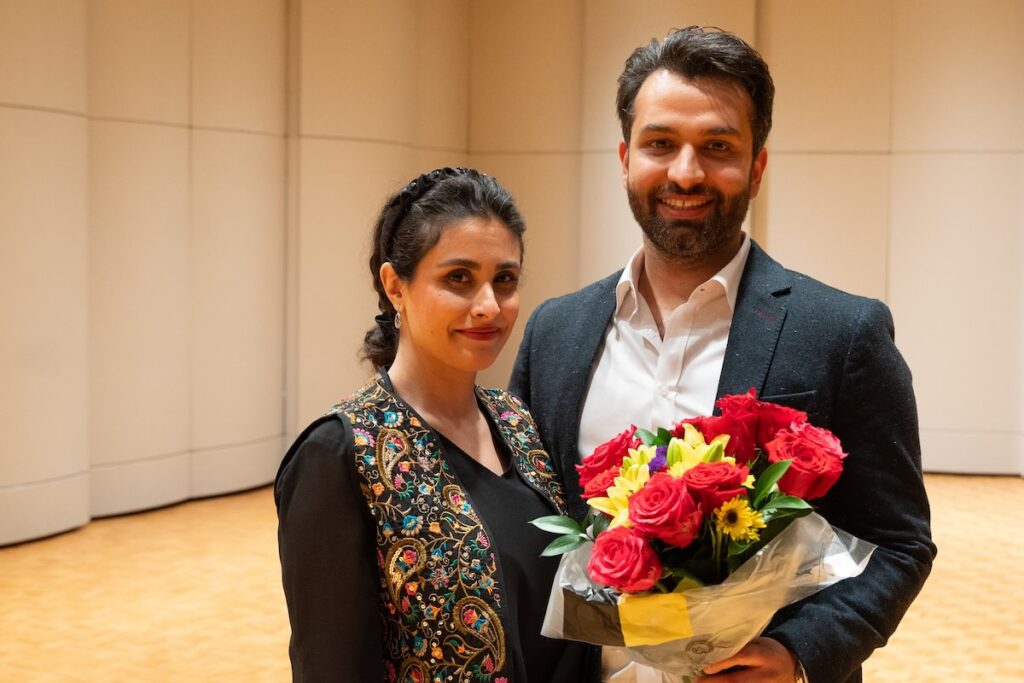
One of your Instagram posts had a sweet yet striking caption that coming to Oklahoma became “a turning point” for you. Can you speak more to this sentiment and how your approach to your music may have changed or evolved since moving to the U.S.?
H: Coming to Oklahoma became a turning point for both of us, not because life suddenly became easier, but because it asked us to change, adapt, and grow in ways we had never experienced before. Our path into music was already unconventional. Neither of us studied music as undergraduates, and choosing this direction meant leaving behind stable careers and starting over in a very demanding field.
When we moved to the United States, we stepped into a life full of uncertainty. Yasaman arrived first, just one week after our wedding, and we were forced into an unexpected ten month separation. That period was emotionally very heavy for both of us but within that difficulty, we found something we did not expect. We found kindness, support, and a genuine sense of community in Oklahoma.
For Yasaman, this turning point came when people began to truly recognize her as an artist. They saw that she is not only a skilled musician, but someone who can bring different art forms together and collaborate in a meaningful and creative way. For me, it was the moment my music was first performed and embraced by musicians here. Hearing my work come to life, and seeing others connect with it, gave me a sense of confidence and belonging that I had not felt before.
Since then, our approach to music has changed in a fundamental way. We no longer separate our life from our art. Our experiences, our struggles, and our memories are now part of everything we create.
I CARE IF YOU LISTEN is an editorially-independent program of the American Composers Forum, and is made possible thanks to generous donor and institutional support. You can support the work of ICIYL with a tax-deductible gift to ACF. For more on ACF, visit composersforum.org.