Hannah Kendall expresses her fascination with a multi-dimensional rainbow of timbre through her retelling of plantation history and her unearthing of the hope that both inexplicably and inevitably rose out of that horror. Simply put, Kendall’s music is a time machine. Performed on Miller Theatre’s last Composer Portrait of the 2025/2026 season by the International Contemporary Ensemble (conducted by Vimbayi Kaziboni), Kendall’s compositions transport you into the spaces she speaks about. These are physical and emotional spaces; the sounds she chooses — like kettles and harmonicas — orient your mind and your central nervous system into dread and uncertainty. And then she reveals their gem: true, heartbreaking moments of serenity.
Performed with a keen ferocity by Nuiko Wadden, Tuxedo: Diving Bell 2 (2021) promptly thrust us into Kendall’s disorienting soundworlds. Thanks to the harp being prepared with various afro hair accessories, it seemed to have exchanged some of its strings with tones from other instruments like bamboo wind chimes or the mbira. The piece is part of Kendall’s ten-work series that responds to Jean-Michel Basquiat’s silkscreen work Tuxedo, upon which the phrase “Diving Bell 2” is written.
Kendall connects the Diving Bell with the Middle Passage — both containing immensely unsafe situations including the constant possibility of death by drowning. The work opened with Wadden humming while vigorously strumming in the higher register, gradually adding resonance and texture variance as the work wove itself down towards the sinister, dark tang of the harp’s lower pitches. An apex moment: blue and pink plastic hair picks cackling across the strings like some earnest incantation.
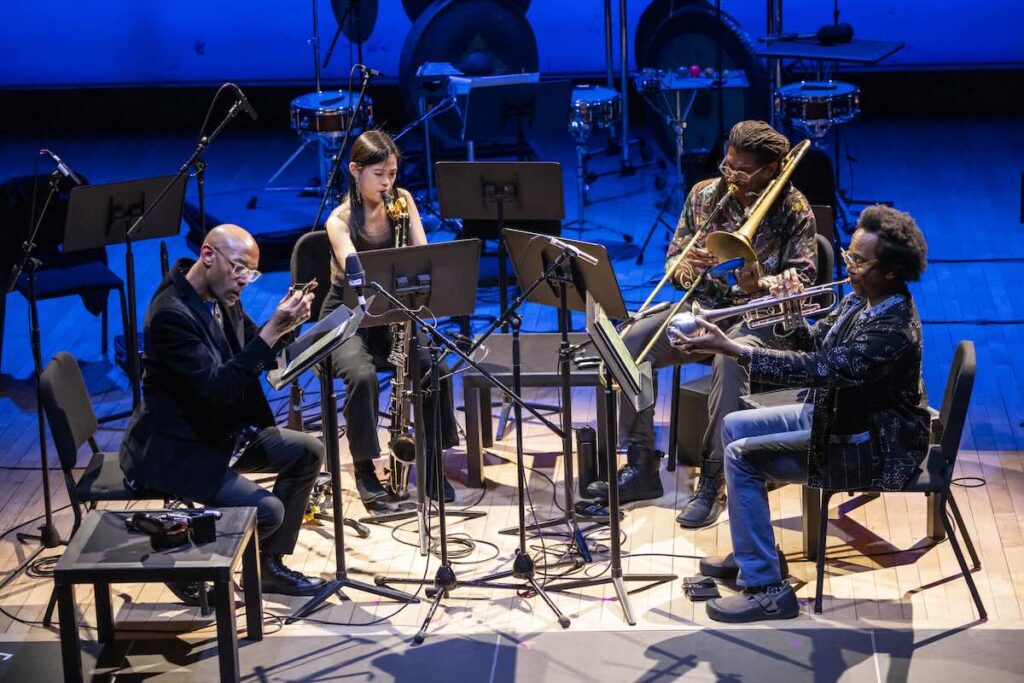
A soft gleam of translucent harmonics opened when flesh is pressed against the dark (2024), widening into Damian Norfleet’s dizzyingly high, immediately calming falsetto that swooned into Jonathan Finlayson’s harmon-muted trumpet and Timothy James Robinson’s trombone before finally falling into music box twinkles. This piece also speaks about the Middle Passage, the cruel and inhumane forced maritime journey of millions of enslaved Africans across the Atlantic. Here, Kendall invited us into another symbolic and textural mainstay of her work: the walkie talkie. Walkie talkie static glimmered into her the sonic palette of haze like so many noises caught on air, carried on the wind. What is vibration but a message in space moving on waves?
As soon as these timbres reached some semblance of calm, the striking interjection of growling and overblowing from Yu-Ting Cheng’s bass clarinet broke it. Symbolism is everywhere here: Norfleet sang, struggling, his own hand covering his mouth but trying to speak anyway. A bosun’s whistle vacillated between sounding like itself and sounding like birds. A dolphin appeared via trumpet. In the afterimage of the work’s unceasing sonic tumult: Norfleet’s rich, barely hummed “how great thou art” with the corresponding toy music box held in his hands.
Even sweetness can scratch the throat (2023) brought sugarcane plantations into view. Timbral clouds of harmonics in the winds and scratching in the strings presented a state of flux; several musicians talking into walkie talkies proved unsettling, undiscernible before being replayed on loudspeaker. Harmonica extended techniques performed by many in the ensemble gave a sense of growth as sounds bloomed across the stage into other instruments: air sounds in the flute made an ombre-like fade into viola harmonic double stops.
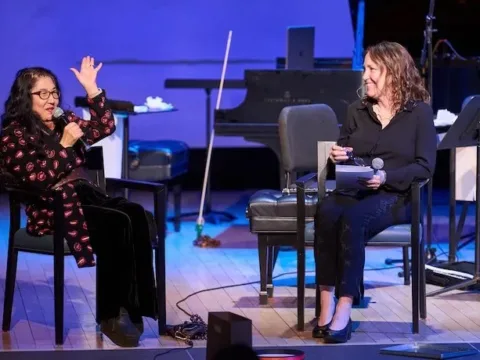
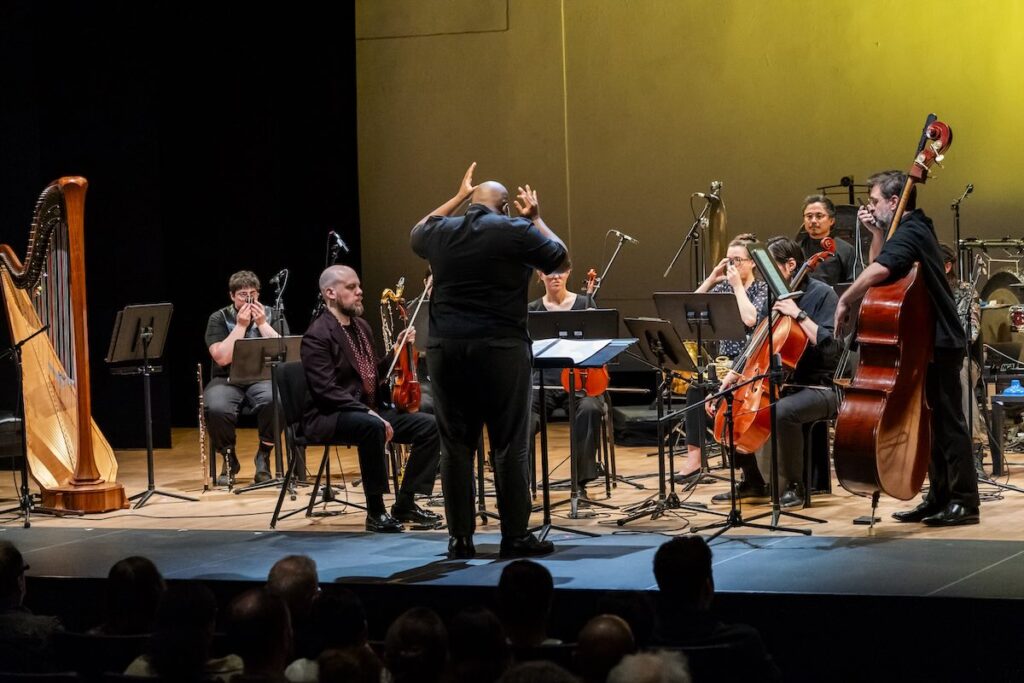
“I must have a chorus of kettles…they sing and wail at the same time,” said Kendall about the U.S. premiere of building a burning house (2026) during the intermission talk with program director Melissa Smey. The work immediately transported us into the liminal, uneasy space of a morning in the kitchen of a plantation. Levy Lorenzo’s snare drum sounded more like marbles falling, bouncing, and rolling across an uneven floor before appearing in the hand: in the process of being dropped again. A foggy span of bells swelled into the air: what are the molecular differences between the bracelets of bells upon the wind players’ wrists and the shackles on the wrists of the humans conjured back into present memory by this work?
Over the vigorous sonic and somatic sighing and scrubbing — the bows of violinist Modney and violist Carrie Frey in behind-the-bridge tremolo — Isabel Lepanto Gleicher’s acrobatic piccolo and Tello’s chirping clarinet in high seconds sounded uncannily like a kettle on the boil. And thus Kendall’s foretold chorus began: players picked up kettles from the floor and put them to their mouths. No matter what gets said into the kettle, with enough velocity of air, what emerges? Screams.
This concert was never meant to be one that calms or entertains, but it told its stories clearly on multiple levels. The physicality of this music is energy that begins on stage, yes, but it also transfers to you: it shows up in how it makes you squirm or sigh. Kendall’s music MUST mold you into corporeally uncomfortable places to provoke the thoughts these pieces are asking you to have, the images she is asking your mind’s eye to create and consider.
I CARE IF YOU LISTEN is an editorially-independent program of the American Composers Forum, and is made possible thanks to generous donor and institutional support. You can support the work of ICIYL with a tax-deductible gift to ACF. For more on ACF, visit composersforum.org.