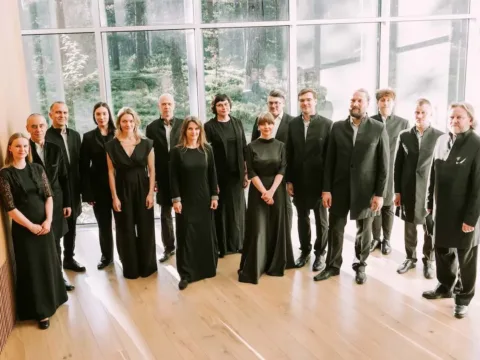
The Estonian composer Madli Marje Gildemann explores the fragile thresholds between sound, embodiment, and perception. Her music often dwells in states of suspension and transformation, drawing on extended instrumental techniques, subtle timbral shifts, and an acute sensitivity to sonic space. Moving fluidly across a continuum of musical transformation, Gildemann crafts immersive, destabilising sonic fields that invite close listening. Her new album, Dream Sequence of an Ancient Forest, is marked by a precise and imaginative command of extended techniques, which forms a distinctive sonic language of movement between interiority and exteriority and an intense disquiet.
Osmosis for string quartet and prepared piano is a gradual, permeable exchange between sonic bodies; timbres, harmonies, and textures diffuse across instrumental boundaries, creating an almost imperceptible migration from one state of sound to another. The work begins delicately with spare piano figures and high violin harmonics punctuated by tapping, breath, and other percussive extended techniques. As the piece unfolds, the centre of gravity shifts downward into the low register, and with it, the terrain darkens, accruing a sense of tension and unease that transforms its initial fragility into something far more ominous and immersive. What emerges is a work of striking harmonic and textural richness, its gestures refined yet insistently, refreshingly listenable.
Transpiration for string orchestra unfolds with a moisture-like resonance, its fragile sonic particles – plucks, pops, and flickering articulations – seeming to evaporate from within dense, slowly shifting textures. Violins sustain quiet, crystalline tremolos at the very top of their range, while the low strings create intense harmonic beds that ebb and grow, creating a sense of breath-like expansion and contraction. Gradually, Gildemann saturates the mid register with intense, unyielding sustained tones, thickening the texture and anchoring what had initially felt weightless. What begins as an externalised physicality – suggesting lift, release, and circulation – draws increasingly inward, enclosing the listener within a pressurised sonic ecology. It’s as if we have moved inside the process itself, where motion is continuous but no longer visible, only felt.
Photosynthesis for flute, bass clarinet, violin, viola, cello, and prepared piano inhabits the same ominous, richly-saturated sound world as the preceding works. High strings trace downward-bending glissandi in repeated figures, while the woodwinds contribute air sounds and flutter tongue. Gildemann’s music foregrounds texture, density, and directionality. The piano articulates tremolos and insistently recurring tones, punctuated by softly-struck clusters that deepen the sense of unease. At the climax of Photosynthesis, the strings surge into anxiety-inducing upward trilled glissandi as the winds and piano rapidly arpeggiate, creating a moment of heightened instability. The piano then drops into a low bass note, anchoring the texture as the ensemble recedes into quieter iterations of earlier gestures. The piano ultimately overwhelms the texture and the winds dissolve back into breath.
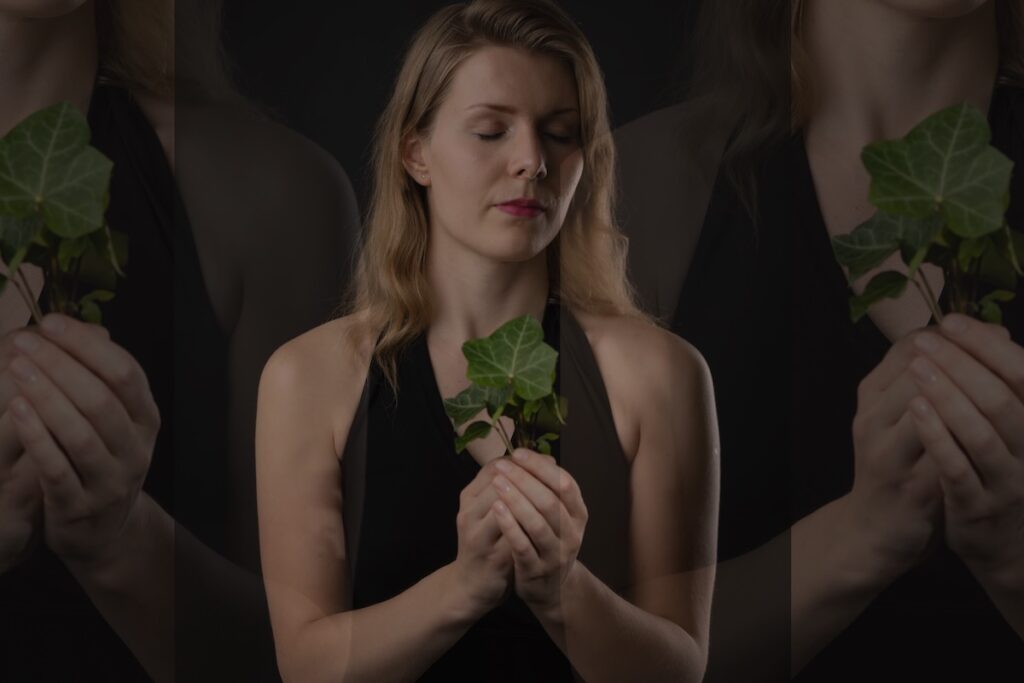
Nocturnal Migrants for string quintet, percussion, and prepared piano is furtive and quietly anxious, its surface alive with clusters, string harmonics, and tremolos that seem to hover and flicker in the dark. With the addition of percussion – most notably the low, rolled bass drum and dragged cymbals – the piece is the album’s most shadowed and unsettling corner. Each player traces an independent line of elusive, often fragmentary textures, their gestures rarely aligning but instead accumulating into dense, surging waves of unease. The music feels less like a fixed structure than a shifting environment, its contours continually dissolving and reforming. The prepared piano adds a metallic, zither-like resonance, while the strings oscillate between fragility and pressure. The result is a taut, immersive landscape in which tension is sustained rather than released.
The title track for two pianos and megaphones is ironically (given its instrumentation) the quietest and most fragile piece on the album. The megaphones are used to create sustained warping tones like whalesong. Gildemann’s prepared pianos are percussive, the language of pops and plucks recalling the raindrops and skittering feet of previous tracks.
The longest and earliest work on the album is saved for last, and it is genuinely terrifying. Dating from 2017, AH-64 APACHE/Sumiseja, sumiseja… is scored for overtone singer, throat singer, two violins, two double basses, piano, and percussion, incorporating found objects such as whistles, hair dryers, ratchets, and megaphones. The title invokes the military Apache attack helicopter, while the Estonian word sumiseja refers to something that emits a soft, continuous buzzing; an insect, a machine, or a more abstract, hovering presence. Performed by Ludensemble under the direction of Kaspar Mänd, the piece unfolds as a study in sonic dread. At its nadir, the fusion of throat and overtone singing with glassy string harmonics and low, vibrating sonorities conjures a sense of inescapable horror. That Gildemann composed the piece in her early twenties only deepens its impact, marking it as an astonishingly assured achievement for a young composer who has become a distinctive emerging voice in contemporary music.
I CARE IF YOU LISTEN is an editorially-independent program of the American Composers Forum, and is made possible thanks to generous donor and institutional support. You can support the work of ICIYL with a tax-deductible gift to ACF. For more on ACF, visit composersforum.org.