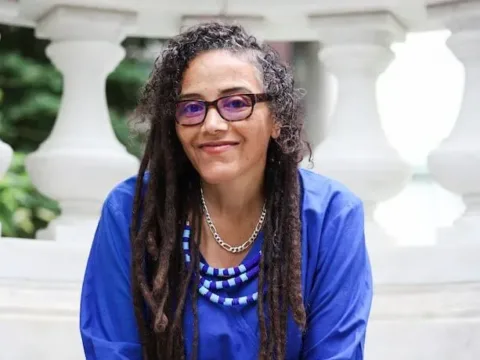
Defining the full scope of Amina Claudine Myers’ artistry feels impossible. At 84, she has nurtured an expansive practice defying genre and boundaries across classical, jazz, gospel, and avant-garde idioms. As a pianist, organist, vocalist, composer, improviser, and educator, she has worked all over the world, from touring with celebrated musicians Anthony Braxton, Archie Shepp, Sola Liu, and countless others — to 11 full-length records, and large-scale commissions for orchestra, choir, and theater.
As a young girl from Arkansas, Myers’ first foray into a lifetime of music was discovering her voice. “I was about four years old. I was at a house with two of my mother’s friends, and they were asking me to sing,” she shared in a recent interview. “Sing, Claudine. Sing. I would always sing ‘Yes, My Jesus Cares.’” The southern Black women in her family and childhood neighborhoods had a substantial impact on her. The women of the Baptist Church she attended organized girls into a choir that performed holiday plays, and as a young teen, Myers started putting together her own groups, teaching gospel music and hymns by ear.
Concurrently, she began studying classical piano at age 11. Learning music theory and delving into notated scores opened a window of opportunity for her. “I learned to write music both by learning to play hymns at church, and by looking at classical scores,” she explained. In college, she acquired skills to arrange and write for large ensembles – but her true love has always been choral music that emphasizes the classical voice.
While her upbringing and background in spiritual and classical music remained pillars of her creativity, jazz pivoted to the forefront of her expression as a young adult. Her first gig was playing solo piano at a night club where she started out by attempting to emulate Nina Simone. Later, the club owner invited her to play organ, an instrument that was beginning to make its way into the scene — and an instrument that Myers, at the time, didn’t know how to play. Up for the challenge, she agreed to perform, and just like that, she became an organist.
This proclivity to say yes and rise to the occasion would become a recurring feat throughout Myers’ career, and her move to Chicago in the early 60s changed the trajectory of her life as an artist. She initially moved to the Windy City to work as a teacher. But when a conga player took her to a club, she was asked to sit in on piano on a whim.
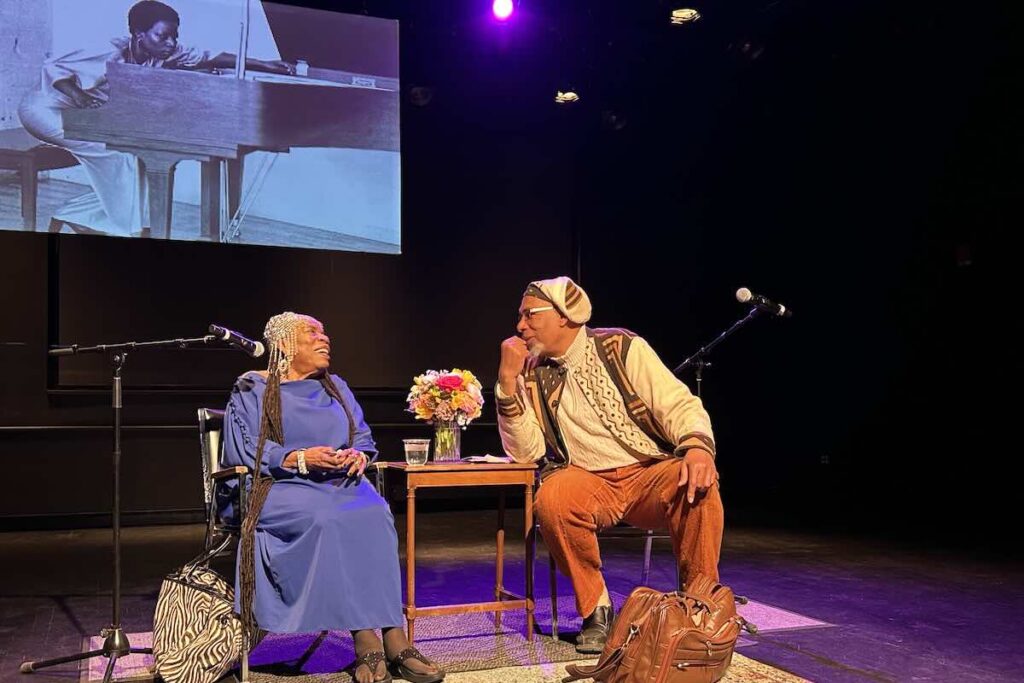
“The club owner fired his piano player and hired me! That’s how I started playing in Chicago,” she explained. By way of jazz clubs and speakeasies, Myers eventually came across the musicians of the Association for the Advancement of Creative Musicians (the AACM), and was invited to join the premier collective for experimental Black music.
“That’s when I really started writing music,” Myers reflected. “We had to put on our own concerts — everything started progressing for me. I learned how to improvise by being a member of the AACM. I finally realized that I was a musician.”
Early artists of the AACM like Henry Threadgill, Muhal Richard Abrams, Roscoe Mitchell, and Wadada Leo Smith became her inspirations and collaborators as she developed yet another facet of her talents. “They were creating their own way of writing and being, and I said, ‘I can do that, too.’ I learned so much from them.”
Her improvisational philosophies on self-expression and communal listening stem from her time working with the AACM. “You can’t be wrong in improvising because it’s coming from your heart. It’s coming from your soul. You don’t know what you’re going to do, but you listen. If you’re playing with others, you listen to each other. That’s how we played.”
Ever since her time performing and touring internationally with members of the AACM and other all-star jazz heads, Myers has honed in on composition and recording. As a composer, she takes inspiration from her life experiences as every artist does, but is also greatly influenced by cultural narratives. Negro spirituals find their way into Myers’ melodic palette, along with ancestral stories and histories. Performers of her work are urged to reach beyond the notes on the page, and to imbue performances with “feeling and soul.”
Her more recent output spans works like the AACM-produced mixed chamber piece Interiors written for New York’s S.E.M. Ensemble, and the introspective staged work A View From the Inside. Her intimate solo record Solace of the Mind (2025, Red Hook Records) features Myers in all of the modalities she’s amassed over her lifetime: vocals, piano, and Hammond B3 organ. She’s currently refining a new symphonic work inspired by Harriet Tubman, and revamping an improvisational suite for chorus, pipe organ, and percussion for a recording project. Still a proponent of education, Myers also conducts workshops and maintains a private teaching studio in New York.
Throughout her life, Amina Claudine Myers has struck a balance between foundation and spontaneity. The ability to adapt to any path before her is admirable — her legacy lies in consistently allowing herself the freedom to experience and express all ways of being. In recollecting one of her most memorable performances with the great Von Freeman in Brussels, she remembers, “We just started playing. No announcements. Musicians didn’t have music, you just used your ears and played. That meant you needed to study and know theory. I encourage everyone to keep active — and to listen.”
I CARE IF YOU LISTEN is an editorially-independent program of the American Composers Forum, and is made possible thanks to generous donor and institutional support. You can support the work of ICIYL with a tax-deductible gift to ACF. For more on ACF, visit composersforum.org.