For more than a century, the New York City neighborhood of Harlem has been a synchedoche for Black artistic innovation and transformation. From the 1920s to early 1930s, the Harlem Renaissance saw a blossoming of Black creativity in music, art, fiction, and poetry. Some of the significant work from this period includes Alain Locke’s “New Negro;” the music of Duke Ellington, William Grant Still, Florence Price, and Louis Armstrong; and the writings of Langston Hughes, Zora Neale Hurston, Nella Larsen, and Jessie Fauset. Today, Harlem is no longer just a location: it is an essence, an ethos — a history that continues to resonate.
Such is the case for composer and cellist Malachi Brown. His new chamber ensemble work, It’s Black, It’s U.S., is a love letter to Harlem that uses the neighborhood as a microcosm for themes and issues that are relevant nationwide.
“It speaks to the gentrification of Harlem — of Blackness — since the inception of this country,” Malachi told me via Zoom. “It’s telling a story from a localized level, but you can see it from the broader picture of Blackness as a whole.”
The septet for flute, clarinet, bassoon, French horn, violin, viola, and cello was commissioned by ACF’s Recomposing America initiative for the Sugar Hill Salon, a Harlem-based chamber music series and artistic collective. The work is set to premiere on Jun. 17 at The Africa Center.
As founder, executive director, and bassoonist member of Sugar Hill Salon, Alexander Davis was closely involved in the early stages of the work’s development. “One thing that we often do at Sugar Hill, because we are working with new composers — there’s some sort of contemporary element involved, but also the genres of Black music or Brown music still play into it, and that’s very much happening in Malachi’s music.”
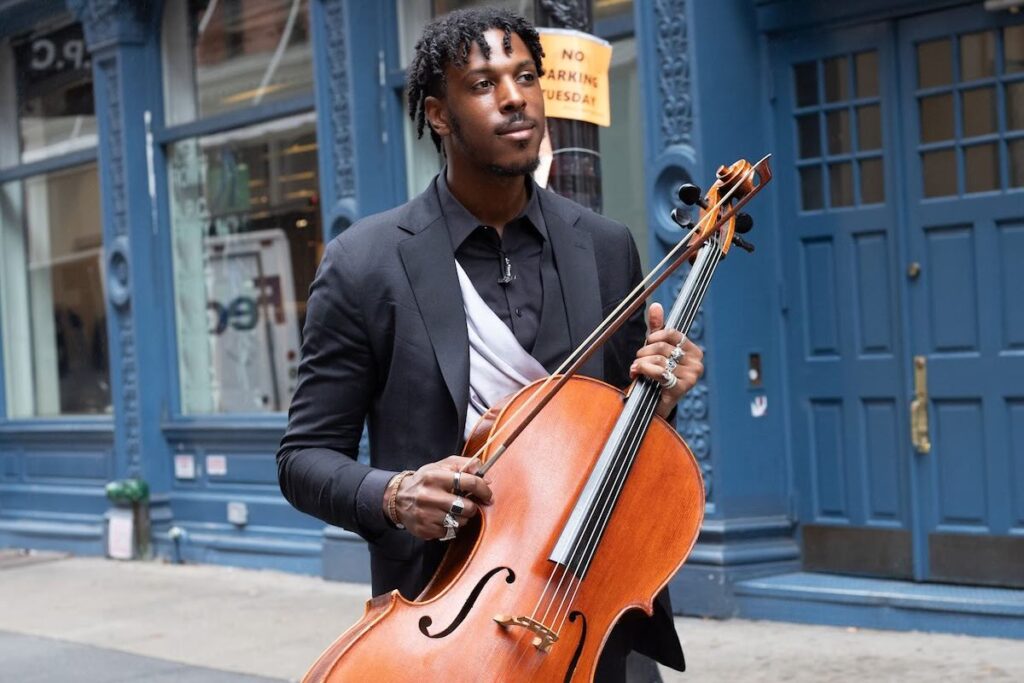
The double meaning of the title — U.S. referring to “us” and the United States — is Malachi’s engagement with Sugar Hill’s mission and the goal of Recomposing America: get more diverse voices front and center.
“When we think of ‘America’ and an ‘American composer,’ it’s been some random white man, and that doesn’t represent the populace of who makes up America — and I should say the U.S. specifically,” Malachi explained. “I love that this project exists, because we’re going to hear a lot more new voices in the coming years.”
Malachi’s early life was full of music: he played commercial jingles that he had learned by ear on his toy piano, wrote songs with his mother, sang in the children’s chorus at church, and started playing cello in fifth grade. But music was never a serious career option until a high school mentor pulled him aside one day.
“My teacher in the robotics program that I got into, he’s like, take that audition for [The Governor’s School for the Arts]. Your heart is in music. It’s not here,” Malachi reflected. “And I was like, okay, let’s see. I just have to apply myself, but if I do get in, I’m going to try to do music. And that’s when it became a defining factor for me.”
He continued his studies in composition and cello performance at Old Dominion University and later Ithaca College with Andrey Kasparov and Jorge Grossmann and Evis Sammoutis, respectively. Malachi now maintains an active career as a composer and cellist based in NYC. A self-described neo-Romantic, he is a lover of melody and works predominately in standard genres for solo instruments and ensembles.
It’s Black, It’s U.S. is a work that blurs the sometimes arbitrary boundaries between absolute and programmatic music. As Malachi explores themes of the United States and Black culture, musical fragments from jazz and church traditions burst out from more standard classical elements, a musical metaphor he described as “trying to break free of those chains.”
Malachi also uses R&B rhythms, ostinato, and transition; minimalist techniques; and in the case of the third movement, “Meditation,” Parisian flair and finesse. It’s a kaleidoscopic view of Black American culture and history, and a window into Malachi’s personal influences and interests.
“As a Black American, you are absorbing so much information and so much culture while still holding on to your own,” Alex shared, “and I feel like you’re getting that in Malachi’s piece. The Black experience is not just one, and the Black ear is not just one. It’s a really beautiful piece; the colors are insane, and ‘Meditation’ is one of my favorites. I’m excited to hear how this piece ends!”
On the continent and across the diaspora, Black art has traditionally been more than creativity for creativity’s sake. There is also a function, be it a slice of social commentary or a call to action. Malachi’s composition – and the “Meditation” movement specifically – does the same.
“It’s hard to find places to meditate,” he told me. “It’s hard to find the break that you need in this country, a safe space for you to feel like you have room to breathe, which is, essentially, the crux of that movement. We are surrounded by whiteness as a structure in this country, and especially in Harlem, it’s becoming less and less of a safe space for Black individuals, even though that used to be the majority.”

“A piece like It’s Black, It’s U.S. is about moving forward, while our present day culture feels like it’s going backward,” Alex expressed, reflecting on current issues. “So it really feels like you’re being pulled into different time periods at once. We’re kind of stuck in-between what we were promised and what we knew is going to come – but isn’t coming. And what might go back and what we’ll need to fight again.”
And yet, like the composers, artists, musicians, and writers of the Harlem Renaissance, the process of creating doesn’t stop. In this era of white retrenchment, the presentation of ideas, stories, and perspectives from Black, Brown, and Indigenous peoples is once again even more urgent. For Malachi and Alex, it was important that the work be premiered by Black musicians – using an Afrocentric focus that communicates a message of belonging and community that can be and should be utilized by folks of all colors.
“I would love to see people of other nationalities play this music,” Malachi told me. “It’s not just limited to Black musicians playing it because of the title. It’s meant for everyone to experience the narrative, even if you are a performer from a different background.”
This “Black narrative context” that Malachi puts forth in It’s Black, It’s U.S. eschews the restrictive practices of whiteness. It is emblematic that Blackness is not only a racial identity. It is a perspective, a practice, an ethos; a deep, vast, transplendent ocean that has room and wants to make room for all.
I CARE IF YOU LISTEN is an editorially-independent program of the American Composers Forum, and is made possible thanks to generous donor and institutional support. You can support the work of ICIYL with a tax-deductible gift to ACF. For more on ACF, visit composersforum.org.