Money Matters is a NewMusicBox x I CARE IF YOU LISTEN collaboration, supported by New Music USA
There are many well-known stories about composers working outside of music: Edgard Varèse once sold pianos, Philip Glass drove a taxi, Charles Ives built a career in insurance, and Steve Reich worked as a mover to support his early projects. As Hilary Purrington noted in her essay “In Defense of the Day Job,” almost every composer has done nonmusical work — yet this alternate path simply does not exist for everyone. This is the reality for international and foreign student composers, whose work options are limited by immigration policies. So, how does one’s musical and financial journey unfold within those legal boundaries?
Aspiring composers from abroad who study or work in the United States navigate a complex system of visa regulations that have grown increasingly restrictive over the past decade. While the bureaucratic details can be overwhelming, the core principle is simple: international student composers on F1 or J1 visas are only permitted to work within their field of study and under institutional supervision. They may participate in field-related projects or accept specific work like assisting in the music library or tutoring, but always within a limited number of hours and with formal authorization.
Typical student jobs, such as babysitting, dog walking, or working as a barista are prohibited. Even within music, the boundaries are rigid. I have seen students lose their legal status after performing a single gig one day before their work authorization officially began. Every engagement must align perfectly with institutional approval — a frustrating obstacle when an ensemble or commissioner is ready to collaborate, but paperwork lags behind.

The same bureaucratic complexity extends to graduate students, who are further along in developing their careers. Pursuing a professional opportunity often requires extra time and an additional layer of authorization. Imagine an international doctoral student composer who finally secures a commission: in this instance, the commissioner must draft a contract and provide a formal letter for the university, which then requires advisor approval within a specific timeline before granting institutional clearance.
After completing a degree, international composers typically have one year of Optional Practical Training (OPT), which allows them to work in a field related to their studies. Within that year, they must secure contracts or multiple engagements, sometimes even unpaid, to maintain status.
Given the specific requirements of the artist visa, many international student composers maximize their time in academia and pursue a terminal degree, even when a university teaching job is not their ultimate artistic goal. Graduate school can provide four to six years of institutional support, access to resources, and teaching opportunities. Extending one’s “student” life becomes a practical and strategic choice. Yet programs offering such sustained support often admit fewer than ten percent of applicants, making them both highly competitive and crucial stepping stones.
The overall path of an international composer typically follows this sequence: student life, artist visa period, permanent residency, and eventually citizenship. During the student or artist stages, one is not technically an immigrant but a nonmigrant, granted temporary entry to study or work, not to establish a general livelihood.

Composers on professional O1 visas cannot take any job outside their artistic field. The expectation is clear: if you come to the U.S. to make music, you must only make music. The O1 visa typically lasts for three years. Within that span, international composers often feel immense pressure to “make it,” to achieve enough artistic recognition to justify an extension. This exhausting chase for visibility often results in being overworked and burned out. Those in applied fields such as film or media composition, already prone to exploitation, face particular precarity; many work without receiving credit, a common practice in Hollywood.
The feeling of constant uncertainty also extends to finding creative opportunities. Some programs, such as orchestral readings or residencies, use vague eligibility language like “residence in the U.S.” without realizing that “residence” carries a different legal meaning for international composers: we may be considered residents for tax purposes while still classified as non-residents for immigration purposes. Many self-select out of such programs, only to later discover that “residence” simply meant living in the U.S., and that those opportunities were actually fully accessible.
This highlights how important it is for administrators, program organizers, and curators to understand these nuances when framing eligibility criteria. Greater awareness of immigration distinctions not only promotes fairness but also prevents the unintentional exclusion of international artists from opportunities meant to foster artistic growth. International composers have long held a strong presence in programs, festivals, and concerts at prominent venues and institutions. Their backgrounds, distinct artistic voices, and perspectives often enrich the cultural practices and visibility of the organizations that present them. Yet while international composers are celebrated publicly for their contributions, they frequently face hidden barriers behind the scenes that complicate their professional trajectory.

During the “student” and “artist” phases, choices that might otherwise stem from pure artistic curiosity become constrained by the need for documentation, visibility, and institutional approval. Even the idea of being “pro career” or “self-promoting,” often viewed pejoratively in classical circles, takes on new meaning: rather than self-interest, it is a condition for maintaining legal status. International composers thus find themselves in a paradox: if they pursue opportunities assertively, they risk being seen as overly career-driven; if they do not, they risk losing the very career that allows them to remain.
For many, maintaining a visible online record — through posts, recordings, or press — becomes a necessity, not vanity. These traces serve as proof of ongoing artistic activity required for visa renewals. Visibility equals legitimacy; without it, one’s artistic existence becomes harder to verify.
Experimentation, the lifeblood of new music, is even harder to sustain when economic security is fragile. Experimental work, whether in jazz, electronic, or contemporary classical settings, often takes place in nontraditional venues. These spaces, while artistically vital, are rarely recognized at first glance as legitimate indicators of “professional success” in visa adjudications. Foreign composers thus carry the burden of constantly having to justify the historical and professional value of their art. While skilled attorneys can argue for the artistic value of such work, the process remains a significant bureaucratic barrier.
The time spent collecting documents, requesting letters, and reviewing applications is an ongoing challenge; the artist visa demands substantial evidence, and these tasks repeat with every renewal. Permanent residency, or the green card stage, marks the true beginning of immigration status, but requires significant legal, financial, and administrative resources. Staying informed about policy changes and deadlines becomes as necessary as tracking grant applications, teaching openings, or score submissions. Still, reaching this stage is a major milestone, typically granted only to those who can prove an outstanding, well-established career. This is also the point where opportunities shift: many grants, awards, and residencies are open only to permanent residents or citizens due to funding restrictions.

If pursuing an academic position becomes part of an international composer’s career path, another challenge emerges: institutional sponsorship. Tenure-track positions for composers are already scarce, with highly competitive searches in which every element of an application —portfolio, teaching record, and institutional fit — can be decisive. For international candidates, the stakes are even higher. Remaining in the U.S. requires employer sponsorship: first for a work visa, or later, for permanent residency. While many universities can support this, each institution manages budgets and legal resources differently. Even with non-discrimination policies in place, there is often an unspoken concern about whether the additional administrative and financial burden influences hiring decisions. In practice, requiring sponsorship can make a candidate appear more costly or complicated, creating a barrier that domestic applicants do not face.
The complexity of immigration journeys and the nuances of each path create a landscape full of assumptions and misunderstandings about the lives of international composers in the U.S. The idea that a composer can “just do music” may sound idealistic, even romantic. Yet for international composers, it is not a choice; it is a legal condition.
One way we can make our field more inclusive of international composers is by shifting our understanding of what constitutes a “day job.” For many musicians, teaching, performing, arranging, or engraving are not “alternative” work, but extensions of their creative voice. These roles keep composers engaged in the act of music-making, shaping their communities, influencing peers, and sustaining their artistic practice. And these activities are among the few legally permissible forms of employment for international composers, aside from composition itself.
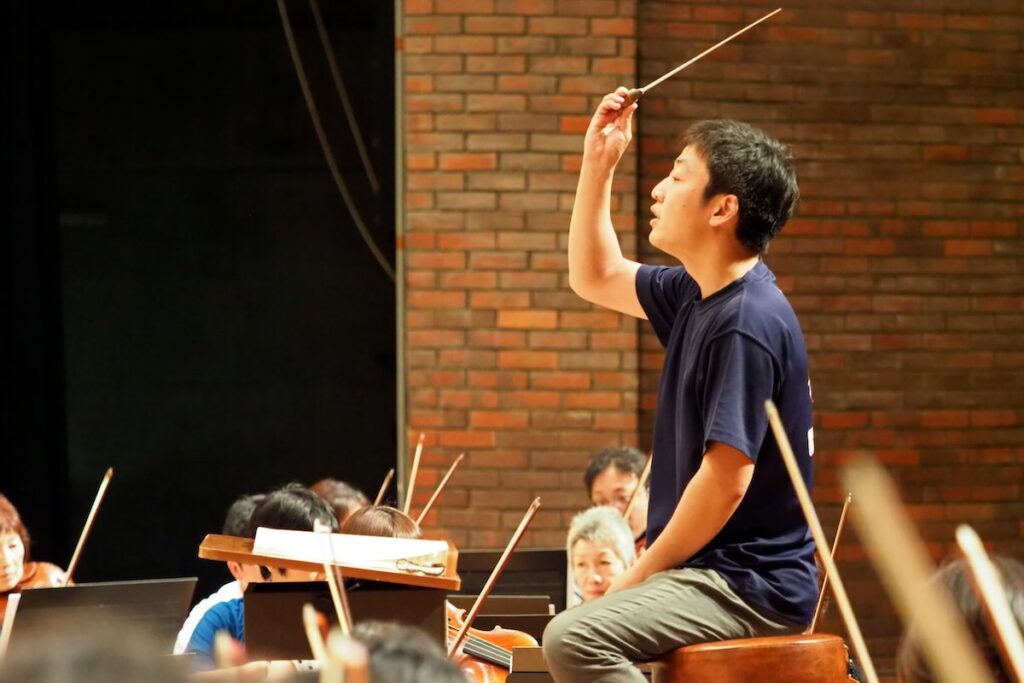
Conducting, performing, and teaching are often integral to a composer’s artistic identity, practice, and philosophy. Academic positions can also offer the precise conditions under which new works thrive: access to ensembles, sabbaticals, residencies, and institutional resources.
While legal constraints prevent international artists from taking nonmusical work, they do not erase the cultural stigma often attached to it. The prevailing expectation that a “serious” artist should devote themselves entirely to their craft still persists. International composers, therefore, face the worst of both worlds: they are barred from pursuing the economic stability nonmusical work could offer, yet still judged by the same purity standard that equates artistic value with total professional devotion.
Ironically, the system that insists on this artistic purity often undermines the very conditions that allow experimentation to flourish. To sustain creativity under such circumstances requires not only talent but resilience, precision, and the constant ability to translate every artistic act into proof of professional existence.
This complexity is not meant to elicit pity from local colleagues, but rather understanding and a willingness to recognize the differences that shape each composer’s journey. Local musicians often form shared professional expectations that tend to overlook how legal boundaries, such as those imposed by immigration status, profoundly shape artistic choices and possibilities.
Ultimately, the condition that “you must only make music” should not be a quiet burden carried by international composers alone. It should instead prompt our field to reflect on how the structures of legality, labor, and prestige shape who gets to participate in artistic life — and under what terms. If institutions and colleagues understand immigration restrictions as systemic forces rather than individual obstacles, support can become proactive rather than incidental. Ensuring that international composers can sustain their craft without constant precarity is not just compliance: it is an investment in the multiplicity of practices and philosophies that keep our musical communities alive. In recognizing these realities, we move closer to a field where “only making music” becomes a genuine possibility.
I CARE IF YOU LISTEN is an editorially-independent program of the American Composers Forum, and is made possible thanks to generous donor and institutional support. Opinions expressed are solely those of the author and may not represent the views of ICIYL or ACF.
You can support the work of ICIYL with a tax-deductible gift to ACF. For more on ACF, visit composersforum.org.