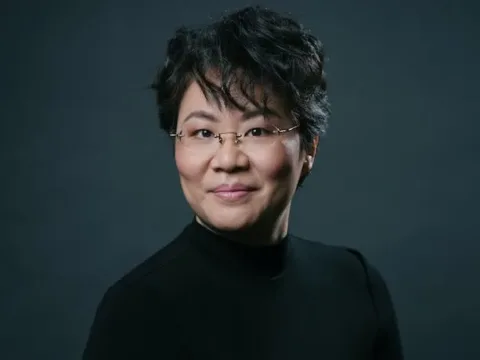
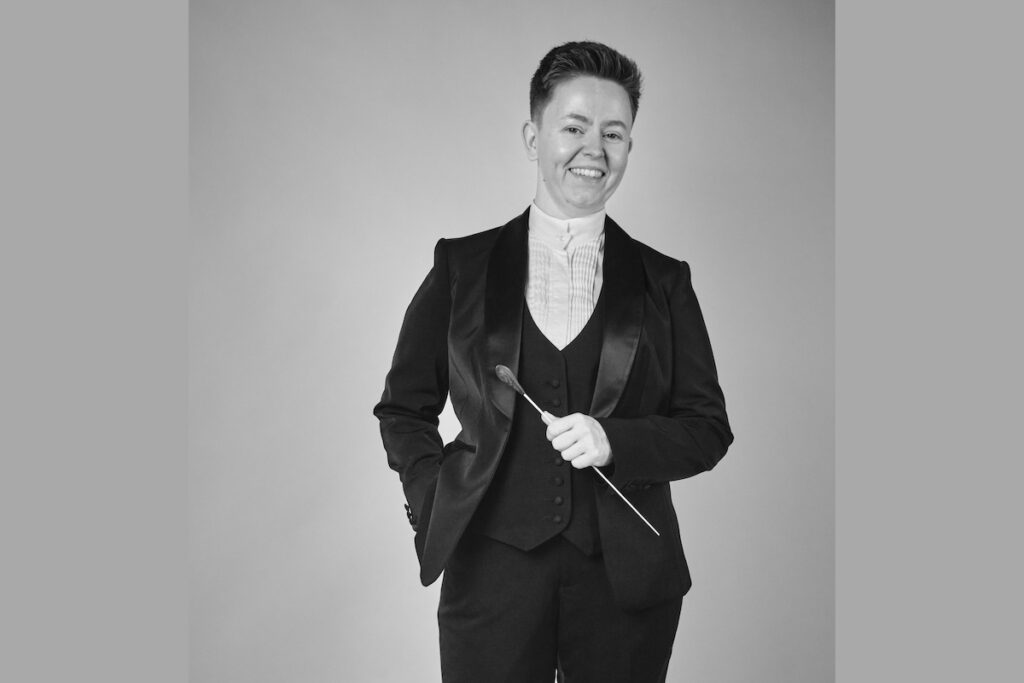
Before she became a professional conductor, Australian-born Ingrid Martin was a doctor of emergency medicine, and later a teacher. These alternate careers have directly contributed to her advocacy and leadership skills in classical music, where she champions new repertoire and creates immersive experiences through thoughtful curation. She has commissioned, conducted, and recorded scores of premieres, including 15 works for youth orchestra. Her unusual path has infused her conducting with empathy and clarity, driving her mission to make classical music accessible and transformative for everyone.
In her early twenties, Martin completed a Graduate Diploma in conducting, and in her later twenties, she moved to the US to undertake a Masters in Wind Conducting at the University of Minnesota. After returning to Australia in 2014, she built a full-time career as a freelance conductor, working in schools, universities, orchestras, and the community, including as Artistic Director of Melbourne’s Crosswinds Ensemble. She made her professional conducting debut with the Melbourne Symphony Orchestra in 2022, launching her online leadership and development platform Conducting Artistry the same year. She has conducted major orchestras across Australia and Aotearoa New Zealand, and in 2024 she was appointed the New Zealand Assistant Conductor-in-Residence for the Auckland Philharmonia, Christchurch Symphony Orchestra, and Dunedin Symphony Orchestra. This September, she will join the Detroit Symphony Orchestra as Assistant Conductor and Community Ambassador.
Balanced with craft projects, Melbourne’s world-class coffee, and the occasional cat on her lap, Martin is a conductor whose vision extends far beyond the concert hall – into community, education, and global cultural leadership.
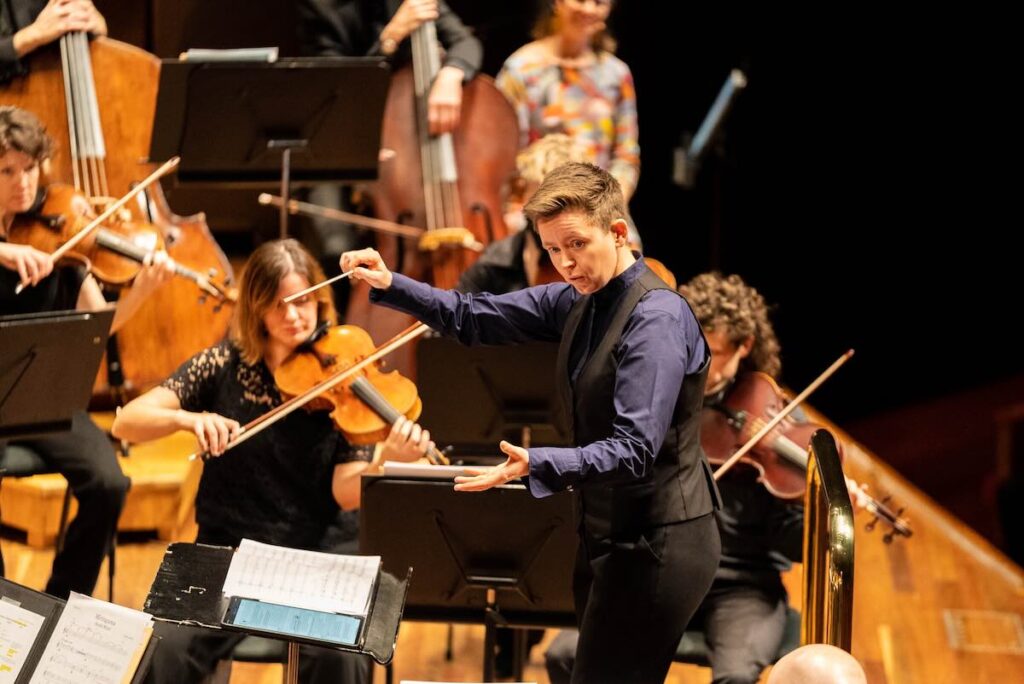
When you’re programming concerts, what qualities make you confident that the music will speak to audiences in relevant and engaging ways?
Music’s greatest power is its ability to express and reveal emotions and experiences that are both personal and universal. A performance has done its job if the performers and audience feel connected in our shared humanity, experiencing something deeply human and alive together.
When I choose music I look for emotional depth and range. Deep music moves people – whether that’s to elation, or anguish, or introspection – and has something original and genuine to say. Range is vital for maintaining interest and engagement, for both musicians and audiences. I think very deeply about curating the emotional arc of a program and what journey we’re taking the audience on.
How the music is presented deeply influences whether it feels engaging or relevant. As highly trained musicians we can talk all day about harmonic progressions, but that means nothing to a casual concert goer. In fact, it can be alienating and shaming. This disconnection is the exact opposite of what we’re after.
Emotions are the common ground that unite audiences, music and performers. Pain, love, fear, longing, anger, determination. Music becomes relevant and engaging when we make it relatable. It’s our job to guide the audience to experience the music on this emotional level.
Can you talk a bit about the idea of “toxic perfectionism” you’ve written about on Conducting Artistry and how to overcome self-doubt – along with the doubt of teachers?
Perfectionism and fear of failure is a major issue in classical music culture.
For many this stems from connecting our work to our self worth. This often begins with our teachers. Our music education system is rooted in a centuries old master and apprentice model, where skills and attitudes are passed on from hero to reverent hero-worshipper. These ‘masters’ hold such cultural power and influence that they and their methods are rarely challenged or interrogated. Now, in the 21st century, we have robust data about what safe and effective teaching and learning looks like at all levels. Yet many people teaching outside of school environments have little or no training in these skills. Many teach how they were taught, often unknowingly perpetuating a cycle of psychological harm.
Much of what is erroneously called ‘teaching’ in classical music is just error detection. Worse still, much of this error detection focuses on the person, rather than the behaviour: ‘You were flat there,’ ‘You missed the dynamics.’ When we hear this once a week from someone whose approval we crave it’s unsurprising these messages and scripts become internalised. Our minds take up the negative mantras introduced by our teachers. The longer we rehearse these scripts the more ingrained and powerful they become. We learn to believe that our performance is an indication of our self-worth. I played well = I’m good. I played badly = I’m bad. This internal shaming is at the heart of a lot of trauma, perfectionism and performance anxiety in our industry.
I had many great teachers, but still ended up with some of these thought patterns. Consciously disconnecting my performance as a musician from my worth as a human being has involved both long-term internal work, and practical tools I can use when I feel the anxiety crescendoing!
The deep, ongoing work has involved a lot of self reflection, journalling, reading and therapy to understand the ingredients and motivators behind my self-doubt and feelings of inadequacy. For years I had an app on my phone called ‘I Am’ that fed me affirmations at random times to change my internal scripts. When I first started using it the phrases seemed so uncomfortable and icky, but a year later the same phrase would appear and I’d think ‘yes, that’s how I feel.’
Practicing the mental skills of high-stakes performance is just as critical as practicing the music. I often get most anxious in the lead up to a first rehearsal, especially with a new group. Having done the long-term work in a low-pressure setting means that I have these sayings and beliefs to fall back on even when I am feeling escalated. In that moment, I remind myself that I’ve done all I can and the most important thing to focus on is making great music. I also do very simple breathing and physical exercises to get myself in my body and regulate my nervous system.
In 2023/2024, orchestral pieces by just ten (dead) white European men were performed at a rate of more than 4:1 compared to music by all women, and work by non-binary composers was barely programmed at all. How can we wrestle with inequality and stagnating forces in orchestral programming?
I think it’s up to all of us to examine how and why we got here, interrogate our own unconscious bias, and take personal responsibility to change the culture one act at a time.
A book that really opened my eyes to the cultural forces at work behind these patterns was The Authority Gap: Why Women Are Still Taken Less Seriously Than Men, And What We Can Do About It by Mary Ann Sieghart. I learned that when it comes to representation in literature, art and media, the prevailing attitude can be distilled as: ‘men’s stories are universal human stories, women’s stories are women’s stories, they’re niche’. Notably, non-binary voices aren’t even mentioned.
The problem is that these attitudes are often unconsciously internalised by all of us, regardless of gender. This means it’s up to each of us to actively seek out, listen to, learn, share and program music of marginalised voices.
Whenever music and artists are chosen, we need to ask ‘Whose voice is missing here?’ If we value representation then our choices should reflect that at every level – from concert programs, to soloists and conductors, to audition excerpt lists. When someone (us?) says ‘It’s too expensive,’ we must remember that our budgets are the true reflection of our values. We need to put our money where our mouth is.
Everyone has the power to take action, however small. Introduce your stand partner to a new work that could be included on an audition list. Email a cool piece to your artistic team for consideration. Insist on representation in concerts you conduct. Learn unfamiliar repertoire to include as a soloist or in chamber gigs. Our enthusiasm can open minds and ears.
How did you make the decisions to leave emergency medicine and teaching to pursue conducting professionally, and what advice would you give to others considering a career change?
For me each transition was about shedding the expectations of others and clarifying what I really wanted. Regardless of age, it’s so easy to be swayed by others’ expectations of us – whether that’s our parents, teachers, friends or society. But ultimately it’s our life, not theirs. We need to make our own informed decisions, and take responsibility for our choices.
If a past choice is no longer serving us, it’s up to us to make a new one. Sunk costs – what we’ve already invested – often hold us back from changing tack. Ignoring sunk costs helps us make decisions that serve our present needs.
We often mistakenly confuse what we can and can’t control. We waste emotional energy on people, places and things we can’t control – like winning an audition, or someone else’s approval. Learned helplessness means we lose our sense of agency and end up blaming others for things that actually are in our responsibility – like our own feelings, actions and responses. Knowing what we can and can’t control is vital for longevity in any career.
On the practical side it’s vital to understand what we’re signing up for. Research to understand the similarities and differences between the work you are doing and where you want to go. Similarities help us understand transferable skills. Differences help minimize surprises and regrets.
What are you most excited about with your upcoming role with the Detroit Symphony?
There are two types of conducting work. Guest conductors are like emergency doctors. Your job is to build rapport very quickly, and solve problems in a brief, intense window before you part company. An ongoing role, like an assistant or music director, is more like a family doctor who builds a deeper, long term relationships. Though I worked in emergency medicine, my dream was always to become a family doctor. After a few years of heavy travel I’m excited to put down more stable roots in one city, and cultivate a long term relationship with the musicians and staff in Detroit.
It’s also a great opportunity for cultural exchange – for me to introduce them to Australian music and composers, and for me to learn more about contemporary American music. I love working with young people, so I’m also really looking forward to leading the Detroit Symphony Youth Orchestra every week.
I CARE IF YOU LISTEN is an editorially-independent program of the American Composers Forum, and is made possible thanks to generous donor and institutional support. Opinions expressed are solely those of the author and may not represent the views of ICIYL or ACF.
You can support the work of ICIYL with a tax-deductible gift to ACF. For more on ACF, visit composersforum.org.