Bone fragments of each of the twelve Apostles lie in a sealed reliquary at St. Patrick’s Cathedral in Manhattan. Like the other holy relics housed at the church, they serve as physical reminders of the saints and martyrs that came before, helping believers feel more connected to a sacred past. In her new album, our little matches (New Focus Recordings), composer Clara Kim puts the relics of canonized Western classical music on display— not simply for veneration or critique, but as symbolic objects with shapeshifting functions. With masterful collaging technique, Kim stitches dozens of canonical fragments into her own soundworlds, inviting us into alternate portals of unsettling sentimentality and industrial brutality.
Themes of subjugation, alienation, memory, and sacrifice permeate our little matches, and the seven tracks prompt connections between Nazi Germany, covert fascism, hostile architecture in urban spaces, and the social disposal of trans people. Kim’s sonic language superbly represents intricate layers of hiding, control, and suffering — which is to say, this is not an easily-digestible album. It is, however, worth engaging with — aesthetically confident, dramaturgically cohesive, and emotionally complex. Veiled and enigmatic, Kim’s work never tips into the opaque or impenetrable.
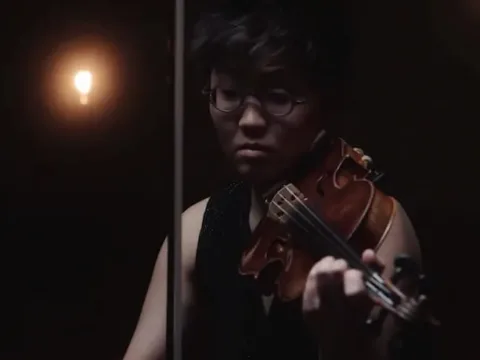
Situated halfway through the album is the eminently re-listenable piano quartet reliquary, which features the four players (including Kim on piano) morphing through a series of classical fragments held together by original material. But this is no mere jukebox; Kim’s transitions sound effortlessly nimble — transitioning from Prokofiev’s Piano Sonata No. 7 to Beethoven’s Kreutzer Sonata to Brahms Piano Quartet No. 3 to Debussy’s “Feuilles mortes” Prelude to Bach’s Cello Suite No. 2 in the span of 30 seconds — while the overarching work feels reverent and restless.
Helmed by Kim’s expressive piano playing, the quartet members deftly dart between a range of performances styles, changing on a dime from crunchy contemporary techniques to Baroque detaché to the ponderous sways of Romantic music. At various points, the performers let slip errant hits, random plucks, accented harmonics, and other sounds that don’t belong (has the mandatory reverence for canonical composers become stifling?) until they finally leave the stage entirely, letting the hot mic pick up their shuffling footsteps.
In many ways, reliquary is the centerpiece of the album, establishing a core premise from which the other tracks stem: that the “classical canon” is lamentably treated as both a holy relic and an “anachronistic remnant of the past, kept for its association with the romanticized notion of the ‘great masters’” — thus causing the music to lose artistic value and “become mere objects serving soft power,” according to the liner notes.
letters to a screen for clarinet, voice, and fixed electronics builds on this premise with a cloying needle drop of Strauss’s Metamorphosen — a piece expressing the late Romantic composer’s mourning of the destruction of German culture at the end of World War II. Though Strauss did not agree with the Nazi Party, his romanticization of a cultural past that was inextricably intertwined with fascism illustrates how oppression can hide beneath the facades of culture and sentimentality. In letters to a screen, Kim depicts the extreme forced isolation of political prisoners by layering three “levels” of communication, represented musically by real performances, recordings, and artificial MIDI performances. As each layer grows in intensity, its isolation becomes more apparent, the disparate performances screaming completely independently of one another. In the final 10 seconds of the track, the discordant layers are flattened and unified by a fast-forwarding effect applied to the entire cacophony, terminating in an abrupt, unceremonious ending.
The album is a prime example of electroacoustic composition done right. For all its clashing dissonances, nothing feels arbitrarily placed; the eclectic parts all belong together, supporting an overall concept and emotional arc. At the same time, Kim employs recurring motifs, too, my favorite being the ominous, slow-crashing whalesong effect (referred to as “waves of doom” in my notes) heard in eldorado, extinguishing dance, and how warm a little match would be. Even the purely acoustic pieces (reliquary, albumleaves, and stations (palimpsest)) have no trouble fitting into the same soundworld as the electronic ones.
Stations (palimpsest) for string quartet juxtaposes two competing sonic narratives — music from the classical canon and the gritty textures of NYC’s Port Authority Bus Terminal — evoking the trend of hostile architecture that keeps homeless and other “undesirable” people away from public spaces. Rather than cutting in her own field recordings from the terminal, Kim slowed down the recordings and transcribed them for string quartet using spectral analysis. While the original source material is not easy to identify from listening alone, the ambient bus terminal-inspired passages are easy to distinguish from quotes of Sibelius and Beethoven. Some of the most striking moments are when the strings evoke vehicle horns by striking crisp chords of artificial harmonics. Kim employs a similar strategy in albumleaves for solo piano with spectral chords derived from recordings of a bell tower in Chautauqua, New York.
our little matches is the kind of work that invites continuous research and revisitation, yielding more insights each time. At the heart of the album is a struggle to reconcile the paradox of its relics. Kim’s powerful voice challenges us to contend with that struggle, too.
I CARE IF YOU LISTEN is an editorially-independent program of the American Composers Forum, and is made possible thanks to generous donor and institutional support. Opinions expressed are solely those of the author and may not represent the views of ICIYL or ACF.
You can support the work of ICIYL with a tax-deductible gift to ACF. For more on ACF, visit composersforum.org.