Money Matters is a NewMusicBox x I CARE IF YOU LISTEN collaboration, supported by New Music USA
It is becoming increasingly difficult for working class musicians to build a touring career. Whether an ensemble is just starting out or long established, it’s a daunting proposition to rely on income from concerts alone to have a successful tour. Uncertainty surrounding artist fees and tour expenses can be paralyzing, and a lack of experience can leave you unprepared for the reality of being on the road. Without inherited wealth or deep pockets, which allow financially privileged artists to afford touring while taking losses, the critical question becomes: can independent, working class artists undertake financially sustainable tours?
The quick answer is “yes,” but many artists do not receive training on how to integrate the necessary budgeting, accounting, and planning skills into their artistic practice. As a freelance musician, 90% percent of tours I’ve organized have successfully utilized a hybrid model of combining concerts with additional guaranteed income streams such as educational activities.
This article primarily focuses on the financial aspects of putting together tours for mid-career artists. While a lot of this will be helpful to any musician who wants to tour, I am focused on advising artists who either go on the road solo or as a bandleader who makes most of the decisions and allocates the payout of fees.
In 2023, The Guardian published a comprehensive article laying out the challenges of touring for working class musicians. Tom Excell, leader of the successful Afro-Jazz project Nubiyan Twist, admitted in the article: “After four albums and 15 years doing this, to still be having to gamble on whether I’m going to make anything, while everyone else gets paid a guaranteed amount, is a struggle.”
For many new and mid-career ensembles, there is no set ‘guideline for fees,’ which makes the process of estimating tour income inherently difficult. Venues can offer a broad range of options ranging from donations, percentages of ticket sales, a guaranteed fee (based on what promoter deems is an ensemble’s capacity), or a combination of those options. While a small-scale tour may still seem manageable despite these income ambiguities, there are many expenses that can come as a surprise, leaving you with a lot less money at the end than you expected, or even in the red.
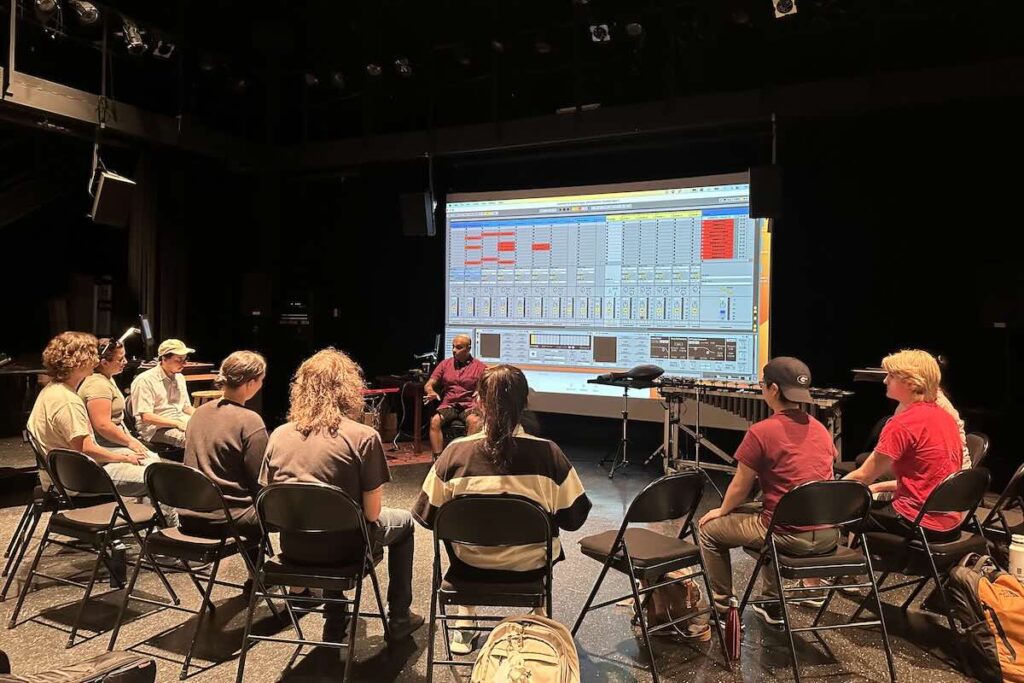
In my experience, one of the best ways to create a financially sustainable tour and offset the volatility of artist fees and expenses is to supplement concerts with additional sources of guaranteed income. For me, this has often included educational activities. I began working as a teaching-artist in New York City public schools and gained experience teaching various percussion instruments and electronic music production. I adapted those skills for students of different age-groups and proficiency-levels, and have thus been able to work with a wide range of students at educational institutions elsewhere.
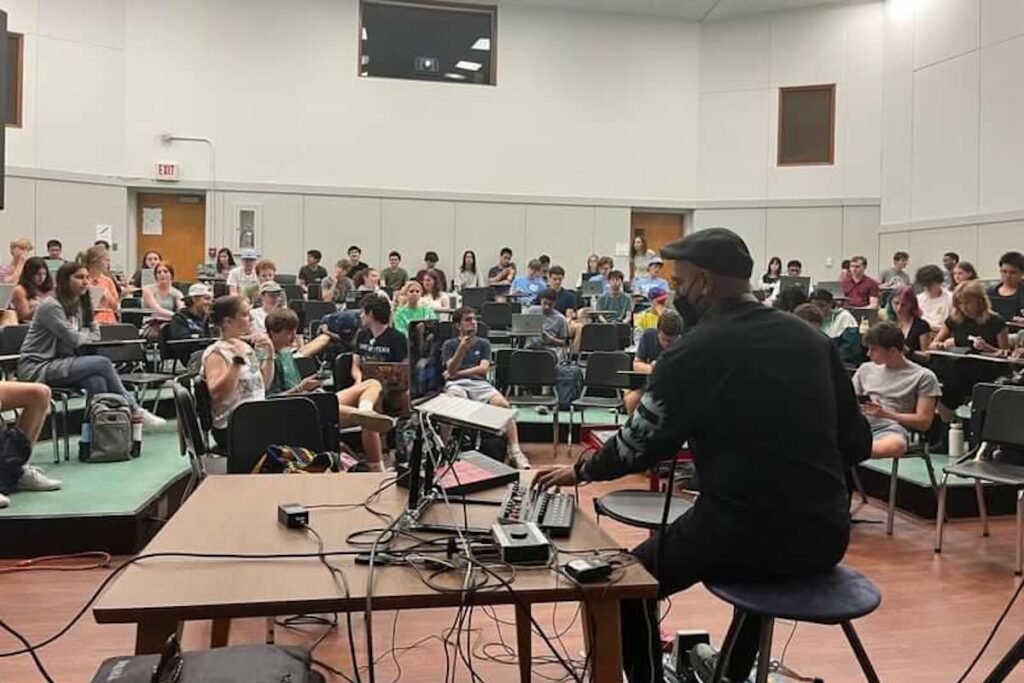
Workshops, masterclasses, talks, and clinics sponsored by a corporation or an educational or cultural institution are likely to come with some sort of guarantee fee. The old saying, “those who can’t, teach,” is simply an inaccurate anachronism. While teaching certainly isn’t intuitive, developing those skills via private teaching or working for teaching-artist organizations can be a valuable asset for boosting tour budgets.
When you’ve identified your unique skills that you can share with students, seek out music schools, universities, and high schools with music programs that might be interested in a masterclass or a guest engagement. For example, I was invited to play an unpaid showcase for my record label at a London performance venue last year. I reached out to the music production software Ableton and the electronic drum maker Alternate Mode to sponsor an appearance at The Drum Show in Liverpool, and I also scheduled a workshop at an electronic music academy in Glasgow.
Both of those educational activities covered my international flights, housing, local travel, and meals, thus allowing me to come home with a modest profit. A cultural or community center that serves a particular demographic may also align with your background. On a recent concert tour through the US Northeast, I gave a beat-making workshop at the South Side Community Center in Ithaca, NY, which works with underserved BIPOC youth.
Of course, booking these events can be time consuming — you need to research which school, university, cultural organization, or sponsor would work in the tour itinerary. Learning how to connect those dots over a geographic region can feel intimidating, but is of utmost importance to utilizing this hybrid model to build a successful tour. Once you’ve planned a tour and researched all of your potential income sources, devising a detailed budget spreadsheet is critical before you commit to undertaking it. Knowing your baseline tour income and detailed expenses to a reasonable degree of certainty can take a lot of the stress out of the tour-building process.
The line items for income can include fees from performances and workshops, as well as merchandise sales. The line items for expenses should include travel (flights, rentals), local transportation (buses, taxis), gas, tolls, parking, hotels, meals, and any equipment rentals. Also add a line item for ‘miscellaneous,’ which can include unexpected fees such as currency exchange losses. An example of a tour spreadsheet might look something like this.(This is an open source template that you can download and use for your own tour planning.)
For your income, err on the conservative side. Even though we all hope for sold out shows, estimate low turnout for any “door gigs.” Best practice for calculating this is to research the venue capacity and ticket price, then ballpark a low turnout.
Many expenses will be straightforward, but categories like gas, meals, and local transportation can be tricky to estimate. Even though apps and online estimators for gas now exist, I prefer to use a simple formula and plug in my own numbers using my car’s MPG rating, regional gas prices from gasbuddy.com, and Google-maps estimates for distance between different venues (also padding the numbers to account for extra trips inside a given city):
[ 1/MPG x $/Gallon x Miles driven = $ Gas Estimate ]
Setting a realistic total meal budget that accounts for meals covered by promoters is also important as meals can add up quickly.
If you are touring with an ensemble, artist fees could be quite possibly the trickiest expense, as your ensemble members may have high expectations for fees — or even insist on baseline guaranteed fees. One of the things that can fracture relationships with fellow musicians is when they feel cheated or don’t understand where the money goes. Ensemble members may not be aware of the many costs associated with touring, or the amount of labor you are doing behind the scenes. Having a clear conversation ahead of time about all of the variables and key figures in the spreadsheet is important.
These budget spreadsheets ultimately serve as a reality check on who you can hire for your touring project. Plugging those artist fees into the spreadsheet quickly reveals what your budget can handle. I’ve devised this handy flowchart for a ‘go, no-go’ heuristic for touring.
There is often a short window for this decision making as dates are being negotiated with venues, so I have found this flowchart helpful. The decision to go on tour based on these five outcomes is ultimately subjective, and I’ve chosen to adhere to C and D for my own business model. Outcome D assumes that the bandleader can ideally have both a take-home fee and an additional booking fee for the extra labor of organizing the tour. While this may not be possible, earning a take-home salary is generally considered a profit for the leader.
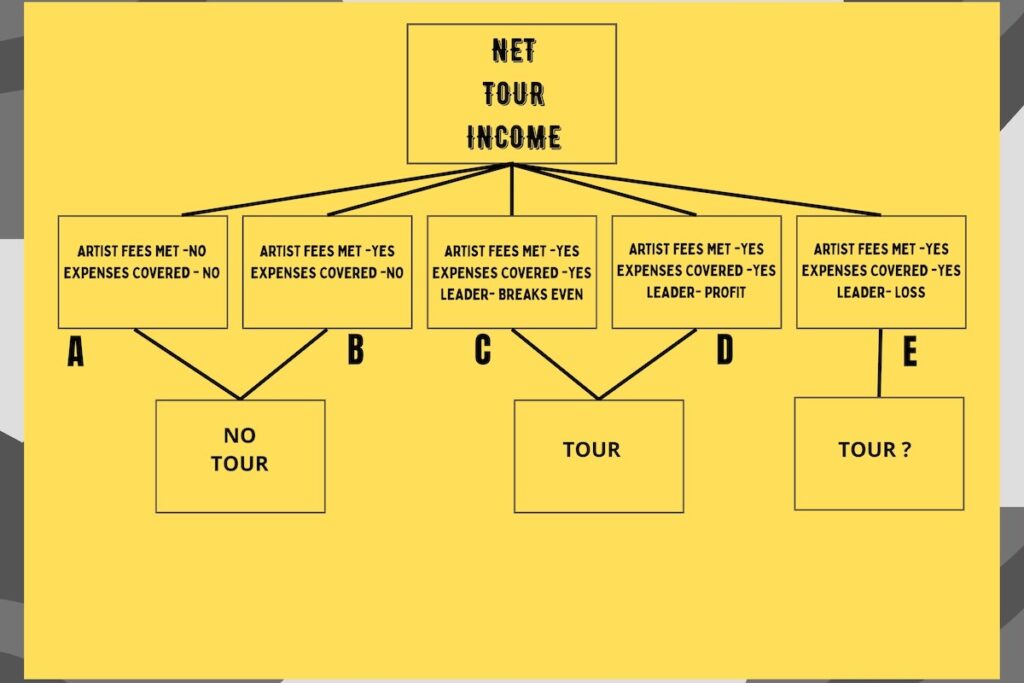
Given my working class background, outcomes A, B and even E, are not an option. I did put a question mark on E though, as it’s an outcome where lost revenue from last minute postponements or cancelled gigs may be known before setting out, but it could be too late to cancel the tour without seeming unprofessional. Late cancellations by the artist could result in being blacklisted by a venue or tarnishing one’s reputation. So in this instance, the bandleader is the first person to absorb this loss of revenue.
What happens after the tour can also be critical in determining an overall profit/loss. It’s important to remember that both performance venues and educational institutions will be reporting your income to the IRS or local tax authority, so filing taxes correctly is critical. Being able to easily extract expenses from tour spreadsheets significantly streamlines the process of listing deductions for the tax filing process. Furthermore, sending ensemble members a non-employee 1099 — a tax form used to report payments made to individuals who are independent contractors or freelancers — may also reduce the leader’s tax liability.
If the leader’s own income is also mostly reported via 1099s (paid in cash and online deposits from gigs and other secondary untaxed income sources), the leader may end up owing taxes at the end of the year. Therefore, hiring a tax accountant who has music industry experience may also help lower the tax burden.
As performing artists, we’re always looking for opportunities to promote our music and grow our audience. However, the reality of the music industry is such that generating and sustaining profits from concert tours alone is increasingly out of reach for most artists. If working class artists are to survive alongside their wealthier peers, staying organized and boosting revenue from other income streams needs to become an essential component of the touring model. While establishing name recognition over two vastly different sectors such as performance and education isn’t feasible for everyone, thinking ahead about supplementing touring income to create a hybrid touring model is a reality that many artists have to accept.
I CARE IF YOU LISTEN is an editorially-independent program of the American Composers Forum, and is made possible thanks to generous donor and institutional support. Opinions expressed are solely those of the author and may not represent the views of ICIYL or ACF.
You can support the work of ICIYL with a tax-deductible gift to ACF. For more on ACF, visit composersforum.org.