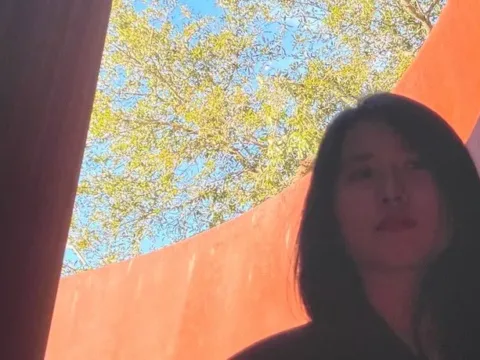
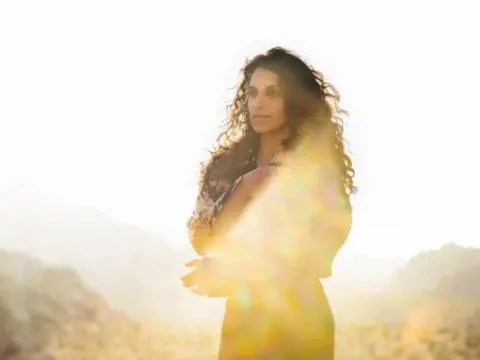
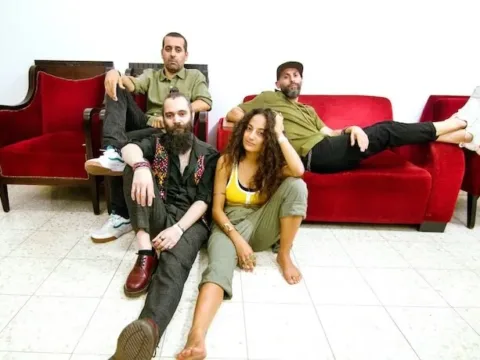
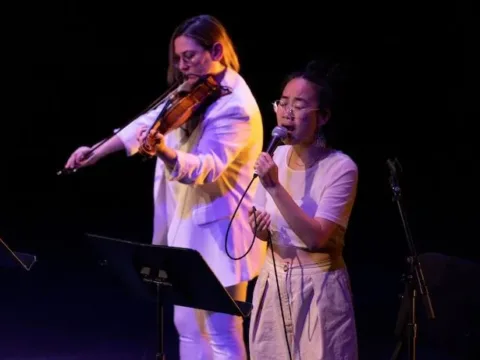
The creative output of queer multimedia artist Lu Coy is expansive; their works encompass electroacoustic composition, song, installation, theater, and ceremony, and are often rooted in their Indigenous Mexican and Ukrainian-Jewish heritage. They frequently collaborate with LA-based artists and projects as a composer, woodwind instrumentalist, vocalist, and electronics specialist. Coy has performed with Four Larks contemporary performance incubator, Vibration Group opera company, Latin-futurist San Cha, and recorded with alt rock band Blonde Redhead. In addition, they regularly participate in LA’s queer Alt-Latin music scene, and perform Yiddish and Ladino songs in the Ashkenazi and Sephardi Jewish musical traditions.
This month, the Roy and Edna Disney CalArts Theater (REDCAT) will host the 22nd annual New Original Works (NOW) festival celebrating invention and experimentation across music, dance, and theater in LA. Over three weeks, audiences can witness nine large-scale artistic productions that grapple with the zeitgeist of the 2020s — from diverse cultural identity and histories and heightened anti-immigration sentiments to mental health in late-stage capitalism.
On Nov. 20-22, NOW will present Coy’s Becoming the Moon, a theatrical portrayal of Florentine Codex: General History of the Things of New Spain. This 16th-century ethnographic manuscript by Fransiscan friar Bernardino de Sahagún narrates the stories of genderfluid Mexica deities Tecciztecatl and Coyolxauhqui. Coy fuses this historical text with original music and poetry — and since its first iteration in 2023, has further expanded to convene choreography, visuals, and other extramusical elements that aid in their innovative world-building. Ahead of the new production, we caught up with Coy and asked them five questions about queer narratives and liberatory art practices.
Becoming the Moon incorporates interdisciplinary presentation (music, movement, animations, and storytelling) — how did you navigate and balance each of these elements? Did you work with any collaborators in conceptualizing how everything would flow together?
Becoming the Moon has been a tapestry woven through collaboration since its earliest stages. My process began with consultations at the Getty Research Institute, working with scholars of the Florentine Codex—a 16th-century manuscript commissioned by the Catholic Church to document Mexica “Aztec” life—whose insights deepened my understanding of Nahua cosmology and ritual. From there, the work took on an interdisciplinary life through collaborations with artists in my community who helped shape its visual, physical, and sonic language.
An early version of the piece was directed by LILLETH, who encouraged me to incorporate storytelling after hearing me read translations of the codex aloud—leading to the voiceovers that now thread through the performance, often paired with projected imagery. I later developed movement with Estrellx Supernova, whose generative prompts inspired the work’s reenactments of death and transformation. I recently expanded the choreography with my current director Anna Luisa Petrisko and my creative producer Sebastian Peters-Lazaro.
The visual dimension emerged through a conversation with Eve LaFountain, who suggested integrating imagery from the codex itself. This led to a collaboration with Paradise Khanmalek, who created animations blending original footage with imagery from the Florentine Codex under my direction.
That being said, this work is still new and in development. My creative team and I are constantly interrogating the work to find balance, as are the technical and curatorial teams at REDCAT – Theater at this scale is impossible without collaboration and I’m thrilled to have this level of support. The work has been evolving quickly and in exciting ways since we began working with REDCAT this summer and I’m excited to present these developments in the coming weeks.
How does your research of ancestral stories/cultures and the 16th-century Nahuatl text set in this opera relate to your own lived experiences — and to the current social climate for queer and trans people today?
When I read the Codex’s account of Tecciztecatl I definitely saw something of myself reflected in their journey. Tecciztecatl first appears as a masculine deity who volunteers to be sacrificed in hopes of becoming the sun. For a moment he succeeds, but is then regarded as too “soft,” “delicate,” and “cowardly” to be the sun. He’s dealt a violent blow to the face as punishment and cast into the underworld. There, Tecciztecatl transforms into a feminine deity of the moon and is tasked with control of the tides and nightly matters. It’s there, in darkness, that Tecciztecatl discovers her power.
I recognize this arc of rejection and transformation in my own life. I once aspired to be an orchestral clarinetist, but found myself dismissed by my professors at conservatory. In a seemingly “open” environment I found an abusive hypermasculine culture that prized extreme virtuosity over sensitivity and imagination. Even with the highest jury grades in my department, and the best attended recitals in my studio, the chairs of my program did not see or respect me. It wasn’t until I left that world and found the queer punk latinx underground of LA’s eastside that I felt fully embraced by a community who was excited about who I was and the gifts I had to offer. They loved that I was feminine and queer. They wanted to hear me sing and dress me up and were dazzled by my playing. The “underworld” became the site of my liberation, and my role as an artist in Los Angeles began to grow.
The myth upon which my opera is based speaks to a broader trans and queer experience: we are often discarded to the margins, but in those shadows we forge our strength. Today, as our world edges further into fascism and Indigenous, trans and queer bodies are increasingly criminalized and erased, I feel an urgent need for spiritual and ancestral support. I want to engage with and learn from the sentinels of an Indigenous, gender-expansive past. I look to Tecciztecatl for guidance into an uncertain future.
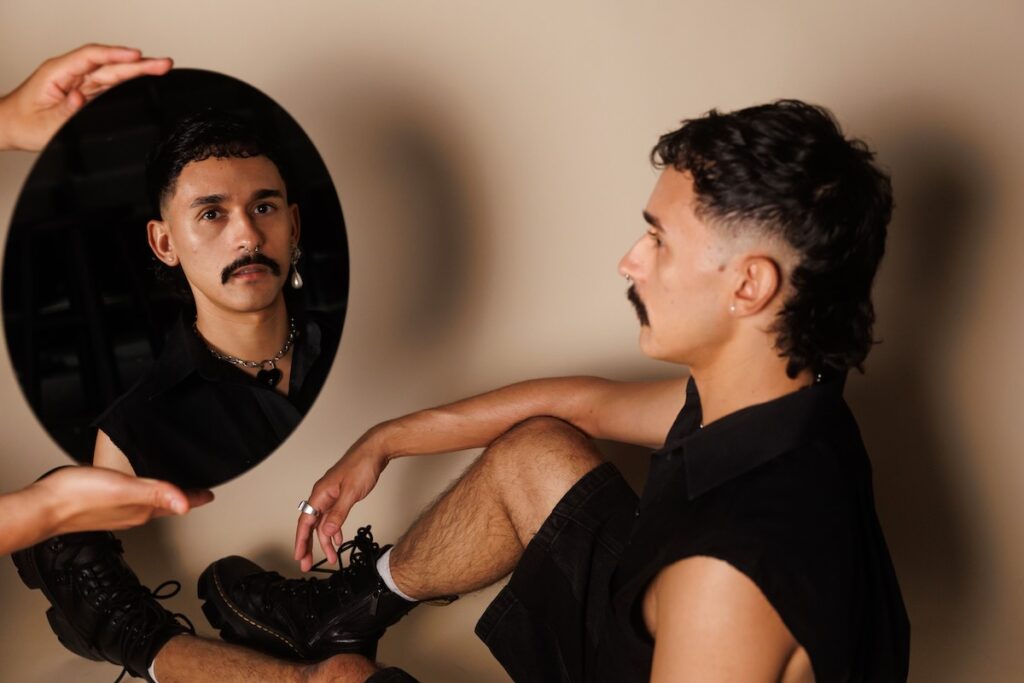
In program notes, you mention an interest in “excavating queer narratives which have been buried under layers of colonial erasure, and venerating the ‘failures’ and ‘monsters’ who have been overlooked and neglected.” Can you unpack how this unfolds in your work?
When I speak about “queer narratives,” I’m referring to more than depictions of sexuality or gender variance. I’m interested in queerness as a way of seeing and structuring a story — in reorienting who stands at the center, and how a tale is told. To me, queering a narrative can mean choosing to amplify the figure who has been dismissed as a “coward” or “monster.” I’ve made work that centers scabies mites and wasps, two highly vilified and misunderstood species, recontextualizing them as mothers who should be venerated in death. Queering as practice can also mean choosing modes of expression that are subversive, endangered, forgotten or invisibilized. I chose to build a career singing in Yiddish and Ladino, languages often described as “pigeon” or “bastard” tongues. I’ve set to music, translations of Nahuatl songs whose melodies did not survive the arrival of the Spanish.
My REDCAT performance continues this commitment to queerness in both narrative and form. In the Florentine Codex (which was commissioned by the Catholic Church) Tecciztecatl is mentioned briefly in a chapter on the cosmos, and described merely as a “coward.” There is no acknowledgment of Tecciztecatl’s gender variance or their spiritual significance within Mexica cosmology. Yet researchers at the Getty have shared with me that Tecciztecatl’s transformation into the moon was understood as a feminizing process, and that a large temple in Tenochtitlan, Teccizcalco, was dedicated to her/his worship. There, archaeologists discovered a massive stone sculpture of a conch trumpet—the symbol of Tecciztecatl—the largest representation of a musical instrument in all of Mesoamerica. This attests to both the importance of the instrument and the centrality of this deity, whose story I aim to restore to the center.
Your practice encapsulates a lot of different mediums, cultural influences, and facets of identity. What are some of the integral approaches that shape your process, and how do you define your musical language?
My musical language is multifaceted and shifts depending on the medium with which I’m expressing it. My Spanish phrasing and ornamentation draws from Boleros, Flamenco, and Sefardi Romances. When I sing in English, my music naturally leans toward the textures of my favorite experimental pop and folk influences– musicians such as Björk, Laurie Anderson and Sufjan Stevens. In my woodwind playing, it’s clear that I’m classically trained, but the ornamentation and expressive gestures with which I decorate my phrases are much more reminiscent of my experience with Klezmer music.
The soundscape of Becoming the Moon unfolds through layers of flutes, synths, and my own voice–both in its own form and processed through harmonizers and auto-tune–interwoven with Pre-Columbian instruments such as the Huehuetl drum, bells, rattles, ceramic flutes and conch trumpets.
Research is a vital part of my compositional process. When I find a subject that excites me, I conduct many hours of research before I write. For this work I studied the Pre-Columbian musical systems of the Mexica and learned that before the Spanish invaded, the Mexica had instruments which fell into three primary categories: those which are struck (drums), those which shake and shimmer (rattles, bells) and those whose bodies vibrate with breath (clay flutes, conch shells and other aerophones). Notably, there are no plucked or bowed instruments (stringed instruments, harps). This taxonomy directly influenced my instrumentation for Becoming the Moon: I drew from the former categories, especially bells and the conch trumpet which have associations with the underworld and moon, and intentionally excluded stringed instruments.
There’s a beautiful “viral” video of you leading 1,000+ Jewish folks and allies in the Yiddish and Ladino song “In Kamf” as part of an anti-Zionist protest in LA several years ago. Can you talk about the significance of music as a form of solidarity and vehicle for resistance?
“In Kamf,” written by the great Jewish labor poet David Edelstadt in 1889, became a hymn of Jewish workers everywhere in the late 19th and early 20th centuries, and is entirely in Yiddish (though I did sing Ladino songs as well in that action, which took place in November 2023, during which Jews and allies staged a civil disobedience calling for a ceasefire in Gaza).
Song is an incredible vehicle for resistance for many reasons. Namely, I’ve been amazed by how it can unify a mass of people. The cacophony of a thousand suddenly becomes one voice, and in this moment your nervous systems, emotions, and political demands align. I’ve also found that learning a song can commit a message to memory deeper or more viscerally than one communicated or iterated in other forms. And the message of “In Kamf,” though now over 136 years old, is a particularly powerful, truthful and critical one right now — the tyrants can take everything from us, even our lives, but our spirit, our movement, and the truths we have committed to memory, cannot be extinguished.
Singing this song in solidarity with Palestinians to me had a uniquely charged significance. It demonstrates that my Jewish values and heritage inform my moral compass, that our struggles are intertwined and that I, as a Jew, cannot truly be free until there is freedom and dignity for Palestinians.
For me, singing in vernacular Jewish languages is an act of resistance against the Zionist state, which for decades forbade the speaking of Jewish languages other than Hebrew in the hopes of homogenizing Jews into a “new” people, rejecting thousands of years of linguistic and ethnic diversity. It’s a commitment to the memory of Jewish life before the Zionist project, a rejection of its violence, and commitment to a future beyond it.
I CARE IF YOU LISTEN is an editorially-independent program of the American Composers Forum, and is made possible thanks to generous donor and institutional support. Opinions expressed are solely those of the author and may not represent the views of ICIYL or ACF.
You can support the work of ICIYL with a tax-deductible gift to ACF. For more on ACF, visit composersforum.org.