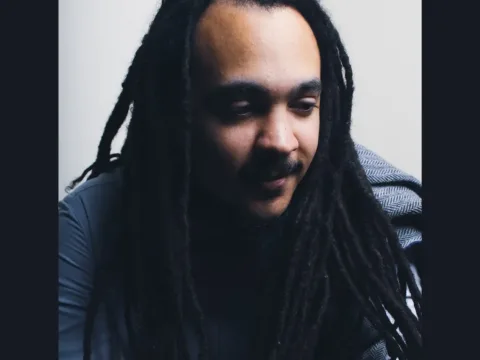
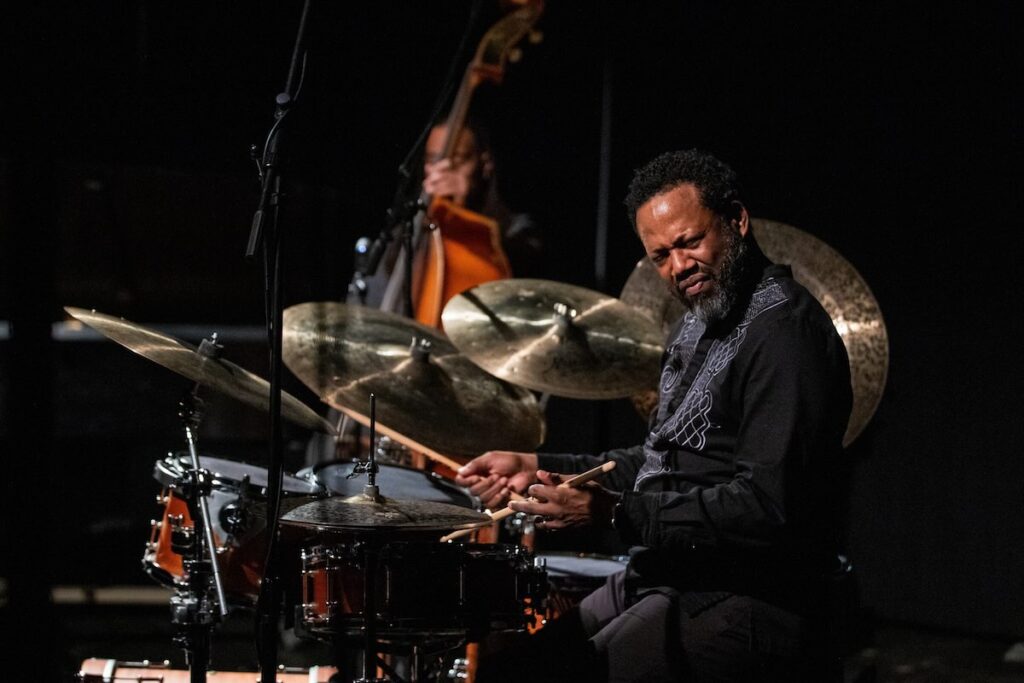
Musician, composer, and activist Mark Lomax, II dares to trust himself by playing the notes that speak to him most. His ideas of accepting the fullness of who you are and finding the power each of us have within is foundational in his outlook and approach to his art. Beginning his musical journey as a drummer in the Black church at the age of two, Lomax learned the value of leaning into his own voice in choosing to play the rhythms that were most authentic, even at the risk of “getting in trouble.” His resolve to perform what truly inspired him galvanized his desire to affect change.
Despite his terminal degree in music composition, Lomax has maintained a commitment to Black history and art as a throughline in his work with additional studies in African-American Studies and ethnomusicology. This dedication is illuminated in his 2019 project “400: An Afrikan Epic,” a 12-album cycle, documentary, and curriculum released on the quad-centennial of the first arrival of enslaved peoples to the United States. The work tells the history of the African Diaspora in three parts: pre-colonial Africa, the Ma’afa — a Swahili word meaning “great disaster” that refers to the period between 1619 and 2019 — and Afro-futurism. The composition juxtaposes aspects of classical music and traditional Black music with the use of a string ensemble, jazz quartet, and African rhythms.
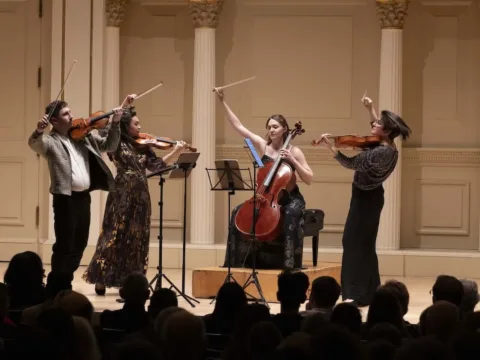
These thematic and musical elements are also present in his most recent work, The Unity Suite. Premiered on Oct. 2 at The Wexner Center for the Arts in Columbus, OH, the six-movement suite invites listeners to interrogate what humanity must overcome to realize peace, framed through the lens of traditional Black sacred music.
In a time when artistic expression feels increasingly fragile, Lomax is committed to creating. We asked him five questions to learn more about this resolve, and to gain more insight into his artistic process and upcoming projects.
You speak highly of the musicians you have worked closely with over the years. Can you share more about that “something special” that makes someone a good collaborator?
In my experience, good collaborators are those whose creativity amplifies my own. They are open to experimentation, willing to ask “why” and “what if,” can generate and share original ideas, and are genuinely concerned with finding the most authentic stories to tell in super creative ways. That “something special” comes from curiosity, openness to the unknown, and a willingness to pursue that path to its logical end.
I’ve had the pleasure of working with Edwin Bayard (saxophonist), Dr. William Menefield (pianist), and Dean Hulett (bassist), in various ensemble configurations for the better part of the last 25 years. While we met as colleagues, we’ve become brothers. They check me and ask critical questions to ensure our presenting music is at the highest possible level. When I told them I wanted to do the 400, they didn’t blink. They simply said, “[L]et’s do it!” We found the way through it together!
Another significant collaborator on my artistic journey has been the great thinker and writer, Scott Woods. We’ve also got a lot of years in the game together. We haven’t said “no” to an idea in almost 30 years! Like my musical brothers, our process is one of discovery. No matter how crazy or out of our comfort zone an idea has been, we’ve always worked to figure out how to make it happen. Because of that, we have a very eclectic body of work from duets (A Bad Peace) to large ensemble pieces (Black Odes: A Reclamation Suite).
In “400: An Afrikan Epic,” you denote 2019 as the start of Afro-Futurism. Outside of the significance the year 2019 holds in relation to the beginning of the chattel slavery, in what ways does this current timeline feel Afro-futuristic?
I saw 2019 as a call to action! I think this timeline feels Afro-futuristic for a few reasons. First, we weren’t supposed to be here… but we are! Our Ancestors willed it and, through the efficacy of their beingness, allowed for many possible futures. It’s now up to us to remember and become. By doing so, we’ll create a future where we thrive in a melanated reality our Ancestors saw for us.
“The Church” has long been criticized for its inflexibility in modernization. How do you hope your new work “The Unity Suite” will help move the needle in this ongoing conversation?
As a preacher’s kid and one who was brought up in and trained in the Black church, I have a lot of critiques of the institution and question its current relevance in the face of the myriad injustices we continue to face in the American experiment! However, the cultural and spiritual power of our sacred traditions, when engaged and aligned for the good of our people and not profit, is undeniable. Afrikan people have always been connected to that unifying energy permeating the universe. Because of this, I’m not trying to move any needles. I’m leveraging the power of our musical tradition in the way my Ancestors did.
We didn’t have a sacred/secular dichotomy in pre-colonial African social contexts, and I don’t ascribe to that dichotomy in my work. That was my biggest issue growing up in the church. I couldn’t reconcile the notion that there was something just for the church and something else, that was actually the same thing but “different,” for the world. I came into a more profound spiritual understanding once I accepted the fact that the Black church, while important in my formative years, was not the place for me to do my best work.
I actually composed the first iteration of The Unity Suite right after 9/11 and the birth of my oldest daughter a month later. In processing all that had happened, it just made sense to use gospel, blues, and Black improvisational art music (“jazz”) as source material to create a piece of music to bring us together.
In your 2017 TEDx talk, you touched on the idea of needing to set your ego aside in service of your art as a church musician. How do you see this applying to an orchestral musician or a general music teacher?
That was one of the best lessons I learned as a church musician! From my perspective, we are servants. The role of any musician (classical, improvising, gospel, funk, soul, hip hop, rock, etc) is to create an experience for the listener that is effervescent, vibrant, enjoyable, and transformative. I don’t think we can achieve true artistic excellence from the position of ego. Service to humanity is my goal, and creating from a place I call the innerverse is the best way to compose and perform in a way that offers a profound experience for audiences.
Teaching is no different from performing. It IS performance in a lot of ways! My function as a teacher is to disseminate information so students can digest, internalize, and use it in the field. If I center myself in the process, how can students learn? I’m in the way and might get impatient because they aren’t understanding concepts that may be simplistic to me. Focusing on the students, their experiences, and their learning styles is the best way to convey information so they retain it and put it to use in their work.
What advice do you have for Black artists who are afraid to create during this time of artistic suppression and censorship?
I have no advice. I only have the examples of those who came before us to point to. ALL of our art as Blacks in America who have descended from enslaved Afrikans has come out of tragedy, trauma, and loss. The spirituals and the blues are musics born out of the enslaved experience. Gospel and r&b/soul are musical responses to our civil and human rights struggles. Black Improvised Art Music and our concert music derive their origins from the acculturation due to forced removal from our native land and exposure to European culture.
This is what WE do!
Speaking of creating in times of crisis, Toni Morrison said, “[T]his is precisely the time when artists go to work. There is no time for despair, no place for self-pity, no need for silence, and no room for fear. We do language. That is how civilizations heal.” I would amend that only to say, we do art. That is how civilizations heal. This is our sacred work. It is the burden of our gifting. Fear is a choice. We can either follow the footsteps of our Ancestors and create our way through crisis, or we can cower and become complicit in the face of inhumane actions. I choose not only to create but also to use my art to uplift and encourage radical humanity. Only by remembering and engaging our most authentic selves can we find effective ways to combat evil.
I CARE IF YOU LISTEN is an editorially-independent program of the American Composers Forum, and is made possible thanks to generous donor and institutional support. Opinions expressed are solely those of the author and may not represent the views of ICIYL or ACF.
You can support the work of ICIYL with a tax-deductible gift to ACF. For more on ACF, visit composersforum.org.