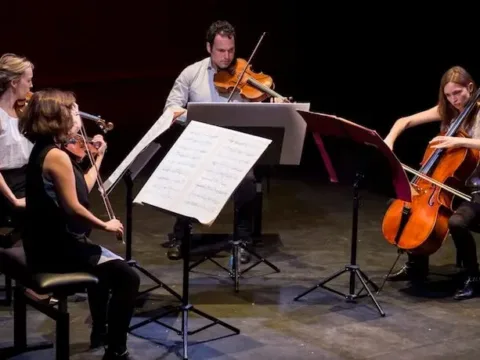
A string quartet album is more than a slice of an ensemble’s repertoire; it’s an expression of what the artists believe is possible for the centuries-old medium. Given the breadth of contemporary string quartet repertoire, this leaves ensembles spoiled for choice. In the liner notes for their latest release, Mivos Quartet violist Victor Lowrie Tafoya says he imagines an album like a room in an art gallery: each piece needs to stand on its own, but also complement the others on display. The individual pieces should come together to express something as a collective that wouldn’t be possible for any piece alone.
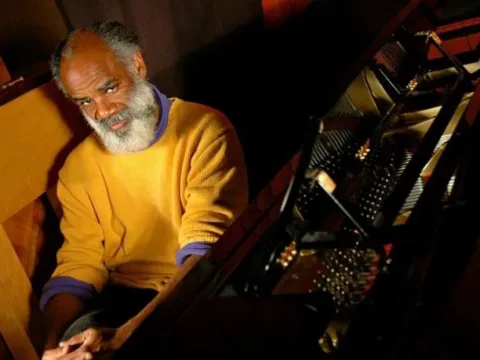
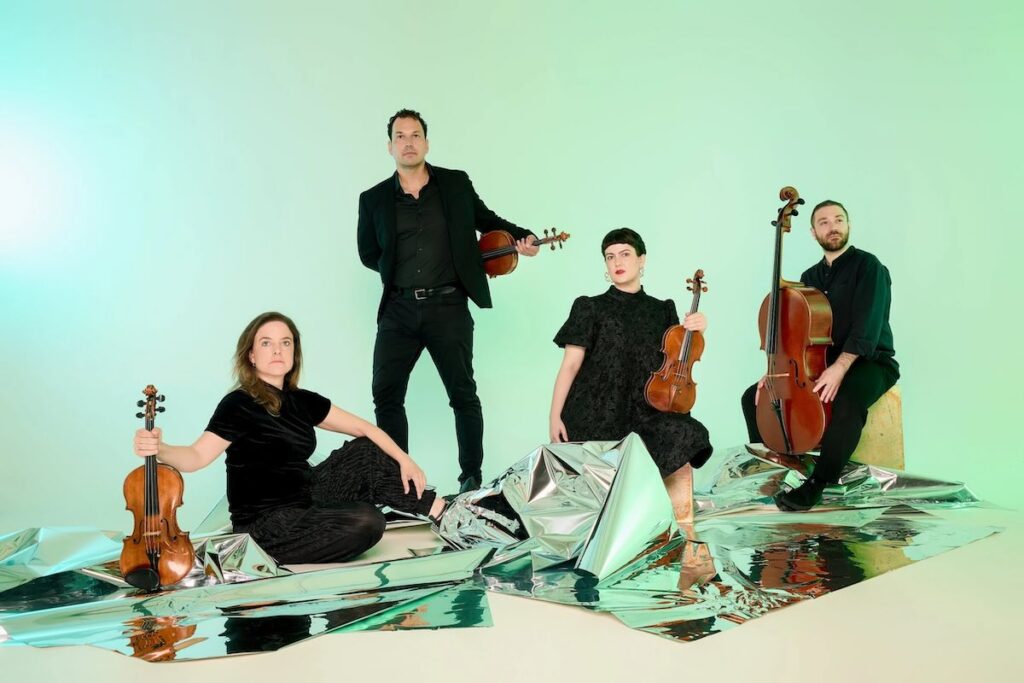
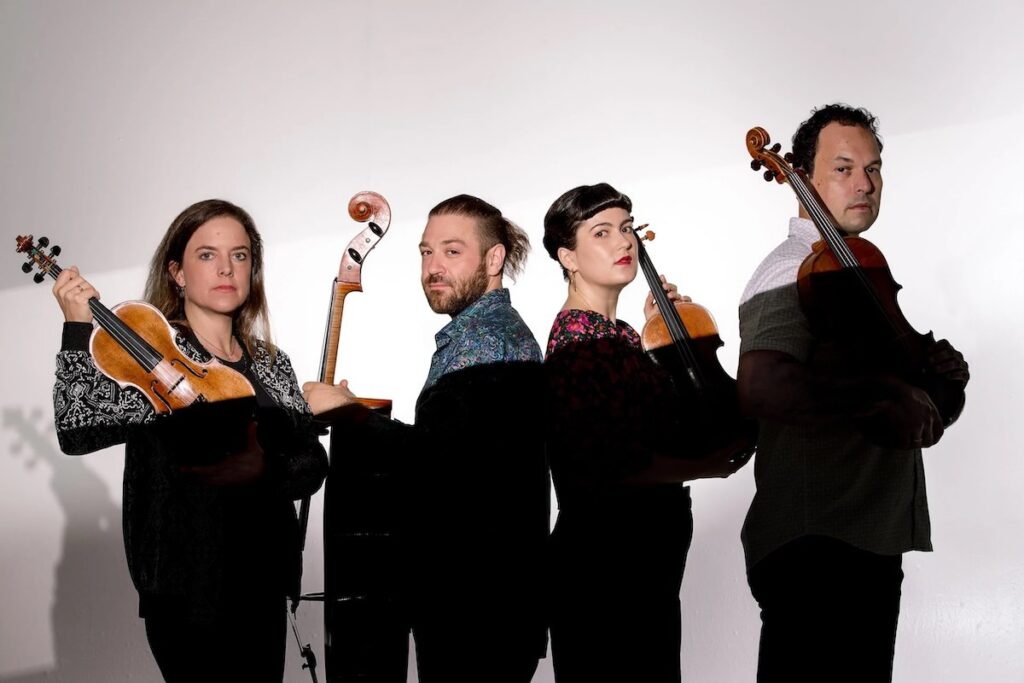
The quartet certainly achieves this with their eloquent and stunning performances of four recently commissioned world premieres on May Our Centers Hold (Sideband, 2025). Mivos Quartet — Olivia De Prato and Maya Bennardo (violin), Victor Lowrie Tafoya (viola), and Nathan Watts (cello) — has been a champion of new string quartet repertoire since 2008. Here, composers George Lewis, Michaela Catranis, Jeffrey Mumford, and Ambrose Akinmusire have each brought their unique voices to the ensemble, and together their pieces show the quartet’s vision for what new music for string quartet can be.
If the album is like an art gallery, then George Lewis’ String Quartet 2.5: Playing with Seeds is the expressionist work; it’s moody and dramatic, with moments of outright violence from the low strings. Lewis took inspiration from the work of anthropologist Paul Richards, who studied rice cultivation practices in Sierra Leone. Richards understands this process as a kind of improvisation that, like music, requires deep knowledge, practice, and the ability to change course. Lewis notes that unlike farming, a less-than-bountiful sonic harvest doesn’t have to mean debt, starvation, or death. The low strings give voice to this precarity in Quartet 2.5, playing as gutturally as they can sul ponticello to emphasize the life-or-death reality that follows the experimentation of growing new plants.
Michaela Catranis’ luminous animal evokes light, impressionist brushstrokes through long tones with shifting glissandiover the top, particularly bringing the night scenes of Degas and Pissarro to mind. The near-constant high string harmonics bring out the “luminous” of the title, creating an almost flute-like timbre. Mivos’s light touch here is audible — the harmonics shimmer without breaking tone or falling out of tune.
Catranis offers some contrast with sections of warmer, lower tones in the cello and viola analogous to a light from inside: a gas lamp, a bustling café, or a warm house. Her inspiration for the piece comes from bioluminescent organisms, Tony Moffeit’s 1989 poem of the same title, and a desire for reflection. Of all the pieces on this album, luminous animal evolves the most with subsequent hearings; in this delicate-yet-steady performance by Mivos, the work’s evocative moments deepen, and its timbres reveal their complexities.
Jeffrey Mumford’s … amid still and floating depths was co-commissioned for Mivos by the Los Angeles Philharmonic Association and the Library of Congress. Though the title might suggest impressionism, I hear it evoking an impasto style with thick timbral layers and clear overlaps of different textures that remain distinct when juxtaposed. Sparse, lyrical gestures are crossed by others that are suddenly louder or technically intricate — the quartet navigates them as easily as actors in a play, knowing exactly where each begins and ends. These contrasts demonstrate movement between the instrumental parts in the same way paint shows movement in works like Shiraga’s Untitled or Van Gogh’s Starry Night: there are no gradual transitions here where voices extend over one another to create a unified texture.
Ambrose Akinmusire’s title track feels the most lifelike — something between a painting and a sculpture — with lush textures that let the cello and viola really go for it in both technique and volume. May Our Centers Hold explores the things that hold under pressure when surface details have disappeared. My first thought of the title was of W.B. Yeats’ The Second Coming, but Akinmusire has a much less bleak outlook. Hope isn’t a feeling I assume that I’ll find in contemporary music, but the end of this piece achieves it quietly. The surging lines and rough backgrounds melt into longer, lighter gestures, and eventually resolve into a single lingering tone.
The Mivos Quartet shares in the liner notes that the commissioned composers are all “colleagues, friends, mentors, and fellow travelers in our shared musical journeys,” and together their pieces form a vivid gallery that looks forward with ambition and optimism. Their sensitivity to each composer’s intention — and their willingness to go for it when asked for sounds that are experimental or unconventional — results in articulate, potent, and masterfully proficient performances. May Our Centers Hold is a beautiful expression of the aesthetic diversity of the string quartet and what the group believes is the future of their ensemble. The future as they see and hear it seems bright indeed.
I CARE IF YOU LISTEN is an editorially-independent program of the American Composers Forum, and is made possible thanks to generous donor and institutional support. Opinions expressed are solely those of the author and may not represent the views of ICIYL or ACF.
You can support the work of ICIYL with a tax-deductible gift to ACF. For more on ACF, visit composersforum.org.