Sarah Kirkland Snider dreamed of writing the opera HILDEGARD in college. She first came to know Hildegard von Bingen as a person purported to have chronic intractable migraines; Snider has suffered these migraines for months and sometimes years without interruption, and she encountered the 12th-century composer and polymath while researching the condition. She was astonished that Hildegard gained an official papal imprimatur — a special declaration that authorized her writings as the voice of God — while managing a chronic illness, which was seen as moral failure or spiritual judgement in her time. Yet Hildegard persevered in her unusual beliefs, considering ill health as a natural imbalance that presented an opportunity to connect more deeply with God. “I thought that was such a beautiful way to think about health, and one of Hildegard’s more philosophical teachings is that creativity is a way to connect with divinity,” Snider shared in our recent interview.
Hildegard’s music wasn’t included in Snider’s undergraduate music history courses, so this research also revealed the medieval abbess’ enormous body of work. Snider describes that encounter as an “awakening,” with Hildegard as a primary female compositional mentor in an education dominated by men. She was intrigued by the conflicts of Hildegard’s spiritual orientation, powerful intellect, and social status as a woman. In particular, she wondered how Hildegard squared her religious beliefs and homophobic writings with her documented relationship with Richardis von Stade, the German nun who worked closely with Hildegard to compile her writings, and whom Hildegard cherished “with divine love.”
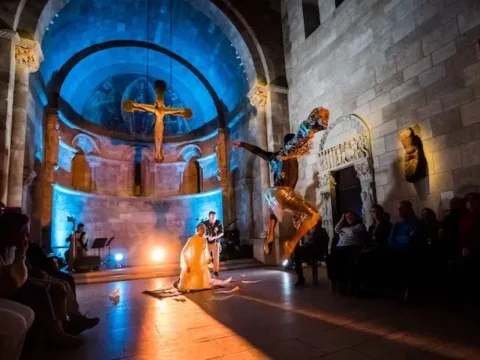
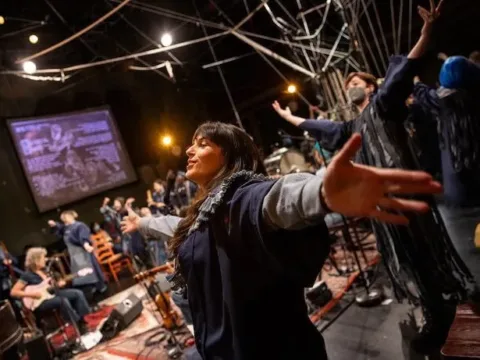
In its final form, HILDEGARD is a two-hour chamber opera co-commissioned by Beth Morrison Projects and the Aspen Music Festival and School. It will have a rolling premiere at LA Opera (Nov. 5-9), PROTOTYPE Festival (Jan. 9-17, 2026), and Aspen Music Festival (Summer 2026). The opera has gone through extensive public workshops at Lyric Theater at the University of Illinois, Princeton University, and Mannes School of Music in addition to support from the co-commissioning organizations. These collaborations informed HILDEGARD’s flexible presentation, so the opera can have effective staging and sound design whether in a proscenium, black box, or outdoor venue.
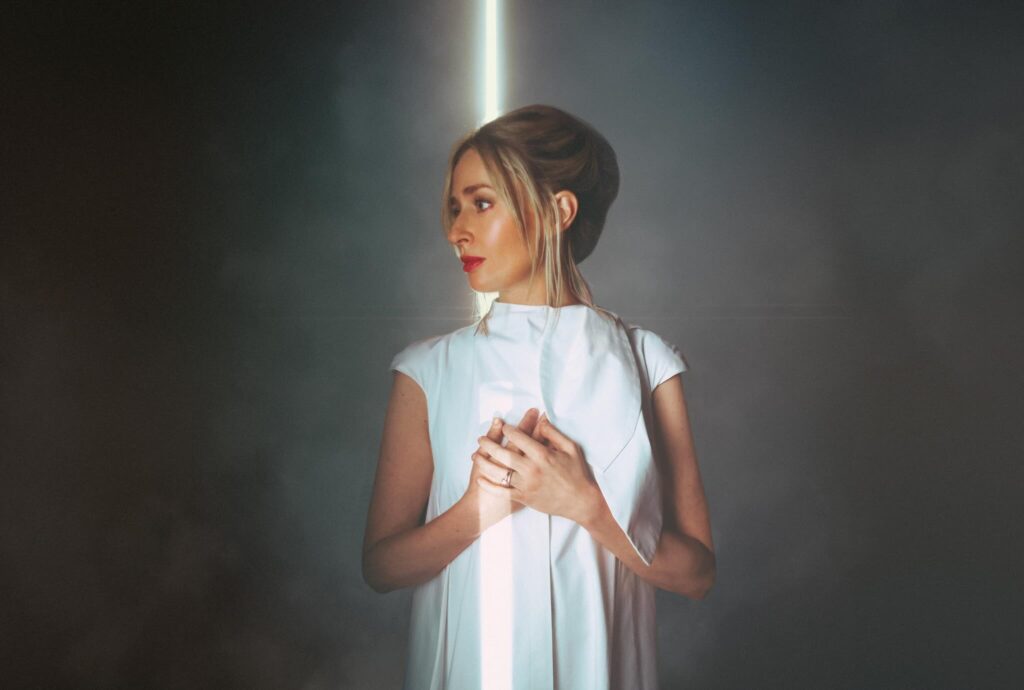
Rather than focusing exclusively on Hildegard’s mysticism, or visionary experiences which were intensely related to Catholic imagery, Snider wanted to explore more universal themes. She was drawn to Hildegard’s revolutionary reframe of illness as a generative spiritual force, and wondered what visions Hildegard had related to her own life experiences. Hildegard and Richardis’ deep bond presented a personal way to examine philosophical evolution, and Snider made the creative decision to introduce Richardis as a character with epilepsy. Snider knew from her personal experiences with chronic illness and her son’s epilepsy diagnosis that together, the characters could transcend medical stigma and theological limitations in radically intimate terms.
“I had these very particular narrative ideas that I wanted to explore, and that made it difficult to work with different librettists because you really have to let the librettist write their own story,” she says. “I used to do a lot of creative writing, but I had stopped all of that to pursue music, and I never studied writing formally. It didn’t occur to me that I could write a libretto in the same way that you often meet performers who feel like they’re not allowed to compose because they haven’t been taught.”
She was also hesitant because of the open sexism that she encountered as a woman in the field of composition. Throughout her education, male teachers expressed surprise that women can even compose. Later professional experiences in the field enhanced the feeling that she would be scrutinized for writing her own text. “It was a very scary proposition, and I didn’t feel entitled,” she acknowledges. “I was afraid of being dismissed out of the gates for writing my own libretto and I thought I would have more credibility to work with an officially recognized writer. It took me a long time to get over that fear.”
After a few attempts to collaborate with different librettists, her publisher and creative team convinced her to write her own libretto, though one of her early collaborators continued to act as a consultant, providing critical feedback and support. Total freedom became the major creative challenge of the work. “I can’t emphasize enough how many times I thought this is too hard, I can’t do this,” she said. “It felt so impossible to climb these mountains, and I had so much doubt about the way it was going.” Often pulled in opposing emotional directions by the text and musical ideas, she would take walks to tease out the most important elements and eventually arrive at a feeling of “rightness” that is hard to define.
Opera seems like the obvious next thing for Snider, who is prolific in every other form of vocal writing. She’s written for all voice types in art song, the Unremembered and Penelope cycles, and choral music with narrative kernels in each song. But she had never told an entire story through music, and it was a challenge to identify the source texts. She knew she wanted some of Hildegard’s writings in the opera, and some biblical passages. “Hildegard would frequently quote the Bible in defending positions in her letters and writings, but I’d never read the Bible,” says Snider. “So I read it.” She drew from the Song of Songs (also known as the Song of Solomon), an erotic love poem, and was determined to write a libretto that passed the Bechdel test and avoided operatic tropes of female competition. She completely re-wrote her original libretto to achieve these goals.
HILDEGARD is scored for chamber orchestra, including string quartet, harp, and winds. The harp plays a particularly important role with its ties to medieval psaltery and Hildegard’s personal soundscape. Snider feels very comfortable in Hildegard’s musical dialect; both women are intuitive writers for voice favoring large leaps, melismatic writing, and sensuous circular lines. But the majority of the opera’s score is Snider’s own harmonic language; the influence of Hildegard is felt through an expansive sense of time, atmosphere, and mood. “I’m very interested in mystery and the sense of creating an immersive, atmospheric space,” says Snider. “That’s something that I’ve always aspired to do in my own music, to create an emotional experience that feels like — for lack of a better word — a resonant spiritual space. And Hildegard does that beautifully.”
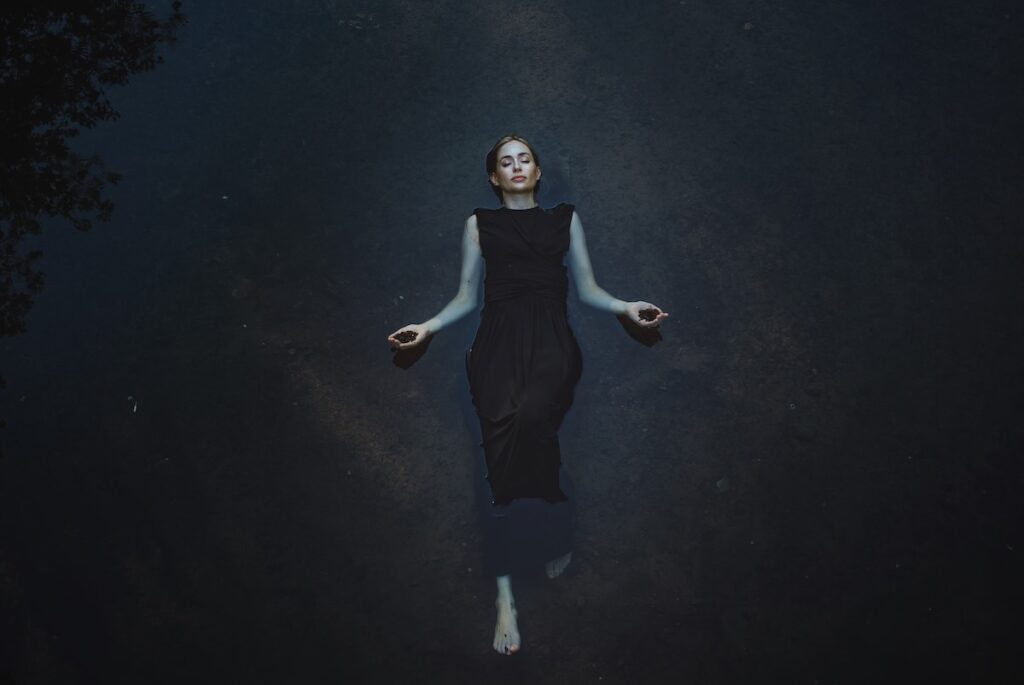
Hildegard often defined emotional space with dramatic contrasts of joyous light or foreboding and even menacing darkness, creating evocative atmospheres that Snider finds distinctly feminine yet undefined. “Maybe it’s what people have historically referred to as ‘witchy’ or casting a spell,” she muses, “but what is feminine and what is masculine? It’s hard to say because all of our notions of what is feminine in music have come from male composers.” Throughout the years, Hildegard’s music has led Snider toward a more expansive concept of gender in musical language, illustrating that sensuality, angularity, precision, and freedom can all coexist.
Both Hildegard’s personal life and Snider’s experience composing HILDEGARD are defined by this paradox of definition and freedom. Despite Hildegard’s theological constraints, her clearly defined musical atmospheres reveal expansive philosophical range. In this millennium, Snider has the freedom to define or abstain from spirituality on her own terms but has still chafed within societal constraints against women. Both composers have found dramatic composition to be an effective vehicle for vast intellectual expression, emotional insight, and personal development.
Like Hildegard, Snider is creating not only an influential body of work but a pedagogical philosophy that empowers others through open vulnerability. “I think it’s good to share these stories of overcoming fears and trying to do something,” says Snider. “Writing HILDEGARD has been a lesson that you can doubt yourself and still get to a place where you’re genuinely happy in a way that you never dream is possible.”
I CARE IF YOU LISTEN is an editorially-independent program of the American Composers Forum, and is made possible thanks to generous donor and institutional support. Opinions expressed are solely those of the author and may not represent the views of ICIYL or ACF.
You can support the work of ICIYL with a tax-deductible gift to ACF. For more on ACF, visit composersforum.org.