Opera Philadelphia’s Complications in Sue is a fun, fantastically stylish, genre-defying work that revels in the unexpected. The co-composed commission emerged from an accelerated creative process conceived by Anthony Roth Constanzo, the celebrated countertenor who joined the opera as General Director and President in 2024, and Justin Vivian Bond. Long-hailed as one of the most influential cabaret artists of their generation, Bond is a Tony‑nominated performer and MacArthur Fellow whose boundary-pushing career has fused theatrical invention with incisive social commentary.
Before the curtains rose on opening night, Constanzo stepped onstage to frame the opera as an “exquisite corpse,” a collaborative game where multiple contributors add parts in sequence without seeing what the others have written or drawn. The assemblage structure is embedded in the libretto by Michael R. Jackson (A Strange Loop), which unfolds in a series of disparate scenes set across ten decades of Sue’s life.
The opera opens on a dark, ritualistic tableau: four figures in black robes and medieval headdresses gather around a black vintage baby carriage to herald Sue’s birth. The mother/death figure, sung expertly on opening night by mezzo-soprano cover Imara Miles and walked by Rehanna Thelwell, delivers a premonitory opener by Errollyn Wallen. This gothic reverie is suddenly interrupted by the arrival of Bond in the aisle costumed in a draped, sheer, glittery dress and a white-feathered showgirl headdress. Bond, playing Sue as a baby, skips up the aisle proclaiming, “It’s my birthday!”
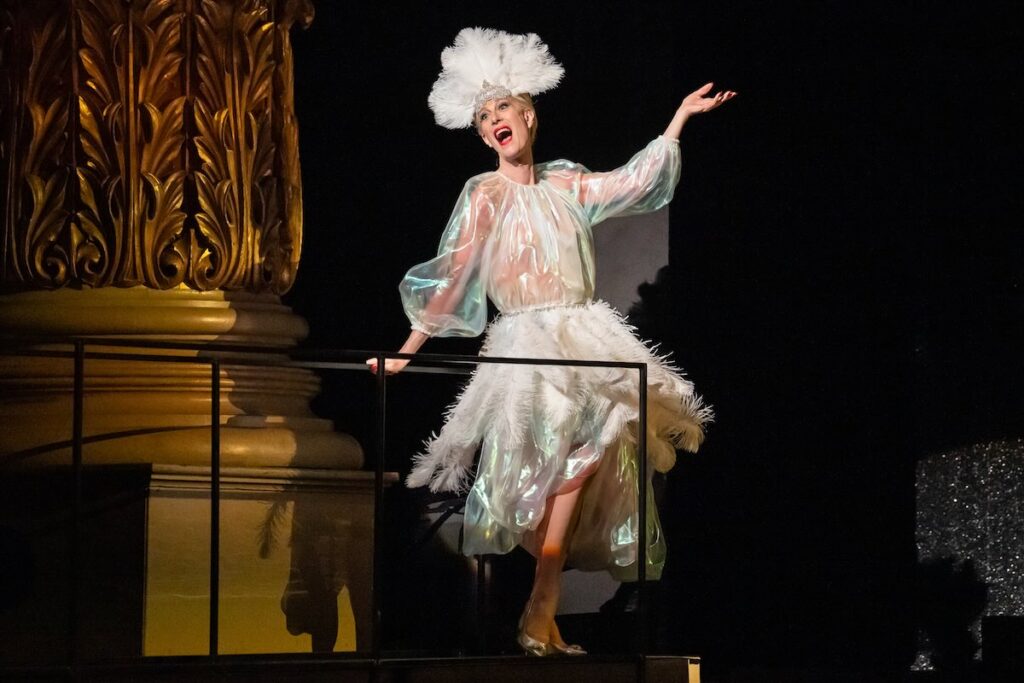
Bond’s entrance instantly reorients the work. Their larger-than-life presence feels both personal and archetypal; they bring to Sue an irrepressible blend of humour, poignancy, and glamorous provocation. How much of the Sue character is based on Bond remains ambiguous; the opera provides only fragmentary vignettes of her life. The character sings just once in the opera, and Bond has one extemporaneous spoken monologue.
The second scene, composed by Missy Mazzoli, is an oddball Christmas vignette: a drab, grey Santa Claus delivers a Christmas dirge ruminating on the adultification of children. Santa’s refrain of “Christmas time / Somebody kill me” drew mirthful laughter as Mrs. Claus chided him to think about the children who still believe in Santa — including Sue. This fleeting glimpse of childhood offers a small brushstroke of innocence amid broader thematic currents; a moment of genuine wistfulness amid the opera’s more acerbic episodes.
Sue’s college years are rendered through Andy Akiho’s neominimalist score, which is rhythmic, witty, and motoric as two classmates seethe with sexual envy while Sue remains mute onstage. Nathalie Joachim’s richly-scored madcap movement turns a TV studio into a dreamlike arena. A TV anchor announces the death of the world’s richest man before pivoting seamlessly to an interview with Sue about her new relationship — and her fear of destroying it. Sue and her boyfriend enact an exaggerated, pantomimed sex scene — one of two camp-inflected sequences that blend absurdist humour with Santa Claus references.
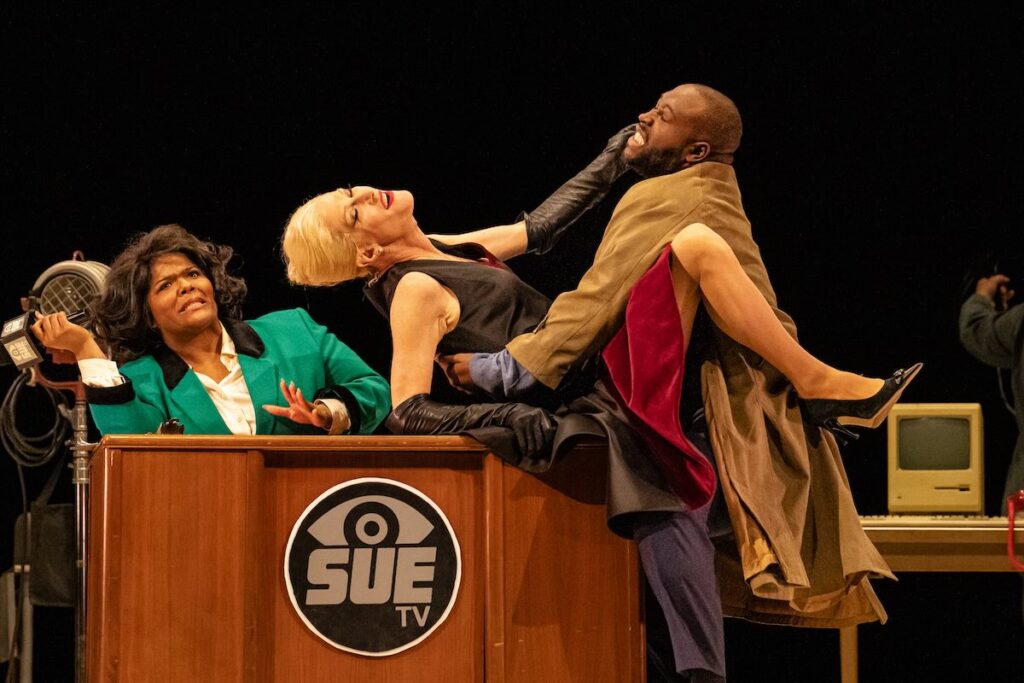
Later, Sue’s now ex-husband calls her from a payphone in a beautifully-written scene scored by Dan Schlosberg, whose music swerves between swing and vintage ‘80s film idioms. This intimate, painful moment is followed in sharp juxtaposition by Cécile McLorin Salvant’s “Algorithm” scene, which bursts into a neon-pink vignette of choreography and design. A glowing checkerboard arrow becomes a cipher for doomscrolling as a trio of singers embodies a social media algorithm with a zombified aesthetic, interrogating the commodification of time, attention, and free thought.
In the next scene by Alistair Coleman, we see Sue in her sixties, living next door to a bloviating neighbour who opines on wokeness and individuality from a paddling pool. Coleman’s aria, sung powerfully by Nicky Spence in his Opera Philadelphia debut, underscores the absurdity of aging in a world dominated by attention-fracturing technologies and social fragmentation. He sings about paying $7 a month to the richest man in the world for free speech.
Sue is finally given a singing voice in Kamala Sankaram’s duet for Sue and her child self, the latter sung by soprano Kiera Duffy. The adult Sue, worn down by life in a “technofeudal gerontocracy,” laments the passage of lost time. In this moment, Sue appears as a statuesque figure — her cool, otherworldly poise and cropped blonde hair resembling Tilda Swinton — that lingers into the opera’s final stretch. Her 87th year — composed by Rene Orth — is a wry reinterpretation of “Bolero,” transformed into a death march supported by a woozy muted trumpet and a venomous duet between bass-baritone Nicholas Newton and Imara Miles. As octogenarians, they try to outrun death, and to outlive Sue, but Sue prevails. The final scene by Nico Muhly features an a capella death quartet that rounds out the work in spare, resonant textures.
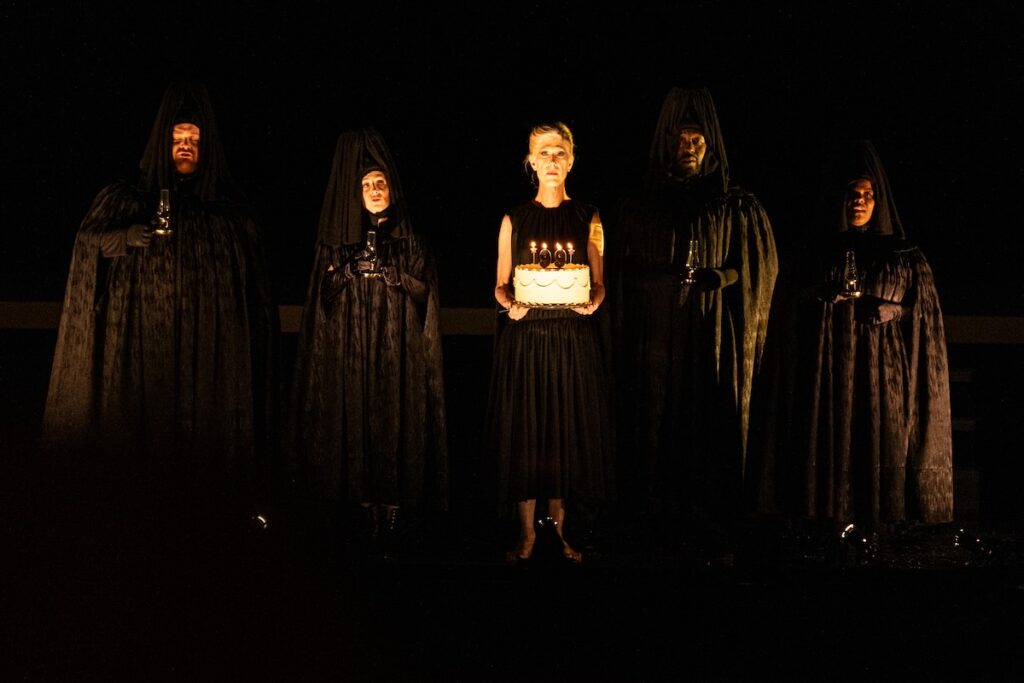
There is something exhilarating about the way Complications in Sue came together: a mosaic of musical styles, theatrical approaches, and creative voices. Though the composers were assigned only the decade of Sue’s life and the performers for whom to write, the shifts in musical palette rarely feel disjointed. Do we know much about Sue by the end of the production? Aside from the few details that are offered about her relationship, she is really a vehicle for social commentary. Despite this, the opera manages a remarkable coherence, buoyed by Jackson’s incisive libretto and a production that embraces both spectacle and critique. In a bold 50th-anniversary celebration, Opera Philadelphia has delivered a work that challenges expectations while affirming contemporary opera’s ability to reflect and interrogate the world around it.
I CARE IF YOU LISTEN is an editorially-independent program of the American Composers Forum, and is made possible thanks to generous donor and institutional support. You can support the work of ICIYL with a tax-deductible gift to ACF. For more on ACF, visit composersforum.org.