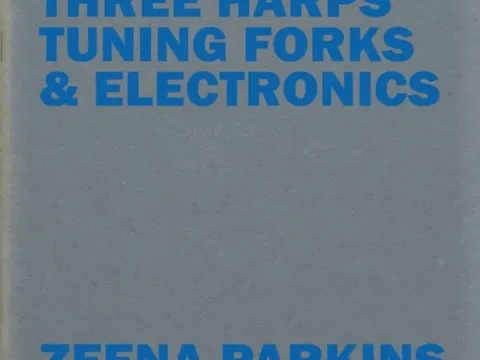
In new music, there is a world of primarily textural music that I sometimes refer to as “creaky door” that historically has just not worked for me. I am not interested in making an overly conservative “where’s the melody” argument, but pieces that fully rely on the deconstruction of how an instrument is traditionally played, without a larger context or development, don’t often leave me feeling terribly engaged. I want to make it clear that I am someone who is usually predisposed to dislike the general approach on Zeena Parkins’ new album, Lament for the Maker (Dec. 2025, Relative Pitch). But despite my musical biases, these are four recordings that I am really in love with.
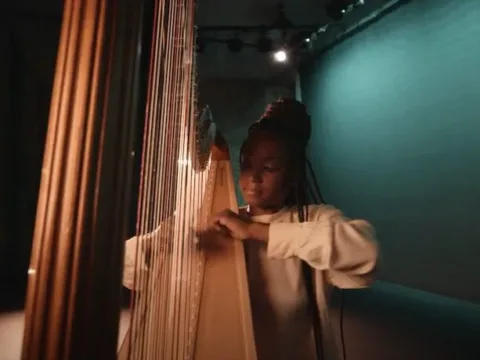
This is music that is almost narrative, that grows and tells a story, which makes sense for this project. Zeena commissioned her colleagues at Mills College to honor its longstanding legacy in contemporary music before it closed its doors and subsequently merged with Northeastern University. What stands out about Lament for the Maker is not just its impressive and earwormy presentation of the vast possibilities that harp and electronics present, but the way the album develops these shifting textures and soundscapes across its 45-minute runtime.
Laetitia Sonami’s She is a Butcher in My Dreams opens the album with a metal creaking, like a gate slowly opening. But where other composers might devote an entire piece to this one sound, Sonami and Parkins create a musical language that folds in and blossoms out of itself. The low hum of that initial ‘creak’ is taken over by electronic hums, over which Parkins employs a wide range of extended techniques like sparse taps and plucks on deadened strings. The final section is primarily electronic and focuses on static-y soundscapes; its relative sparseness makes it feel like an inverse of the track’s opening.
Some of the album’s most melodic moments come at the beginning of John Bischoff’s Pluck, offering a nice palette cleanser from the textural ending of the previous track, and leading well into the electronics that follow. The melodic opening is heavily processed and manipulated through electronics, followed by a section that features electronics and harp in dialogue, rather than one at a time. In that sense, Pluck is a series of presentations and further abstractions of the same material. As the piece goes on, each subsequent section is less connected to the original material than its predecessor, but because the sequence begins with music that is generally untouched by experimentation, each new version reorients our understanding of the base material.
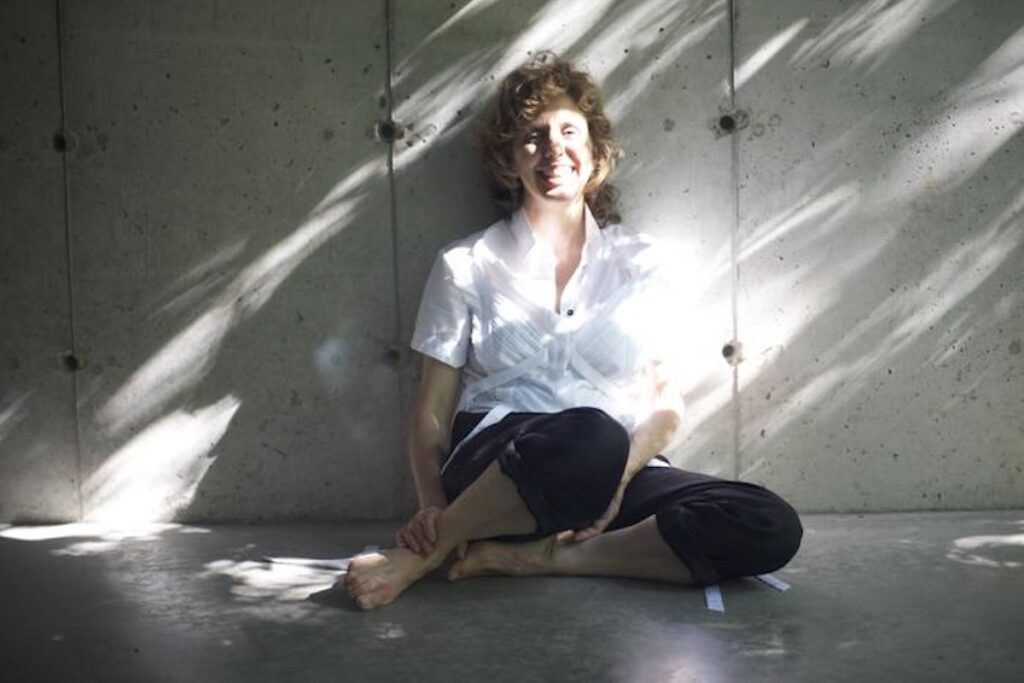
In Such Circumstances of Miscalculations by James Fei finds a middle ground with silence, drones, and long scrapes alongside melodic material punctuated by stabbing chords. Compositions with many disparate ideas can run the risk of feeling overstuffed or so collage-like that it doesn’t read as a unified work. But the collaboration between Fei and Parkins creates something extremely natural, with each new texture unfurling from the decay of whatever came before it. About halfway through the piece, a long silence ends with a series of repeated chords that have an almost gong-like resonance. Knocking sounds interrupt and eventually take over the entire texture before the piece ends with a haunting, cascading melody.
The album closes with Parkins’ own Berlin Bedroom, the latest in an ongoing series of improvisations that intentionally forgo any extra tools to modify the sounds of the harp. Recorded live as part of her final concert at Mills, the performance is based on a buzzing chromatic motif, and every return to that sound is answered by a new texture. Some of the most extreme moments include a buzzsaw rattle from the lowest strings, and the use of softness and sparseness to contrast the bubbling energy of the rest of the piece.
Lament for the Maker is music that balances complete freedom from limitations with strategically implemented restrictions that require out-of-the-box thinking. This might make the album sound like an academic exercise, but this is certainly not the case. In their own way, these pieces are as catchy and melodic as they are experimental, textural, and atonal — and they are a beautiful documentation of a longstanding musical collaboration between colleagues.
I CARE IF YOU LISTEN is an editorially-independent program of the American Composers Forum, and is made possible thanks to generous donor and institutional support. You can support the work of ICIYL with a tax-deductible gift to ACF. For more on ACF, visit composersforum.org.