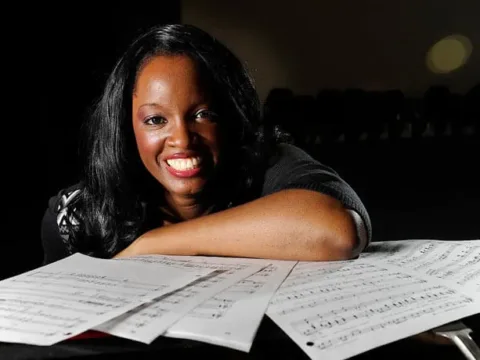
Harriet Tubman’s Electrical Field of Love is a deeply personal album collaboratively written and recorded with Grammy award-winning singer Georgia Anne Muldrow over a multi-day session. On the band’s sixth album (out Mar. 27 on Pi Recordings), the recording process is reflected so clearly in the music itself, which often feels like it is engaging in its own creation — forming, dissolving, and re-forming from a kind of primordial expression.
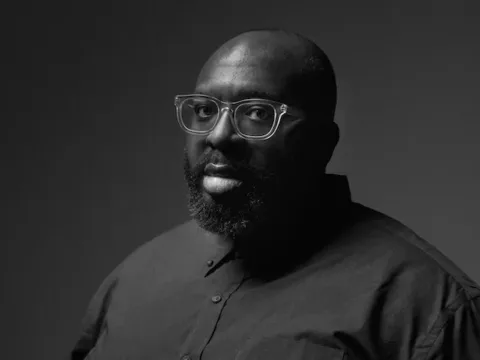
Harriet Tubman is the trio of New York scene veterans Melvin Gibbs (bass), Brandon Ross (guitar), and JT Lewis (drums and percussion). The group’s wide-ranging musical influences draw from a variety of Black musical traditions, but a few specific streams are more identifiable on the album; psychedelic rock, jazz, and funk feature most prominently, but others surface throughout, including hip-hop, soul, metal, and experimental electronica. These sources of musical inspiration are also informed by the politics of Black radicalism referenced by the band’s name, honoring the late abolitionist and social activist.
Like the music itself, the aesthetics of these genres emerge and submerge, even within tracks: an extended analog synthesizer introduction might be paired with distorted guitar, a cascade of avant-jazz drums, and mournful vocals (“Don’t Stand a Chance, After the Boom”). Throughout the track, the group moves seamlessly between improvisatory and more fixed materials, which animate the sense of creation and liveliness at the music’s core.
Other tracks, meanwhile, resemble specific genres more closely, such as the jazz-oriented “A Black Song.” Beginning with a burst of energy, the track is carried by the deftly turbulent, textural, and dynamic drumming work of JT Lewis, shaping and contouring Muldrow’s expressive singing. Later, this sustained energy slowly unravels, growing heavier as the guitar becomes more prominent. Midway through, Muldrow and Ross amplify each other by singing and playing in unison — a particularly striking moment on a record with very few unisons. Muldrow sings: “I can feel” in a descending phrase with a deeply affecting sense of despair, a subdued wail intensified by distorted guitar. But there is also an aliveness that keeps this sadness from overwhelming the music. The polyphonic texture of the ending moments ripples in constant motion, becoming brighter as the song ends.
“Isom Dart Was” leans into funk with an infectious downtempo groove (and particularly Gibbs, whose bass tone is equal parts wet and thick) combined with Muldrow’s soul-infused belting riding over top. In the second half, a strange solo from the guitar takes hold; a playfulness emerges from staccato notes in chromatic patterns and awkwardly long rests. The drums and bass take on a slightly lilting quality in a stream of rolling, slightly uneven triplets. The rhythmic heart of the group is found in Gibbs’ bass playing, which more often provides the groove, freeing Lewis’ drumming and Ross’ guitar playing to move over, under, around, and within the rhythmic pockets he creates.
The danger of an album in this style (group improvisation in the studio, rather than pre-composed and arranged songs) is a tendency to feel erratic or aimless, losing momentum by becoming overly repetitive or too disparate and incoherent. By tackling these difficulties head-on, embracing repetition and wild contrasts, Harriet Tubman and Georgia Anne Muldrow create something wholly unique in the process.
The group’s dynamics are the real basis for how the music comes together, even as it spans a huge range of aesthetics and precludes easy genre designations. Their individual voices shine, but there is also a humility to their approach. They support each other with careful listening, opening the floor and giving space for individual personalities to come forward, each person building bits and pieces of the collective world the music inhabits. There are moments where things lull or disruption takes hold — where the music risks slipping out of visibility and becoming submerged. But the quartet transforms these moments into part of the musical world, too. The result is distinct and emotionally heartfelt as the album enacts grief, love, despair, and wonder in equal measures, while speaking to the history of the Black music that forms its roots.
I CARE IF YOU LISTEN is an editorially-independent program of the American Composers Forum, and is made possible thanks to generous donor and institutional support. You can support the work of ICIYL with a tax-deductible gift to ACF. For more on ACF, visit composersforum.org.