What defines a song? Is it verses, choruses, and bridges organized in a way that builds tension and then releases it? Is it lyrics that tell us about life and all its hope, grief, and messiness? Maybe it’s all of the above, or perhaps it’s something else entirely. One thing is certain: A song is as malleable as it is powerful, a vehicle for bringing us together through the act of listening.
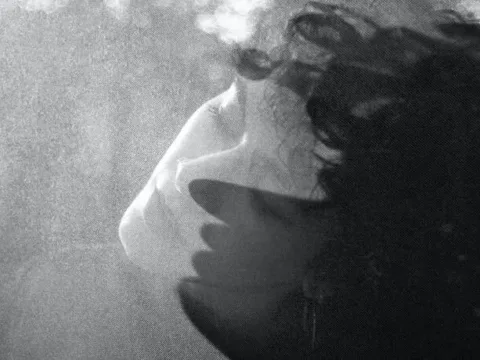
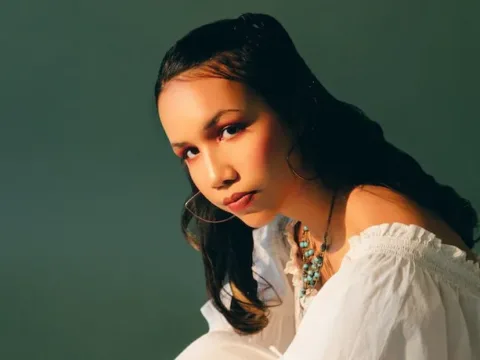
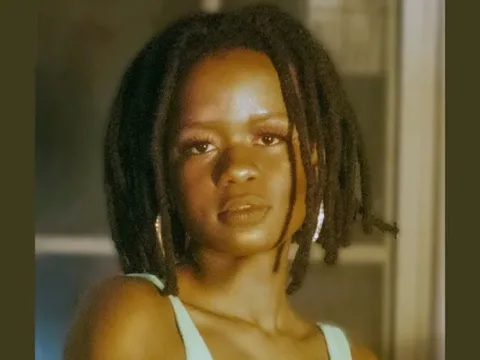
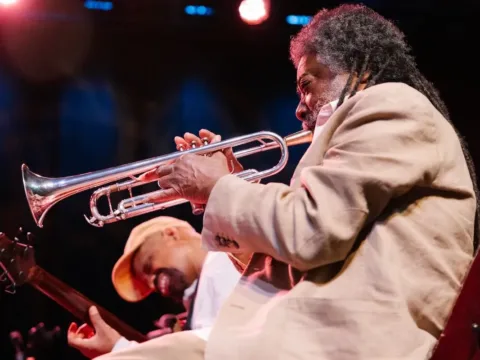
“Luminescence,” a three-day festival that took place at Close Up in the Lower East Side from Feb. 27 – Mar. 1, offered many different perspectives on what it means to write a song. Curated by trombonist and composer Kalia Vandever, the weekend brought together an intergenerational group of artists who upend musical forms or reimagine genre pillars. The highly attended program included multidisciplinary artist Cleo Reed, whose groovy and potent music mixes rap, folk, R&B, and more; Wendy Eisenberg, a singer-songwriter, improviser, and guitarist working across jazz, folk, rock, and experimental music; Toso Toso, a genre-blending band reimagining rock, improvisation, and electronic music; Devon Gates, a bassist, vocalist, and composer whose jazz songs tell stories with effervescence; veteran musicians William Parker and Laraaji; and more.
At its heart, “Luminescence”provided space for intentional listening, motivated by the introspection and innovation of each performance. Throughout the weekend, artists experimented with musical form to spellbinding effect. Wendy Eisenberg kicked off Saturday evening with an intimate solo performance of songs from their forthcoming record, older repertoire, and unreleased music. They played with the attitude of a philosopher and the lightness of a wink, pairing dulcet vocals and virtuosic, rapid licks.
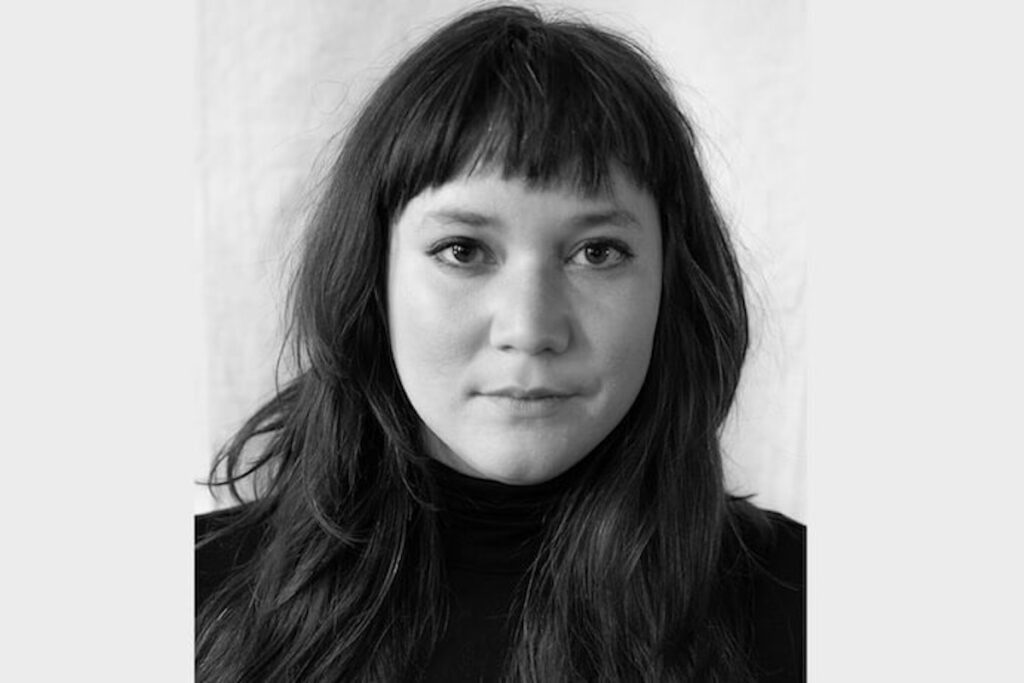
Similarly engrossing was the set from bassist and vocalist Carmen Quill, who performed both solo and with a quintet of musicians comprising clarinetist Kristina Teuschler, violist Dana Lyn, guitarist Ryan El-Solh, and drummer Jason Burger. During her solos, Quill’s diaphanous voice was bolstered by her forceful bass plucks that filled out each whisper (and a mysterious crackle that unexpectedly emanated from her microphone, as if her voice were on vinyl). Most compelling, though, was a song performed with El-Solh and Burger, during which Quill’s bare-bones music came to life in roaring waves of free improvisation. During both Quill and Eisenberg’s sets, the audience listened with great concentration, savoring every melody, riff, and joke told from the stage.
Meditation and attentive listening also proved central to the festival’s exploration of form, exemplified by Jen Shyu and William Parker on Friday and Laraaji and Kalia Vandever on Saturday. Both duos played two unique sets that took on different forms, which provided ample space to play with musical ideas. Shyu and Parker worked with a different set of instruments and lyrics, and Laraaji and Vandever switched from compact forms to looser, more expansive melodies. It was a welcome opportunity to see how artists work through their ideas in real time, and allowed more audience members to experience the performances. In both cases, new, curious listeners streamed into the second set after checking out the venue’s front bar area.
Shyu and Parker’s sets united us through the act of acceptance and communal improvisation. Both sets began with Shyu telling a story about taking a hike, but the details varied each time. During the first set, she travelled along a bridge with a friend; later that evening, she placed her feet into the dirt as water streamed between her toes. In both stories, she asked us what we wanted to receive that night, and we responded with things like love, community, connection, and peace. Parker accompanied Shyu’s words with a whisper from his shakuhachi flute and several double reed instruments as Shyu moved her arms in circles as if she were running her hands through the water.
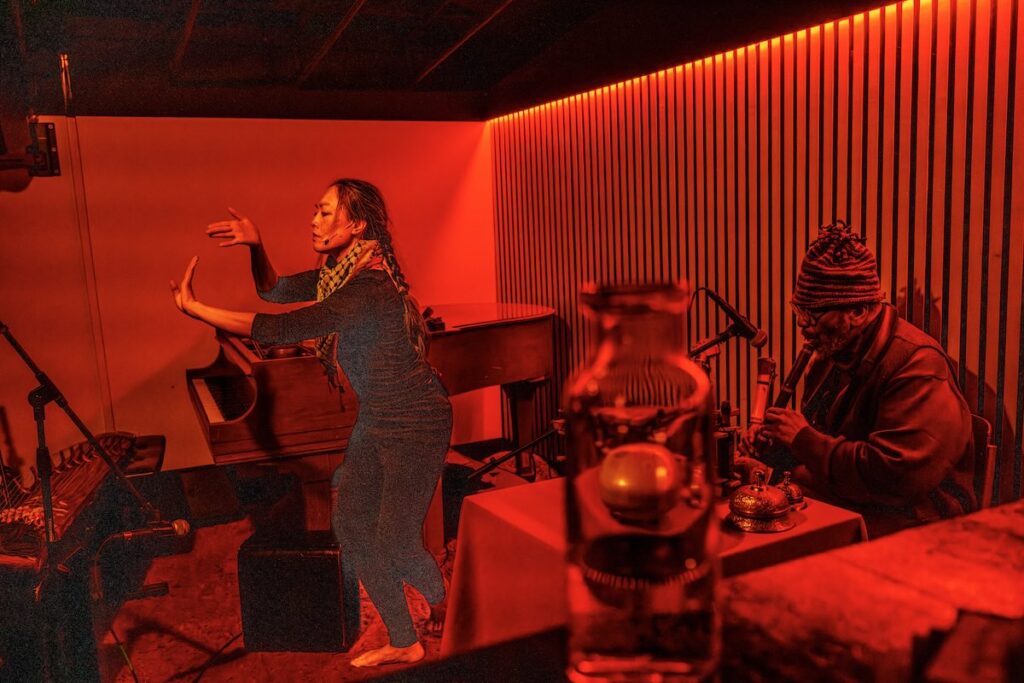
The best moment came during the second set, when Parker plucked, strummed, and ran his bow across his bass, delicately interweaving its many airy textures among Shyu’s ruminative Japanese Biwa. This textural interplay had a cascading effect, mimicking the water Shyu asked us to imagine running between our toes. To close, Shyu asked us what we wanted to surrender; the words anger, fear, and impatience peppered the room, and then we collectively screamed, wishing it away through communal improvisation.
One of the weekend’s highlights was Laraaji and Kalia Vandever’s serene duo sets on Saturday night. Though this was the first time the two musicians had performed together, their on-the-spot songs felt deeply connected as they merged ambient, new age, and jazz. The room became a space for meditation; a recording of chirping crickets wafted through the air from the second we entered, transporting us to nature’s great expanse. The two cycled through different styles, ranging from the signature sound of Laraaji’s sunny autoharp paired with gleaming trombone hums to a fast-paced trombone riff underscored by radiant synths. The pinnacle of both sets came when Laraaji took to the piano for a poignant series of chords that shimmered like a waterfall; Vandever’s trombone glided above with the grace of a swan peddling around a lake. Their music gave space both for listening and healing, again uniting a full audience through free-flowing songs.
At “Luminescence,” the feeling of oneness often came through hushed dynamics and murmured melodies. But on Sunday evening, Toso Toso brought us together in a boisterous, cathartic release. Comprising drummer Kabir Adhiya-Kumar, synth and keyboardist Rahul Carlberg, producer and guitarist Celia Hill, and vocalist Isabel Crespo Pardo, the group presented raucous, ever-evolving music. They were bold and thunderous; their shrieking electronics and propulsive drums, matched with Crespo Pardo’s pliable and fearless voice, shook the space. Crespo Pardo’s performance was particularly impressive, captivating the audience as they seamlessly flowed between singing a ballad and vigorous hisses. The audience cheered and hollered, guiding the group through its jagged shifts. Their energy sent a shockwave through the room, creating a moment of community driven by the feeling of totally letting go.
I CARE IF YOU LISTEN is an editorially-independent program of the American Composers Forum, and is made possible thanks to generous donor and institutional support. You can support the work of ICIYL with a tax-deductible gift to ACF. For more on ACF, visit composersforum.org.