This interview has been lightly edited for clarity.
Flutist and composer Allison Loggins-Hull has always been focused on storytelling. Her projects tend to include history and social commentary, as seen in key collaborations with Julia Bullock and The Metropolitan Museum of Art, Toshi Reagon and Alarm Will Sound, and Castle of our Skins. Those throughlines informed Homeland, her 2018 composition for solo flute inspired by Hurricane Maria, the Syrian refugee crisis, and the killing of Michael Brown in Ferguson. “The piece is just my response to what was just going on in the news at that time, which was a lot of stories of displacement,” she says in our recent interview. “I created a mood board with imagery, and water was a constant theme; I used timbral trills to represent what I feel sounds like troubled waters.”
Homeland not only became a beloved piece in the flute community, but it was the catalyst for Loggins-Hull’s partnership with The Cleveland Orchestra (TCO). In 2021, TCO presented its first COVID-era concert outdoors at the Cozad–Bates House, a historic Underground Railroad landmark. Principal flutist Joshua Smith performed Homeland to an audience that happened to include Music Director Franz Welser-Möst. “Next thing you know, I get a call from Cleveland asking for scores to peruse,” says Loggins-Hull. “I thought they were just considering me for some kind of standalone program. But several weeks later they called and asked if I would like to be the next fellow!”
The Cleveland Orchestra typically awards its Daniel R. Lewis Composer Fellows two years of residency, but they gave Loggins-Hull three years. She proposed reframing the fellowship as a community-embedded practice rather than following the conventional model of restricting musical work within the orchestra.
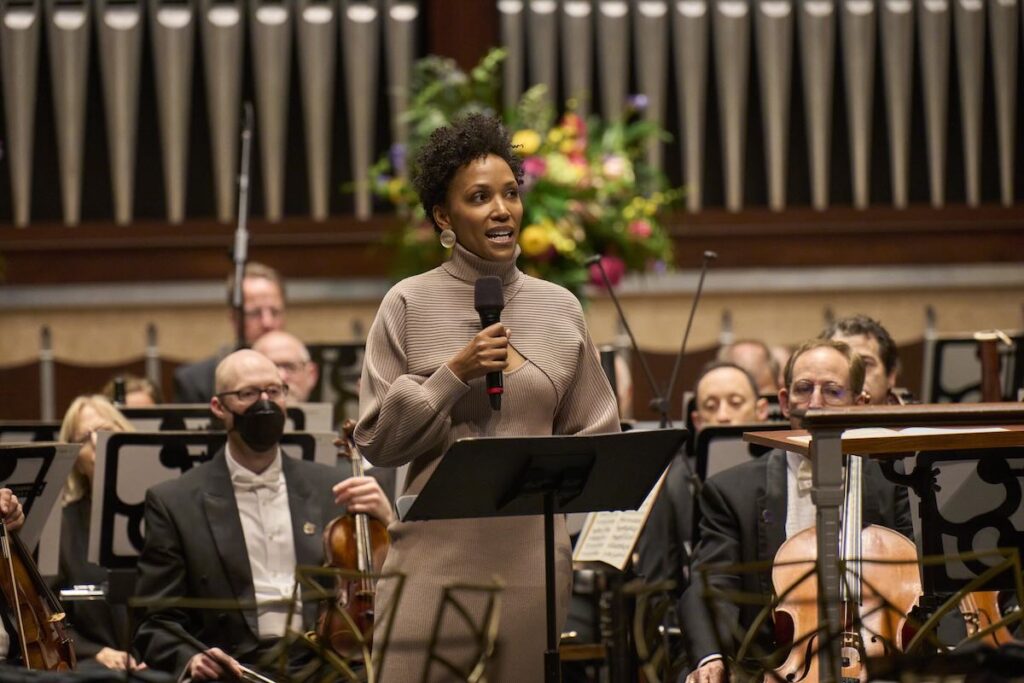
“I found Cleveland intriguing. It’s very modest — but it has a really interesting place in American history, one of the best orchestras in the world, and world-class medical clinics. I was really curious: how did that happen?” She wanted to learn the history of the city with real Clevelanders, and write music that could only be made there. But it takes time to build trust between institutions and local communities, so the organization was enthusiastically on board for an extended fellowship period. “I interfaced with every department,” says Loggins-Hull, “and everybody was game. The musicians, the board, community education — everybody was excited and loves making music. And the concert hall was full!”
Loggins-Hull programmed three concerts for the In-Community Chamber Music Series, which anchored the fellowship. At the Fatima Family Center, a multigenerational community center with after-school programs and a senior choir, the Faith program featured spiritual and gospel orchestral arrangements by Loggins-Hull. Karamu House, America’s oldest Black theatre company with ties to Langston Hughes, presented an interdisciplinary piece by Valerie Coleman for actors and musicians, among other works. And the Ukrainian Bandura Youth Ensemble program Blue and Gold combined classical chamber music with Ukrainian folk song arrangements, featuring the delicate guitar-like bandura that is so significant to Ukrainian history.
The three works that Loggins-Hull composed during her fellowship are documented on Loggins-Hull: The Cleveland Residency (Apr. 17, TCO Media), the orchestra’s first portrait album of a living composer in nearly a century. Her string sextet Legacy is the direct result of her relationships with community partners — and her father’s passing during the fellowship. All three organizations that she collaborated with for the chamber music series had a fierce ethos of preserving tradition across generations. The work weaves gospel scales, blues elements, and cross-rhythms together with the dreamy, harp-like timbre of the bandura and traditional string writing.
These diverse traditions culminated in Loggins-Hull’s cohesive orchestral statement Grit. Grace. Glory. It highlights what Loggins-Hull came to most admire about Cleveland. “There’s a culture of being people who get the job done and are going to do it really, really well,” she says, adding that the city achieves its high standards graciously. The city’s industrial history created a “forward-moving, always-going kind of motion that is palpable.”
And Can You See?, which was originally a piece for chamber ensemble, was expanded into an orchestral piece that blurs and strains familiar melodic material to prompt reflection on corruption, truth, and justice. The Cleveland Orchestra gave the world premiere of the orchestral version, which has its New York City premiere at the New York Philharmonic this month.
A second album, titled Patchwork (May 1, Avie Records), features members of TCO performing chamber works alongside Loggins-Hull on flute and presents a different emotional scope from the fellowship. “I’m always trying to remember or recall what is true,” Loggins-Hull reflects. “This is what happened and here we are; now what?”
The Pattern, inspired by Ta-Nehisi Coates’ charge to start with honest reporting, traces the arc from slavery through the Civil War, Jim Crow, and Civil Rights Movement, providing a musical mirror as the chamber music mimics unbroken setbacks to progress. Kalief for clarinet and piano tells the story of Kalief Browder, the teenager who died by suicide after his wrongful imprisonment and solitary confinement in Rikers Island. Loggins-Hull sets a wailing clarinet as a heartbreaking, isolated voice. But she refuses despair: Shine closes the album with a tribute to resilience and hope amid struggle, featuring text by Zimbabwean-American poet U-Meleni Mhlaba-Adebo. The work’s driving energy and interplay between soprano Laquita Mitchell and Loggins-Hull on flute honors ancestral light carried through the generations.
Since completing her fellowship with TCO in May 2025, Loggins-Hull has kept moving. She is in residence at Spoleto Festival 2026; an upcoming song cycle Friction continues her ongoing collaboration with Roomful of Teeth; and she is regularly playing with Jessie Montgomery’s The Everything Band. But she attributes most of her successes to friendships that have formed over decades of work. She encourages early-career composers to think in terms of reciprocal artistic communities that support an ecosystem. “It’s how you show up and contribute to the bigger picture. We’re all trying to do what we’re all trying to do, and it really is a thing that is much easier to do if you have your people. It’s way more fun… way more human.”
I CARE IF YOU LISTEN is an editorially-independent program of the American Composers Forum, and is made possible thanks to generous donor and institutional support. You can support the work of ICIYL with a tax-deductible gift to ACF. For more on ACF, visit composersforum.org.