“One might describe [my style] as a patchwork: you can really find the seams when you’re browsing through the embroidery,” Kavyesh Kaviraj told me over Zoom. “It’s pretty similar to what I feel like as a human being; I wear all my influences on my sleeve, and I sort of move between them as I please.”
The composer, arranger, and pianist was raised in a cosmopolitan musical culture as the son of Malayali Indian parents in Oman. Growing up, Kavy remembers sitting on his father’s lap and watching him teach Carnatic music lessons. He began studying piano at age two, he encountered Hindustani and Western classical music at school, and he was introduced to Bollywood and bubblegum pop through music swaps with friends.
“I was listening to anything I could find,” he recalls. “At the same time, I was trying to understand and learn Western classical music…but growing up in the Middle East, there is a sort of belonging that you lack.”
This cultural and historical disconnect evaporated when Kavy first discovered jazz through YouTube around age 18 or 19. He immediately recognized improvisation as the commonality between jazz, Carnatic, and Hindustani music, and everything clicked. “I was able to bring all the musical worlds that I enjoyed in one place,” he told me. “Jazz unlocks a lot of that freedom, creativity, and improvisation that I wasn’t able to find elsewhere. So, I made it a mission to find out how to do that.”
Kavy arrived in the United States in 2016 and studied jazz at Columbia College Chicago and Berklee College’s Global Jazz Institute. After receiving his master’s degree, he made the Twin Cities his home and joined the teaching faculty of Walker|West Music Academy.
Founded in 1988 by Reverend Carl Walker and Grant West, the community music school has become a pillar of St. Paul’s African American Rondo neighborhood. Rooted in the philosophy that music is a method of personal and communal expression, Rev. Walker and West recognized their role in providing a haven for children in a community debilitated by urban “progress” and crime.
“Grant West talks about teaching a student and looking out the window and seeing a big police bus go down [the street], and the student kept playing and never noticed it,” Walker|West Advancement Director Khamara Pettus recalled via Zoom. “He knew that they were doing good work and that they should continue.”
And continue it has. Recently moved into their new 18,000 square-foot building on Marshall Avenue, Walker|West continues to be a model of creativity, community, and Afrocentric music education in the greater Twin Cities region. But students aren’t the only ones who have found safety and community at Walker|West. Ernest Bisong, a violinist and teaching artist in upper strings, digital music, and jazz violin, told me that the academy is a place where musicians — citizen and immigrant — can develop their craft and share it with the younger generation.
“Walker|West has always been at the forefront of absorbing talent,” Ernest explained, “especially talent that wasn’t exactly from Rondo, but that was from outside of the country that really knew what they were doing.”
Kavy and Ernest connected as fellow immigrants and eager artists; now they are not only colleagues, but collaborators on a new composition Kavy is writing for Walker|West that will premiere on Jun. 3. Commissioned by American Composers Forum, Sanctuary is a five-movement suite for voice, jazz trio, and string quartet. Episodic in structure, the piece has four prominent leitmotifs: “Hope,” “Loss,” “Anxiety” and “Sacrifice,” evoking shared aspects of immigrants’ experiences that transcend origin points and destinations.
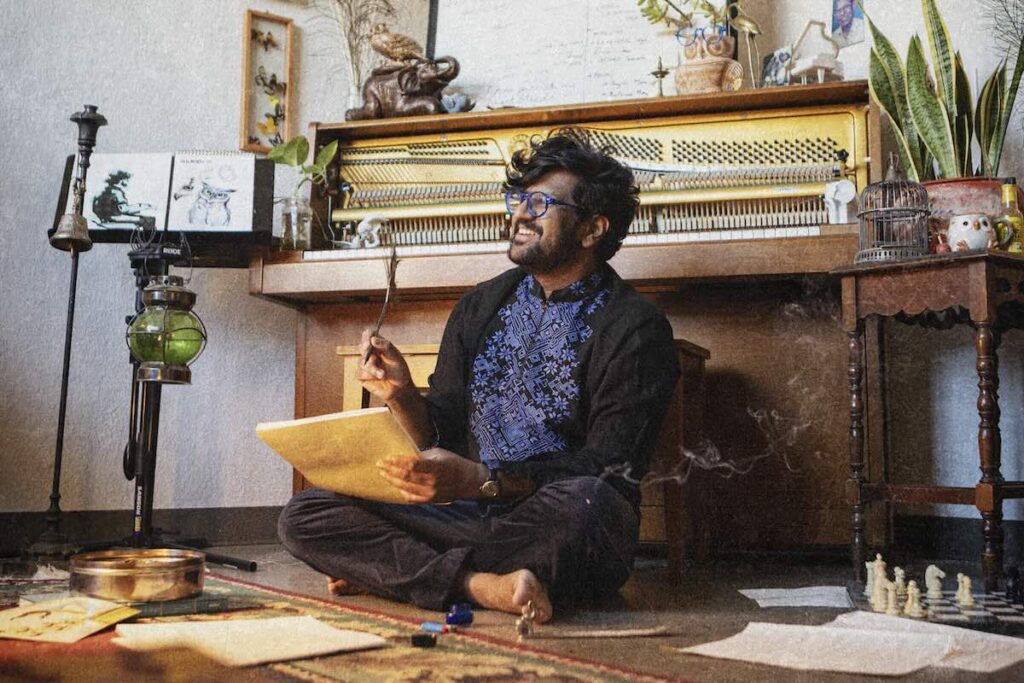
“This is 10 years that I’ve been in America,” Kavy shared. “Almost every immigrant has commonalities in their story, of how they come to be, find sanctuary, find safety, have anguish, have great struggle, have really trying times, but also sacrifice. And one will find that these are common struggles to all human beings. And it’s not just that we’re different because we moved. We’re all still made of the same fabric of humanity.”
In a country that is once again failing its founding purpose, where xenophobia has re-emerged as a pretext for state-sanctioned violence— there are people like Kavy who do not see difference as a deficit. His work affirms that the experiences, cultures, and perspectives of immigrants should never be buried, blurred, or tossed aside. It is no small thing to have the courage to make a home where you choose, regardless of assured success. People who are that brave are not a drain on society; they are living examples of humanity’s vitality, tenacity, and fortitude.
“Telling the story might be very important in this moment to know what it’s like to move and not have a net to fall into. It’s the story of my father when he moved to Oman, and it’s my story when I moved here. It’s the story of my neighbors and my colleagues and students and families that I know. It’s a story that I’m quite familiar with, so I made it a point to be as honest as I can.”
For 100+ years, composers, critics, and performers have bemoaned the lack of a “singular” American sound, disregarding the fact homogeneity undermines people’s creative abilities. For Kavy, it’s a given that he will draw upon all of the music that has informed his life. By utilizing idioms from jazz, Carnatic, Hindustani, and world music, he’s woven a personal style that is nonetheless rooted in the place he now calls home.
His goal to seamlessly blend his musical influences is not a matter of hiding or assimilation: it is an articulation of the lived multiplicity that he and millions of others carry within them. Through Sanctuary and more, Kavy shows us how music reflects the freedom that is routinely found in the diversity of one’s life.
I CARE IF YOU LISTEN is an editorially-independent program of the American Composers Forum, and is made possible thanks to generous donor and institutional support. You can support the work of ICIYL with a tax-deductible gift to ACF. For more on ACF, visit composersforum.org.