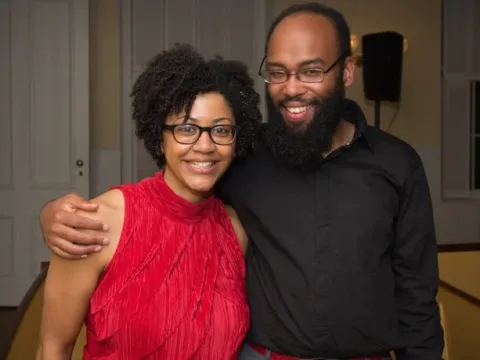
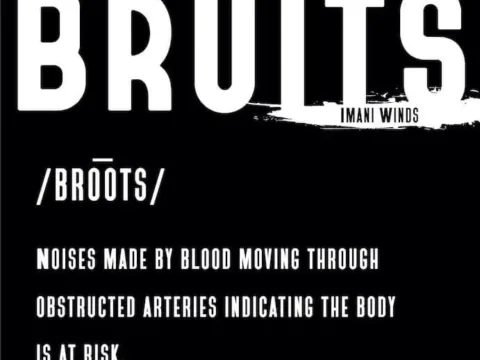
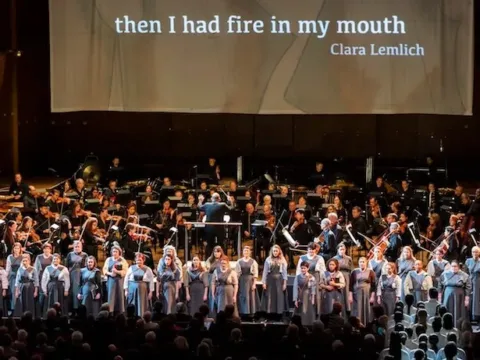
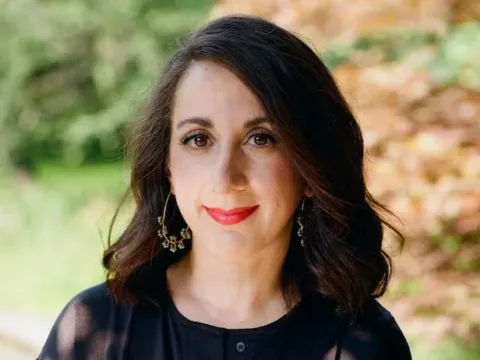
With Project Poetic Justice, artist and activist Ryan Alexander combines his passion for social justice education and his training in composition to create a musical community inside the DC Jail. Over the course of ten weeks, incarcerated young adults are invited to write poetry, compose music, and showcase their work in two concerts: one held inside the jail for the creators themselves, and one performed outside the jail, which the creators’ loved ones can attend.
Now in its second year, the project is supported by volunteer educators from Johns Hopkins University and the Peabody Institute as well as donations from members of the public. Participants in Project Poetic Justice appreciate the catharsis of composition: “Being able to write on a piece of paper and just write out thoughts or just write creative things helped me release a lot of inside anger that I have, anxiety also,” a participant named Tomar told a local news outlet. Participation in the program has improved the young men’s conditions, too: one participant, Shane, had a portion of his sentence waived due to his participation in the program.
Alexander is modest about the potential impact of the short program; his goal is not immediate change, but rather, to plant a seed of musical aspiration in participants’ lives. Yet, in a country where we characterize Black children as ‘superpredators’ and stutter to even say their lives matter, there is something profound about centering the artistry of Black young men in jail and sharing it with the world. Project Poetic Justice reminds us that music is and has always been a tool of liberation.
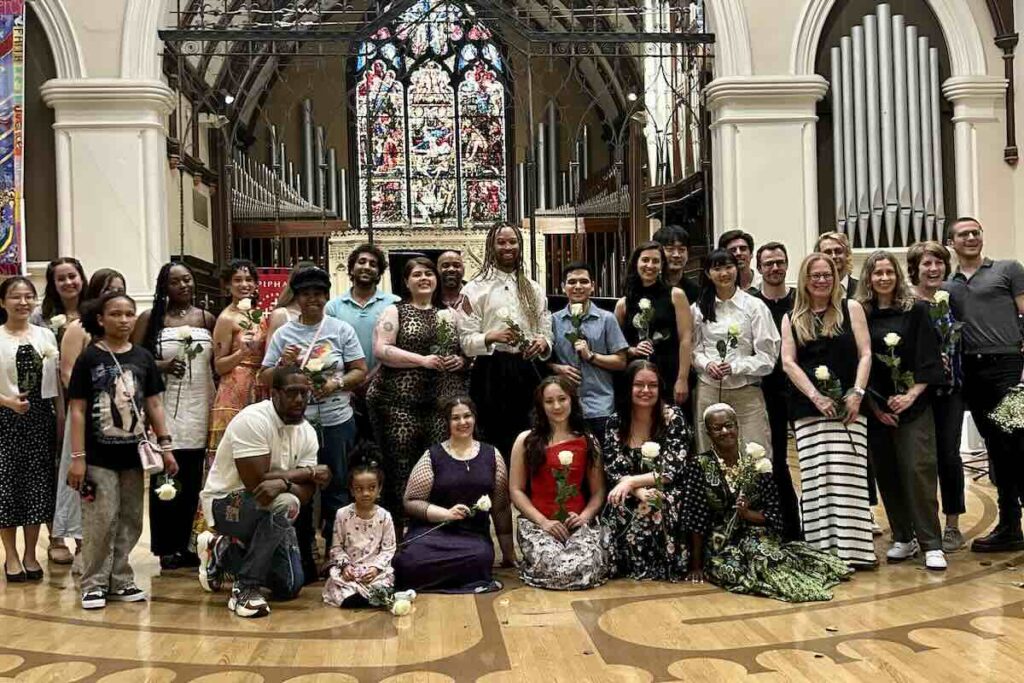
Project Poetic Justice 2026 will receive a private performance at the DC Jail on May 1 and a public performance at Busboys and Poets (450 K St NW) on May 2. We caught up with Alexander before the performances to learn more about the program.
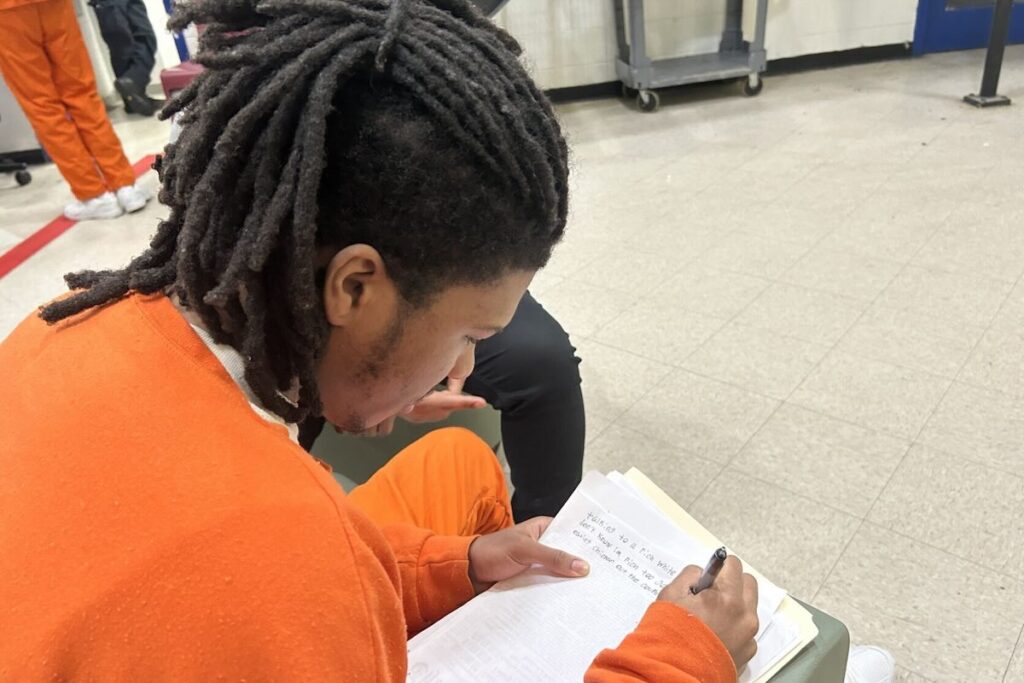
Tell us more about the incarcerated young people participating in Project Poetic Justice. Who chooses to participate in this creative cohort and what motivates them?
First, our participants are curious, passionate, eager, and honest. During our inaugural year, PPJ worked with 18-24 year olds; however, this year we’ve expanded to work with and beyond this age group. Now we invite scholars of all ages to try their hand at poetry and learn more about musical composition. PPJ’s aim is inclusivity and we work with any resident, regardless of their custody level (e.g. minimum, medium, maximum).
Working in carceral spaces brings a level of uncertainty to each session. Sometimes a poet just returned from court and needs the evening to process. Sometimes an opportunity to blow off steam in the gym falls at the same time as weekly programming. As a result, the “cohort” is ever-changing. This year we work on two units with a total of over 50 residents. Instead of an application process, we invite all to participate in whatever form that takes. Are you curious to join for one session to learn about metaphors? Sounds great! Have you already written your own poems and prefer to only participate when composers visit the jail? Awesome!
This approach allows for a self-selection process, while also creating a sense of communal respect for the program. By the third week, it’s clear who wants to participate. This year, about 30 out of 50 eligible residents chose to engage. As for what motivates our participants? To me, the primary impetus is human connection. Some of our participants are limited to video visitation. This means they have zero in-person visitation for the duration of their stay at the jail. The opportunity to learn from an outsider who isn’t an attorney or doesn’t work for the jail may be rare. Our participants are eager to have their voices heard, share their stories, and shift public perceptions of incarceration.
How would you describe the array of musical and poetic styles that cohort participants explore through their compositions?
Since this program is condensed – once per week for only ten weeks – much of the experience is rapid fire. As a result, the program leans on the inherent talents of our participants. I think there’s an unfortunate assumption that incarcerated individuals are distrustful of outsiders; that’s not been my experience. Both years, participants are quick to show off their skills – breaking out folders of fictional stories, poems, heartfelt letters to loved ones, and more. With a little ice breaking, it doesn’t take long to get folks singing, rapping, clapping, and experimenting with instruments. All that to say, the ingredients for incredible poetry and music are there day one.
With the assistance of Poetry Teaching Artists from the Johns Hopkins Writing Seminars, we’re able to formalize things a bit. Participants explore some of the basics, from metaphors to concepts like poetic form. Much of the poetry is free verse or composed with a fairly straight forward rhyme scheme (i.e. AABB, ABAB, etc.). Participants benefit from access to a virtual course in which we house sample music, poetry examples, and supplementary materials for those who want to push their work further. At the end of the day, we believe that poetry is for everyone regardless of prior knowledge.
As for the music, there are no boundaries in terms of genre or form, so long as the poet/composer pairs are in alignment. Our Resident Composer cohort is incredibly diverse and well-rounded this year, so the participants are in good hands. We are limited a bit on how many instruments and what equipment we can bring into the facility, so we tend to keep it relatively simple – mp3 files, a digital piano, synthesizers, snare drums, amps, mics, and the like.
In 2025, most of the participants wanted someone else to perform their works, so many of the compositions were classical-adjacent and ultimately performed by hired singers and instrumentalists – some ventured into the pop and experimental realms. This year, things are taking on a life of their own. Some of the poets want to perform their own works as spoken word or rap compositions in collaboration with our staffed pianist and/or backing tracks. It’s all very exciting to see where this project could and is going.
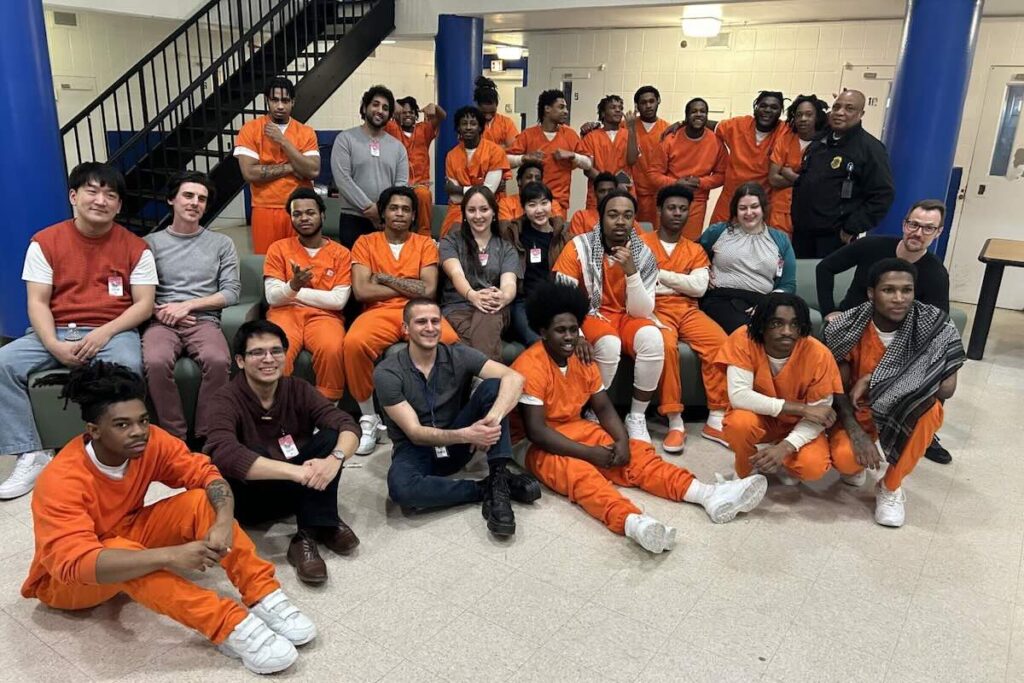
How have you observed the participants’ relationship to music changing over the course of their 10 weeks in Project Poetic Justice?
What I’ve noticed with regard to participants’ relationship to music is that their confidence and willingness to take risks shifts dramatically over the weeks. Residents who don’t necessarily consider themselves poets or performers take on a new identity, claiming ownership over their work in incredibly special ways. For example, a current participant who I’ll refer to as “T” was pretty resistant to the entire process. He didn’t really give me an ultimatum, but it was clear that if I was willing to write a note to his judge evidencing his participation that he might try jotting down some verses.
Five weeks later, and “T” is performing during the closing ceremony over a track produced by current composer in residence Nuburooj Khattak. It’s this sort of exercise in building trust, sticking to your word, and meeting residents where they’re at that results in a deeper bond and buy-in to the program. It’s also the smaller, human moments. That same composer was visiting the jail when the Muslim call to prayer took place on the unit. Him stepping aside from the project and praying with the participants is the sort of moment that cannot be anticipated. It’s those interactions that build relationships and shatter preconceived notions.
It takes open and eager resident artists like Nuburooj to inspire the transformation we see in our participants. That’s why PPJ is so intentional with who we hire, from composers to poets to instrumentalists. We want individuals who represent the inclusive, communal side of art making. This approach creates a judgement free zone in which participants can set down any insecurities and try something new.
Project Poetic Justice is based in the DC Jail, which is notorious for its markedly dangerous conditions: in 2025, the jail’s death rate was 3.5 times higher than the national average. How does participation in Project Poetic Justice help these young men navigate the stark circumstances of their incarceration?
Having worked as the college administrator for the DC Department of Corrections, as well as a special educator within jail and secure mental health facility environments, I’ve thought a lot about what programs can and should do for their participants.
A) It can’t be overstated how desperately our country needs to reconsider our approach to rehabilitation. Even if the DC Jail had zero deaths per year, the reality is that residents face dehumanization daily. And B) jails are highly transient spaces, so oftentimes programming is relatively short-term (i.e. six weeks, ten weeks, or one semester). Though this increases a participant’s chances of completing a program, it typically limits the ability for a given program to have a consistent role in these individuals’ lives. Thus, each session and its impact is critical.
All that to say – I’ve adopted a motto championed by My Block, My Hood, My City founder Jahmal Cole: exposure is key. Of course I think that Project Poetic Justice has an immediate and lasting impact on the lives of our participants – bringing joy, excitement, and possibility into an otherwise stagnant environment. What we really do, however, is expose participants to a broad range of skills and ideas. We equip students with the literary know-how to express their feelings and experiences, we demystify the process of song creation, we bolster interpersonal skills, we expect accountability and transparency, we expand participants’ social and professional networks.
These are the true “skills” or guideposts that ideally help these men navigate their current reality. When the going gets or remains tough, it is my hope that they can reflect on these experiences and persevere in a meaningful and productive way.
How has working with incarcerated youth changed your own artistic practice?
I had a teacher, Randall Scarlata at Peabody, who observed me during my voice lessons and remarked on my visible rigidity and frustration: “you know, if you just let go a bit you might surprise yourself.” It’s a pretty simple statement; however, I think it’s something we lose with age — the willingness or ability to invite surprise into our lives.
Fast-forward through some difficult months, and I decided to test drive my MM recital at the DC Jail. I recruited 40+ residents from male and female housing units who had effectively no idea what they were signing up for. As the date drew nearer, I started to worry. A program featuring Libby Larsen, Hanns Eisler, Sarah Kirkland Snider, Canticles I and III by Britten? Maybe not the most relevant or accessible set for this audience. It was too late to back out.
I’m not sure if it was the group of women following the German text and somehow singing along to the not-so-tonally-centered Eisler set or the group of men glued to the edge of their seats throughout all of Canticle I – echoes of “That I my best beloved’s am…that he is mine…” flitting through the room – but I was for lack of a better word…surprised. Not only by the audience, but also the freedom in my singing. This performance is what birthed PPJ and instilled in me a desire to rethink my artistic path.
It’s really the same with the men in PPJ. They inspire me and force me to rethink the world around me. Working in spaces – whether physical or mental – of inherent, deep struggle is both profoundly painful yet necessary. It breaks down barriers, foregrounds humanity, and allows for honest artistry. As a result of working with individuals experiencing incarceration, I feel less bound to any singular trajectory or outcome with regard to my career … it’s exciting to embrace the messiness tied up with this work.
Additional links:
Please consider donating toward this project via this GoFundMe Campaign.
If you would like to attend the free or by-donation event on May 2nd, 2026 at 450 K Street NW, Washington, DC, reserve a ticket here! This concert and panel event features music created by PPJ’s current cohort, as well as a dynamic panel discussion on the importance of arts programming in carceral spaces.
I CARE IF YOU LISTEN is an editorially-independent program of the American Composers Forum, and is made possible thanks to generous donor and institutional support. You can support the work of ICIYL with a tax-deductible gift to ACF. For more on ACF, visit composersforum.org.