The music of experimental composer Bergrún Snæbjörnsdóttir is surprisingly organic and elemental; equal parts methodical and curious, she constructs slowly evolving soundscapes from breath, metallic resonances, and reedy textures. Swelling long tones form undulating timbral conversations, sometimes at a whisper, and other times cacophonous. And if you’re lucky enough to hear her compositions performed live, they become rich multisensory experiences replete with lighting, fog, and viscerally embodied vibrations.
If Bergrún’s name is on the program, you’re guaranteed to hear something novel: a new instrumental technique, a unique combination of timbres, or a recorded sample that has been electronically processed beyond recognition. She has honed a distinct artistic voice while also routinely offering up ideas that feel fresh and engaging — an increasingly difficult feat in our internet age of endless access and cross-pollination.
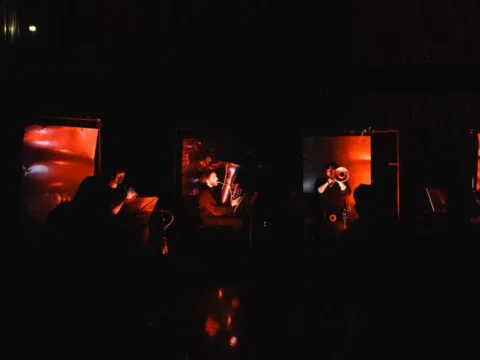
I’ve had two memorable encounters with her work recently. In January at Iceland’s Dark Music Days festival, Apparat ensemble gave the world premiere of Intraloper. The work for brass quartet, thundersheets, and live electronics grew from ideas about climate anxiety and claustrophobia, and has since been named a nominee for the 2026 Nordic Council Music Prize. And in March, Norway’s Borealis festival featured a performance of Roföldur for contrabass clarinet, soprano recorder, and tape. Co-composed with frequent collaborator John McCowen using the Acousmonium multichannel sound system at INA grm, the piece is an attempt to “shake John loose” from the restraints of the contrabass clarinet.
In her eclectic career, Bergrún has been commissioned by International Contemporary Ensemble, Iceland Symphony Orchestra, and SPOR Festival; she has toured with Björk and Sigur Rós; and she was appointed assistant professor of composition at the Iceland University of the Arts in 2022. In the middle of a busy season, we caught up with Bergrún to delve into her creative practice.
What is your process for discovering the fascinating textres and timbres that appear in your compositions?
I identify strongly with the notion of noise as a cleansing force and a great equalizer, sweeping away dirt. Pure tonality and harmony, in the classical sense, can feel so utopian that they almost alienate me with the perfection and control they demand. This probably ties back to my background in classical instrumental training. I had the typical experience of being told there was only one correct way of producing sound, and that anything deviating from this ideal was somehow lesser, or not worth pursuing.
I found it incredibly difficult to reconcile myself with that way of practicing music, and it pushed me in the opposite compositional direction. Very soon after starting to compose I began working with graphic notation and extended techniques, thinking constantly about how to create the right space for free will and chance within the scores I was making. But put simply, I’m interested in exploring what might have been considered “wrong playing” in 1880.
To this day, I still often resist scoring things conventionally because I feel some disconnection from established formats. I also find rhythm difficult to deal with for similar reasons as listed above, if used I like halting rhythms, perhaps slightly imperfect and stumbling — attempting to.
Before I write anything down, though, I spend a great deal of time thinking, imagining, reading, and writing around whatever I’m focused on at the time. I almost never begin composing without first trying to understand as fully as possible why I’m making the work. Often an imagined sound that insists will lead the process as well. By the time I start writing something for performers to follow on paper, the piece already exists as an idea, a system, or a syntax; I simply have to fill in the unheard with what can be heard. That usually happens quite late in the process. I’m not sure whether this fully answers the question, but it certainly lives nearby.
Your music rewards patient listening. How do you consider time and duration when you’re creating a new work, and did studying with Pauline Oliveros influence this approach at all?
My fascination with durational work and durational listening coincided with discovering meditation practice when I was around twenty-two years old. Around that time, David Lynch had arrived in Reykjavík after the Icelandic banking collapse, bringing with him the idea that Transcendental Meditation might somehow save us all. I had been doing some guided meditation tapes before then, but I connected with this deeper way of practicing, it fundamentally changed me.
At roughly the same time, I was discovering Alvin Lucier — especially Music on a Long Thin Wire — and shortly thereafter, Pauline Oliveros. In Alvin, and Pauline’s listening and scoring praxis I found something primal I had been searching for and really related to. It was Pauline’s power, mainly, that eventually led me to Mills College, where she was teaching, and that opened up for me adjacent composers and ways of composing.
Meditation is something I lose and return to periodically, but I always miss it when it’s absent from my life. Sometimes I feel that, in the end, this is what all my work is really about: the attempt to attain a still, vibrating mind, and everything that happens surrounding that want.
Your interviews reveal deep inquiry behind your compositions, and yet the recent performances of your works at Dark Music Days and Borealis had little context in the program. Do you find it helpful for listeners to have insight into your creative intentions, or can program notes become too prescriptive?
I wouldn’t say the absence of program notes for those works was entirely intentional, but I do often struggle to find the right balance — both in tone and in amount — when speaking about my work.
This may connect back to the meditative aspect I mentioned earlier, as well as the kind of space I try to create within the work itself. Ideally I want performers to have a degree of interpretative freedom, and I want audiences to listen fully and inhabit the space through their own experience. I’m not interested in too much hand-holding through program notes, let alone to preach a message.
That said, they can absolutely be helpful when I find the right thing to say. I write while composing — reflections on feelings, states of mind, and ideas surrounding the work — but I’m rarely inclined to share those texts directly. They primarily serve as tools for understanding the work for myself, and I still like to keep that language and the sounds somewhat separate.
As an educator, what feels important to impart to young composers now that differs from when you were in school?
I love this question because I wouldn’t say I encountered a lot of institutional understanding when I first began composing experimental music. I struggled to connect with the traditions that were handed down to me from earlier eras — traditions that are certainly useful and practical in many contexts — and instead I relied heavily on the outsider composer community, particularly S.L.Á.T.U.R, to experience validation and the freedom to create without fear of making mistakes.
Because of that, it now feels extremely important to support students who may have unusual or emerging ways of thinking and creating. I want students who are experimenting to feel seen, and to feel they have permission to pursue any idea as far as they wish to take it.
I also think it’s essential to allow students to discover the limits of their ideas for themselves — not to predict for them in advance what can or cannot be done. People learn enormously through experimentation and failure. More often than not, they find a way forward and arrive somewhere surprising, having realized something new. Ideally, I have not stood in their way while they were getting there, but helped hold the door a little more open.
What ideas and sonic explorations are exciting you as you make your way around the international circuit of experimental music festivals?
Lately, I’ve been slowly steeping more in reading and thinking about deep ecology, ecosophy and the like. I have loved science fiction since I was a child, which still has a hold on me to this day. Looking at life from afar or from within, and entering a state of imagined understandings about how exchanges between living things, dead things, and everything in between work — none of it correct, all of it only felt within, yet deeply interesting to me and my senses. The way systems regulate, states of being, and the relentless intermediary states of everything, all the time, fascinates me, and this is what I write about a lot.
At the moment, it’s difficult for me to articulate exactly how this translates into sound, though somehow it inevitably does — usually at the point when I no longer have a choice but to commit. It almost feels dependent on the chance of the moment, on sensing what needs to happen. But when the answer arrives, the system — or the structure of thought behind the work — is already there to receive it. It becomes a matter of sitting quietly for long enough.
I CARE IF YOU LISTEN is an editorially-independent program of the American Composers Forum, and is made possible thanks to generous donor and institutional support. You can support the work of ICIYL with a tax-deductible gift to ACF. For more on ACF, visit composersforum.org.