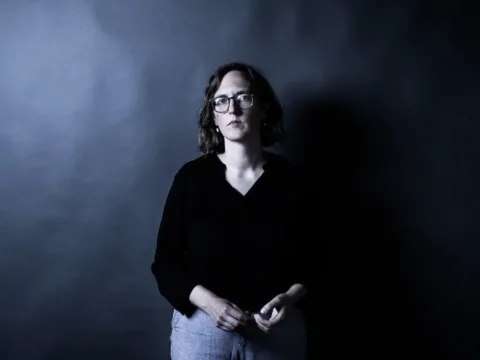
Though air hangs all around us, it’s usually imperceptible. But when it moves, we hear it. A gale rustles the leaves, yielding a bristling crunch; a gentle breeze swirls in the atmosphere, leaving a faint hum in its wake. Like the shifting winds, TAK Ensemble’s virtuosic performances are in a constant state of change. Over the last 13 years, the group has established themselves as adventurers, having premiered hundreds of new pieces that embrace the unexpected.
Between the Air, their latest and eighth album, exemplifies this spirit of experimentation. The album of musical extremes foregrounds texture, using many extended techniques and the full spectrum of timbres and pitches possible on the mixed-quintet’s instruments. But while much of Between the Air explores the unruliness of sound, its power lies in how each work colors silence with the understated nature of air itself.
The five pieces on Between the Air were composed for TAK ensemble over the last seven years and reflect deep, collaborative relationships between the composers and performers. Each showcases a wide range of dynamics and pitches that switch on a dime, highlighting the group’s flexibility and meticulousness. One phrase might be delicate, as unnoticeable as the oxygen in a room, while the next might be harsh and chaotic, conjuring the force of a hurricane. It’s the music of propulsive energy and seamless flow, driven by the willingness of TAK and the composers to travel to the furthest reaches of sound together.
Much of Between the Air shows how quietness can be just as powerful as noise. Lewis Nielson’s “Siesta Negra,” which finds inspiration in Che Guevara’s final writing, unfolds in bracing silence. The piece opens with a series of eerie pants and pitches. It simmers, then boils over into anxious tremolos and drumrolls, but never reaches more than a murmur; the whispers feel even more potent than a screech. Similarly, Golnaz Shariatzadeh’s “moon that sank|wet grass” grows from hushed notes. The piece begins with several sliding tones that fall into each other and then disconnect; as it unfurls, these pitches transform into motor-like roars, building a sonic palette so palpable it almost feels like you could hold it.

Pandemonium erupts elsewhere, but TAK Ensemble embraces the ever-evolving nature of the music and handles these major textural and dynamic shifts with ease. Eric Wubbels’ “INSTRUMENTS” opens the album with siren-like blares that rapidly cut away. Disjointed rhythmic patterns crumple up and then blossom, seesawing between stark quiet and tumultuous crashes.
By the end, the work has become a lattice of highly syncopated patterns that emerge with vigor and then fade away into desolation. Likewise, “At Midnight I Walked into the Middle of the Desert,” composed by Bethany Younge, weaves together TAK’s voices as they recall memories from a fictional world, beginning slowly and then exploding into harsh hisses and rippling percussion. Gossamer and metallic pulsations collide, and haunted voices swirl like ghosts, continuously in motion.
But perhaps the most visceral moments are the subtlest. Tyshawn Sorey’s “for jaimie branch,” written in tribute to the late trumpeter and composer, closes the album with a soft whir and a muted shimmer of vibraphone, layering slowly into a tapestry of placid sounds in the lineage of works like Sorey’s Monochromatic Light. There’s plenty of room for introspection in this lament, and mystery left behind in its dissonances. TAK Ensemble reminds us that even in this stillness, there’s so much left to hold.
I CARE IF YOU LISTEN is an editorially-independent program of the American Composers Forum, and is made possible thanks to generous donor and institutional support. You can support the work of ICIYL with a tax-deductible gift to ACF. For more on ACF, visit composersforum.org.