Looking at the career of Nora Barton, one sees a creative individual living collaboratively. As a cellist, educator, and event producer, Barton’s professional endeavors have taken her to Chicago, Cincinnati, and Northern Kentucky, and in each space, she has blurred the line between experimentalism and community music practice.
During her time in Chicago, Barton was a founding member of a•pe•ri•od•ic ensemble, organized string ensembles for Bluewater Kings Band, and programmed concerts for the Chicago chapter of Classical Revolution. Since relocating to Greater Cincinnati in 2021, Barton has leaned further into exploring the connection and accessibility that is possible with experimental music. She regularly performs electrified solo cello sets as Planchette and has provided live scoring for films by her personal and professional partner Matthew Shelton (Pink Tomb) and the puppet theater company Manual Cinema. Her compositions are firmly rooted in an improvisatory, reactive practice where reverb, loops, pedals, and resonant physical structures are as essential as “traditional” cello technique, allowing her to explore the full range of her instrument’s expressive capabilities. One particularly fascinating example is a 26-minute recording of her and pink tomb engaging with the resonance of a forested concrete bunker in Tennessee.
For several years, she co-hosted cello yoga sessions with collaborator Caren Minitti Harrison. More recently, she has started hosting ambient jams with multidisciplinary artist Jenn Howd through Innerspace Collective, a collective of local experimental musicians. These group events are held in public spaces, where participants are provided a range of sound making devices to utilize during the recorded 90-minute jam session. Part meditation, part group creation, it is an encapsulation of Barton’s creative practice: sharing intimate, individual musical moments with others.
We caught up with Barton to learn more about her approach to community building through experimental music.
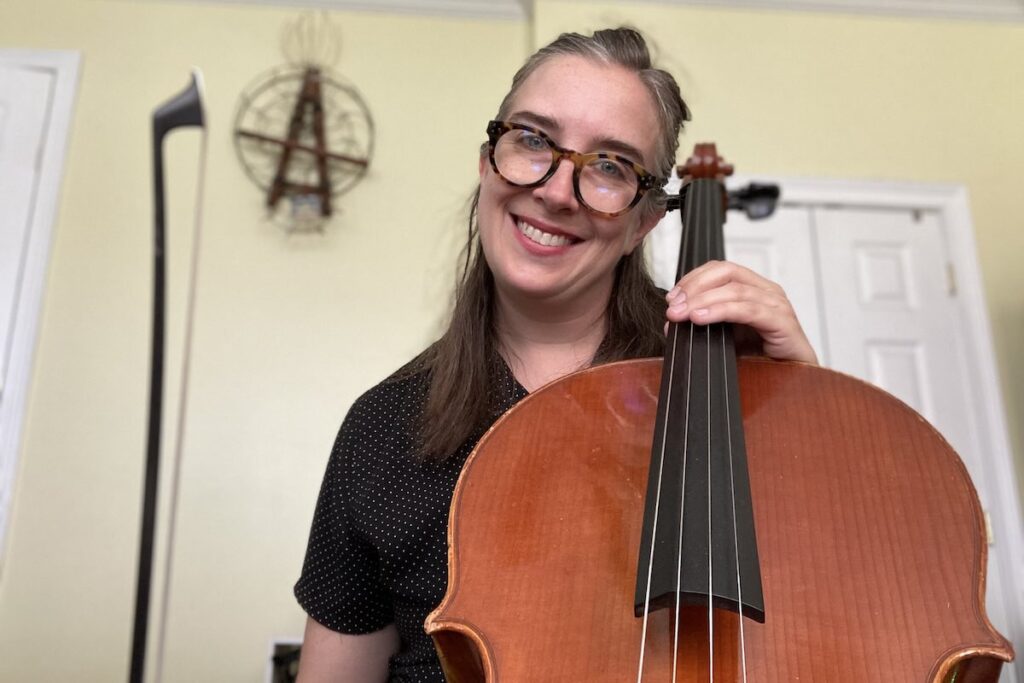
When did you discover your love of experimental music?
My interest in experimental music originated during my undergraduate years at CCM. I was majoring in cello performance and following the same curriculum as every cellist before me, including music theory and history courses, orchestra, and private lessons where the pieces I studied were dependent on the technique my professor was focusing on that week. I worked through method and etude books, scales, and the standard classical repertoire that included cello concertos and orchestral excerpts, generally classical and romantic era symphonies. When we weren’t locked up in our practice rooms, my friends and I would attend any number of recitals held at the conservatory every week. These concerts were like social and artistic lifelines, recharging and inspiring us after the monotony of our studio studies. I witnessed an expansive creative drive, especially at the composition department recitals.
Student composers were pushing the boundaries of what I thought traditional symphonic instruments were capable of. I had not been exposed to “new music” beyond contemporary compositions that still utilized traditional forms, standard keys, and predictable textures. Natural harmonics, col legno and ponticello bow instructions were about as quirky as notations got in our performance studies. This community of artists introduced me to a world of extended techniques that felt like a secret language. I remember watching a cellist perform a piece using artificial harmonics and how easily that shimmery sound pierced through a texture. This created a challenge of balancing these practices during my studies at conservatory. On one hand, I must maintain the discipline of mastering the classical works that my teacher expects me to shape with precision. On the other, I have this buzzing excitement for a new cello language that I can’t really apply elsewhere in my practice at that point.
The cello sonata by George Crumb was my first experience bridging that gap between standard classical studies and experimental elements in “new music.” The piece was nearly fifty years old when I started working on it but Crumb’s use of timbre, color, and dramatic gestures were refreshingly different and struck me as music I truly wanted to connect with. I remember my professor delighting in my enthusiastic play-through, asking, “Why don’t you play the Saint-Saens concerto like you play the Crumb?” This was a pivotal point, realizing that I craved more creative freedom than the classical standards could offer me. Learning the classical repertoire also saddled me with immense pressure to deliver the perfect performance: impeccable intonation, exact articulation, and living up to the weight of century-old traditions of expectations. New music, however, welcomes experimentation and curiosity from the performer, often leaving room for expressive spontaneity that makes for more unique performances.
Many of your compositions are rooted in the relationship between how the sounds of your cello and your immediate surroundings interact with each other. What inspires you to use this particular method of creative expression?
I am so grateful to my 10-year-old self for choosing the cello in fourth grade orchestra. Little did I know that was the start of a beautiful lifelong relationship with one of the most beloved instruments in the world. Its resonance can literally stop people in their tracks, mouths agape. Throughout childhood my parents would joke, calling it “cello eyes”, the stupified look people get when they hear a few notes of cello. In time I learned that the cello’s range of frequencies are some of the closest to those of the human voice which in turn allows the vibrating resonances to settle so well in our nervous systems.
My current project Planchette involves amplifying my cello and running it through multiple effects pedals. The results allow me to perform like a painter with a palette, improvising with loops, delay, reverb, distortion and pitch shifters. The response of the cello varies depending on the size and natural reverberations of the space, therefore affecting the influence of the pedals. It is quite thrilling to explore a room’s ambient vulnerabilities, testing the range of volume before feedback starts, or how quiet you can play before nothing is heard at all. I’m drawn to the interplay between the cello and my surroundings because it makes music feel alive in that moment. The cello’s grounding acoustic sound, when mingled with the textural effects, becomes part of a larger conversation. The rustles from an audience, creaks from the floor, the hum of a pedal, even silence, all shape the music.
So much of your work is community focused. I’m thinking of Innerspace Collective, your performance of live scores for films and plays, cello yoga(!), and the new chamber music sight-reading jam at Schwartz’s Point. Do you think this outward focus is an overlooked aspect of being a musician?
Absolutely, I think community is one of the most vital and often overlooked aspects of being a musician. Especially in classical training, it’s common to get locked into solitary practice and focus only on personal accomplishments but it is important to remember that music is a shared art. Not until it’s exchanged will it come to life and create connection.
Since my return to the Cincinnati area I have enjoyed seeking out new spaces to introduce music. After living in Chicago and being involved with so many wonderful ensembles and diverse projects, I felt compelled to carry this spirit of musical vulnerability to my new community. Projects like the ambient jams and playing cello for yoga classes come from the impulse to dissolve the barriers between performer and listener. I enjoy creating spaces where people feel invited into the process, whether that’s blending sound with movement, hosting accessible classical music concerts, or just creating sound for the joy of discovery together. Through this work I’m reminded why I’m still making music in the first place, not just to perfect something for my own, but to create experiences that resonate in others.
How would you describe the experimental music scene in the Greater Cincinnati area and how has it supported your career?
The experimental music scene in Cincinnati is small but incredibly vibrant and collaborative. WAIF radio station, on the air since 1975, broadcasts a wide variety of genres including experimental and ambient programs. The now defunct venue Art Damage dedicated their programming to experimental and underground music shows for nearly 30 years. The lineage and history of these two organizations have helped keep the experimental energy rippling through the music community today.
Spaces like Radio Artifact, The Comet, Fuse Box, and MOTR Pub carry that spirit forward by offering wide assortments of shows, often mixing genres within the same bill. Add to that Cincinnati’s location, a sweet spot for touring bands to book shows, resulting in a scene that’s both grounded in its community and constantly energized by new voices.
This city is also home to one of the country’s top music conservatories and symphony orchestras, providing a strong foundation for musical excellence. I would love to see more exchange between these two worlds, bringing together conservatory-trained musicians and non-academic players for an exchange of approaches and ideas. People who’ve spent years mastering technique meet those with fresh perspectives and unconventional practices. That mix could keep the work vibrant, unpredictable, and inspiring. Personally, collaborating across that divide has opened doors for new projects and performances that I might never have encountered in a purely academic setting.
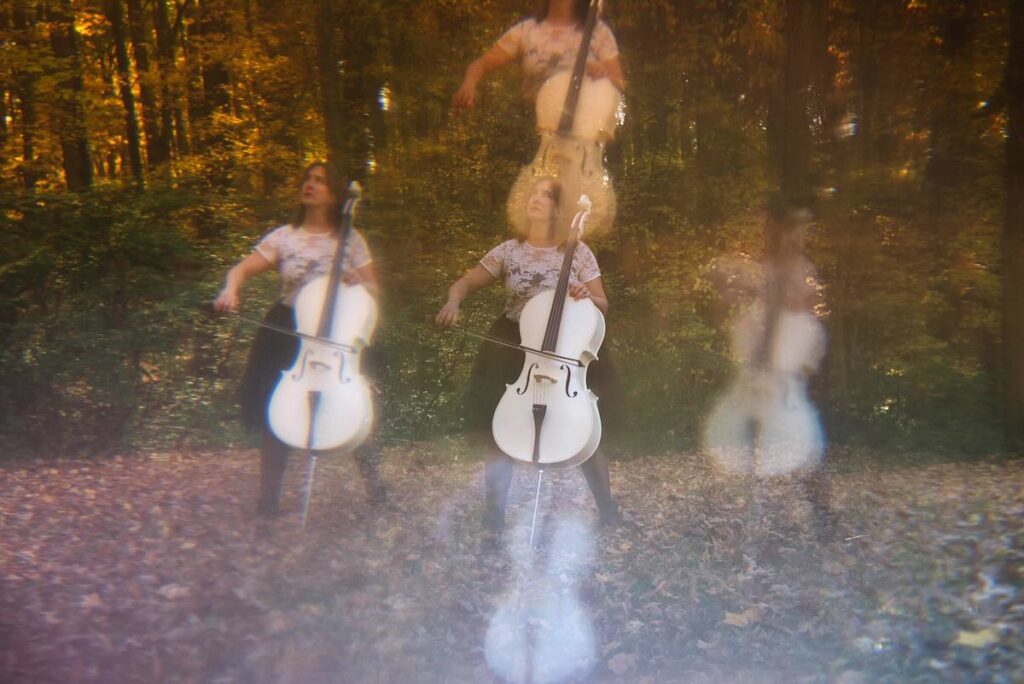
Experimental music is sometimes seen as very heady and intellectual. One thing I really appreciate about your work is how kinesthetic and emotional it is. Is there a disconnect between how experimental music is viewed and how it is practiced?
Experimental music sits under a broad umbrella of styles. The music that first caught my attention at my college recitals was academic in a nature that pushed the boundaries of musical theory, notation and form. As I took more interest in performing new music, I studied the composers that spearheaded these concepts throughout the 20th century. Composers like Earle Brown, Xenakis, and Lachenmann all wrote pieces for cello that opened my eyes to the most abstract and complex music I had seen. It was exciting to expand my repertoire and test my playing abilities with these pieces but I often questioned, how will the audience react to this piece? Will it sound completely crazy, because it does to me! Will the professors all recognize the notes I played incorrectly? Will I win them over with my sheer drive and confidence to play it well?
The experimental music I perform as Planchette lies more in the experiential and immersive realms. I try to be very attuned to the space I have created for the audience to enter and listen. However, if I am improvising, it is inevitable that dissonant notes and textures may creep in. I listen intently and move how the cello moves me. It’s a balance between mindfulness of the audience’s experience and total presence in the moment of creation. I let the music breathe, shift, and reveal itself naturally.
Certainly I am usually in a more stoic headspace when practicing cello at home than when I’m onstage under bright lights in front of an audience. Often I start reminiscing over my classical heritage and will practice some Bach or play along with an orchestra performance on YouTube to help stir the creative juices. Onstage, however, I enter a more open state. I tune in to the energy of the room and attempt to work with what unfolds. The magic for me is when my classical training resurfaces in unexpected ways. Sometimes that Bach phrase or excerpt from a symphony slips into an improvisation without me planning it. In those moments it feels like a dialogue between the past and the present, my years of study meeting the freedom of exploration.
I CARE IF YOU LISTEN is an editorially-independent program of the American Composers Forum, and is made possible thanks to generous donor and institutional support. Opinions expressed are solely those of the author and may not represent the views of ICIYL or ACF.
You can support the work of ICIYL with a tax-deductible gift to ACF. For more on ACF, visit composersforum.org.