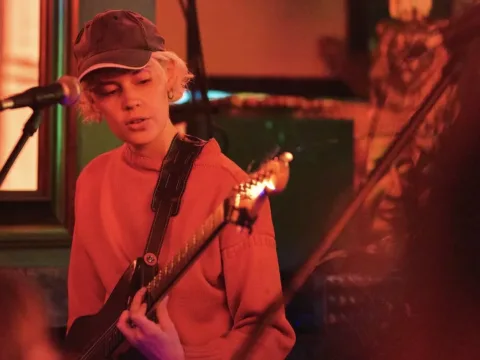
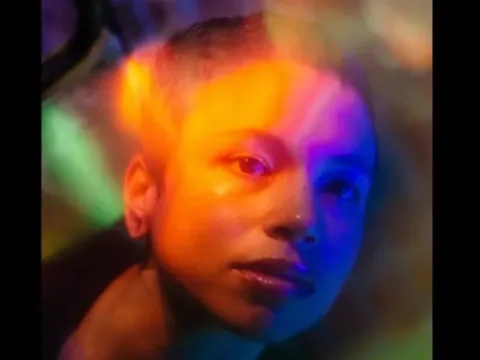
Just before Rafiq Bhatia’s performance at the Warhol Museum on Oct. 7, I had a chance to catch up with the guitarist and composer in the greenroom. Pittsburgh was the first stop on Bhatia’s six-city tour to promote his latest album, Environments, which is out now on ANTI- Records. In chatting about his hopes and plans for the imminent performance, he described his new work as being akin to “the way you can experience a thunderstorm many times, but no two are ever the same.”
Bhatia was joined by trumpeter Riley Mulherkar and Son Lux bandmate, drummer Ian Chang, who performed on the album and co-composed the material with Bhatia in a kind of joint-improvisation, layered into dense folds of electronics and environmental field recordings of birds, bugs, encroaching waves and distant, rolling thunder.
This performance marked a return to the Warhol Museum’s Sound Series, as curator Ben Harrison has previously presented Bhatia and Son Lux in a number of the Warhol’s spaces over the years. I first heard Bhatia’s guitar while traveling through the unhinged multiverse of Everything Everywhere All At Once, the 2022 filmfor which Son Lux became the first band ever to receive an Oscar nomination for Best Original Score. Later, I was enchanted by Bhatia’s collaboration with filmmaker Apichatpong Weerasethakul called On Blue, part of Liquid Music’s specially curated program, “Sun Dogs.” The opportunity to finally hear him perform live in the town where I reside was a special treat that quickly transcended into a remarkable experience.
The rather intimate Warhol Theater offered a striking one-to-one transposition of the mix and soundstage heard on the album with equal clarity and precision. The music emerged slowly with breathy chirps and squeaks from the trumpet, twinkling and bow-like textures from the guitar, and rolling, sandy waves from the drums. Mulherkar’s trumpet seemed to move through the space by virtue of alternating dryness and reverb in the mix.
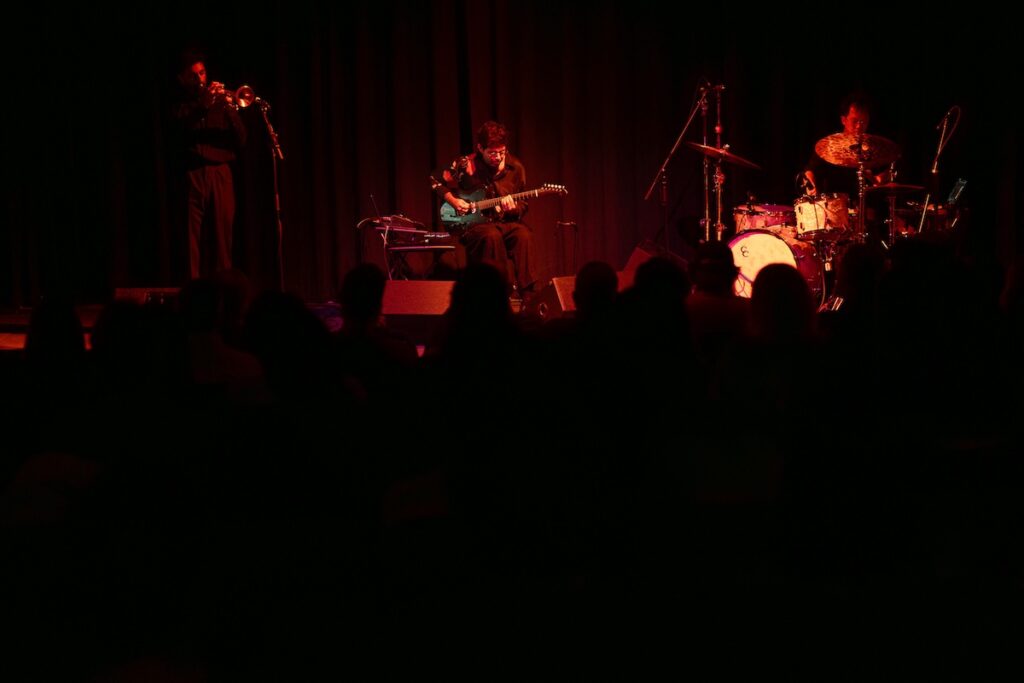
In the most reverberant and lyrical moments, the combination of the trumpet, underlying electronic textures, and washes of sound from the drumset produced a kind of industrial noir indicative of the trio’s jazz-informed performance practice. Certain moments, particularly those played within the surrounding field of nocturnal sounds like chirping crickets and birdsong, felt distantly reminiscent of the notable ambient work Vernal Equinox, by Jon Hassell.
However, Bhatia’s composition stretches far beyond mere ambience. This music is not gentle; it’s big, at times aggressive and chaotic. It moves like crashing surf and expands across space like dazzling lightning followed by awesome thunder. Even during periods with abundant space, there is a focused intensity that charges the air. While improvisatory in nature, each section is distinct and clearly formed, seemingly unbound by the constraints of time or common rhythmic subdivisions.
During the performance, a pulse often emerged, whether from Chang’s expanding drum patterns or Bhatia’s melodic guitar, processed through overlapping loops and delay effects. In each case, the phrasing possessed an elasticity that moved with and through the players as they recalled the structure of the recorded work and responded to each other with subtle spontaneity in real time.
The sold out crowd sat silently engaged throughout, locked in a synchronistic atmosphere of deep listening that manifested holistically and immediately. Many audience members cradled small plastic cups of wine or cocktails from the lobby bar, but the music was so transfixing it seemed as though no one moved to take a sip until the near-70 minute performance waned back into silence. Following the conclusion, Bhatia made only brief remarks to thank the Warhol Museum and their sponsors, and in particular those in attendance for truly taking their time to enter into communion with this work and listen to it. Listening is an activity, the composer implored the audience — more critical to practice in our present world than ever.
I CARE IF YOU LISTEN is an editorially-independent program of the American Composers Forum, and is made possible thanks to generous donor and institutional support. Opinions expressed are solely those of the author and may not represent the views of ICIYL or ACF.
You can support the work of ICIYL with a tax-deductible gift to ACF. For more on ACF, visit composersforum.org.