In a 2022 article for I CARE IF YOU LISTEN, “We Need to Talk About Money,” composer Juhi Bansal dismantles the fallacy that skill and hard-work are enough to guarantee a thriving music career. The unfortunate truth of our field is no matter how talented you are, you’ll likely need a strong network of musician friends, colleagues, and mentors to find success.
For better or worse, the arts are largely relationship-driven. Most gigs and commissions result from referrals, trust, and word-of-mouth. Your community is your career engine: the more robust it is, the more it drives visibility, opportunity, and sustainability. Without it, even your most captivating work risks going unnoticed.
A solid music community also includes resource-sharing where people can offer valuable insight into their — and your — artistic and business practices. It’s easier to navigate burnout and anxiety when you know you can speak frankly with your closest colleague-friends about moving through hardships. If you are isolated from other musicians, though, it can be harder to assess whether you are on the right career path and whether you should keep going. The idea of embarking on a music career without a strong community is — and should be — terrifying.
Unfortunately, various external factors create barriers to finding and sustaining community, including age, education, and financial privilege. Some composition contests and calls for scores offer composers opportunities for connection and performance, but many have an age restriction. Musicians in college settings have an inherent advantage in community-building over those who come to the field later in life or people who didn’t major in music. Summer music festivals can provide access to high-profile mentors, performers, and peers, but often charge high participation fees on top of expensive flights and lodging.

We (Brandon Elliott, a conductor and educator, and Dale Trumbore, a composer and writer) have spent over a decade building a relationship that floats between friendship and professional collaboration. But we also remember that, when starting our respective careers, building creative partnerships like ours felt elusive and intimidating.
So how do you form a musical community if your access to opportunities feels limited? And once you’ve found it, what’s the best way to engage with that community?
BUILD COMMUNITY ANYWHERE
We interviewed 28 composers for our new co-written book, Composing a Living: A Music Creator’s Guide to Money, Relationships, and Business, and many of them mentioned the importance of peer relationships to their process. In an interview for the book, Zanaida Stewart Robles said that she felt that her work was better when she was spending time with peers whose music she values. Juhi Bansal noted that to find your community, “You need to go meet musicians. You need to go to concerts. You need to build those relationships.”
Other interviewees named the following ways to build a community:
- Take low-stakes first steps. Ask to sit in on a rehearsal or attend a single workshop reading with a local ensemble.
- Show up locally. Surround yourself with the people who are just as excited as you about your particular musical niche.
- Exchange opportunities. Offer to connect performers and collaborators in your own network, and kindly but clearly ask when you’d appreciate that in return.
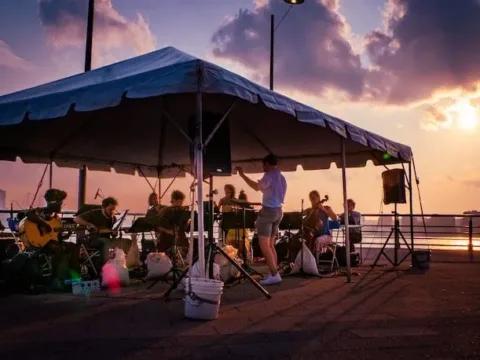
Some musicians believe that community only exists in major cultural hubs like Los Angeles or New York City, but that’s hardly true. Most musicians, no matter where they live, are within driving distance of at least one ensemble (e.g., a church choir, school band, or community orchestra) filled with real musicians and conductors who could become peers and future collaborators.
But if you’re truly in an area without an existing musical community, you might consider starting your own ensemble or finding ways to work with creative acquaintances in other fields. You may know choreographers, filmmakers, poets, programmers, video-game developers, or visual artists who are your “peers” in a different sense: not peers who share your exact skillset, but ones who share your creative ambitions.
MOVING BEYOND ONLINE CONNECTIONS
If you feel as though you don’t have peers in your geographic area, online spaces can serve as another entry point. Social media platforms, composer forums, and even professional organizations with membership directories or Slack or Discord forums can help. Online connections do have limitations, though. How you engage matters more than simply being present or gaining a large following.
To start, reach out to people intentionally. “Cold” messages to performers or composers you admire can feel daunting, but they often lead to surprising opportunities. We recommend “warming up” a cold message by mentioning a mutual friend, a shared alma mater, or something else you have in common. A short, thoughtful note, like mentioning something specific you appreciate about a potential collaborator’s work, can encourage them to respond, and asking one question rather than several may net you a quicker response.
Online connections can give us the illusion that as soon as we accept a friend request, the relationship is established. In reality, that’s only the beginning. Online connections aren’t quick wins; they’re the start of a relationship that may take months or years to yield artistic opportunities. Several composers we interviewed mentioned meeting conductors or performers — both online and in-person — who then took a few years to become a repeat commissioner or champion of their catalog. However, if you keep showing up for your acquaintances, one-off collaborations can organically become decades-long partnerships.
When you have a strong, fulfilling collaboration with an artistic partner, share your vision for a future project with them. Perhaps a proposed project mutually benefits both of you, and you decide to pursue it together, pooling resources, connections, and artistic insights. Even if a collaborator doesn’t want to work together again, they may still want to keep in touch, hear updates about your project, or help you achieve your vision by introducing you to people who are better aligned.

We’ve found it most helpful to always have a plan to turn online relationships into in-person connections. This can happen through small, low-stakes collaborations (e.g., trading feedback on a short piece) or getting coffee to talk about your current projects. Attending a conference can offer another great opportunity for meaningful connection: the hallway conversations, coffee lines, and other in-between moments are where a quick chat with a peer can plant the seed for a future collaboration.
CULTIVATE MENTORSHIP
A mentor is someone who offers advice, opens doors, and invests in your growth with integrity. Mentorship is built less on any formal approach and more on a series of small actions. In other words, it’s not a matter of asking someone, “Won’t you be my mentor?” Rather, you build a relationship over years of little acts of support and connection, like asking for a reference letter or staying in touch through emailed updates and an occasional shared meal.
Musician bios sometimes include a list of prestigious mentors, regardless of whether a musician has studied with a mentor for a year or had just one brief lesson or masterclass with them. Those lists can be daunting, especially if you haven’t had the kind of traditional experiences, like summer festivals or college music programs, that grant access to these recognizable names.
It’s important to understand the difference between a model and a mentor. A model is someone whose career or artistry you study as an example — an individual you can learn from by observing their choices, body of work, or professional path, whether or not you ever met them. A mentor, on the other hand, is not only an expert in the field but someone who actively chooses to ethically guide you. In other words, all mentors serve as models, but not all models will — or can, or should — become your mentors.
As we’ve progressed in our own careers, we have noticed that as we increasingly serve as mentors for other musicians, that relationship rarely requires a formal “mentor” label. Dale is often willing to answer questions from early-career musicians about building a professional career, or to share composers’ most promising works with conductor colleagues. Brandon has found that programming works by early-career artists with Choral Arts Initiative can function as a form of mentorship in itself, leading to repeat performances, album placements, and connections to other conductors.
PEER MENTORSHIP: THE POWER OF FRIEND-TORS
In our book interviews, we discovered that many composers found “friend-tors” just as helpful as a more traditional mentoring relationship. Isaac Io Schankler recommended that composers seek out people who are close in age to them, at a similar stage in their career path, or a little bit ahead of them, particularly in fields like multimedia composition or composing for electronics, because “everything changes so fast with music and the arts and money.”
A “friend-tor” can be a colleague or friend who is exactly where you are in your career path, slightly further along, or in a different field or genre. They may be able to provide everything that you’d want in a more traditional mentorship. For example, a peer may be able to introduce you to a new collaborator, give you helpful feedback on a composition, offer advice when you find yourself in a sticky situation, or even write you a recommendation letter.
SERVING YOUR COMMUNITY
In writing Composing a Living, one of our biggest takeaways was that the most successful composers employ a community-first strategy of music-making. Instead of writing music first and trying to find an audience for it, these composers consider what their community is lacking, then compose music to fill that need.
This approach works on both a small and large scale. For example, if you play an instrument, you already know what repertoire exists for that instrument and what it lacks. As a composer, you can fill that void by writing new music. As a performer or conductor, the same principle applies. How does your unique skillset overlap with the gaps that exist within your musical community, and how can you fill those gaps and grow your community using your talents? That might look like starting a new ensemble or getting more involved in the advocacy side of music-making.
In every interview for our book, we started asking questions about money and business, but found that the conversation always turned back to people. Our 28 interviews revealed that a music career has less to do with what you write or perform and more to do with who shows up for you — and who you show up for. As a musician looking to find community, the most important question you can ask is this: “How can my music serve the people around me?”
I CARE IF YOU LISTEN is an editorially-independent program of the American Composers Forum, and is made possible thanks to generous donor and institutional support. Opinions expressed are solely those of the author and may not represent the views of ICIYL or ACF.
You can support the work of ICIYL with a tax-deductible gift to ACF. For more on ACF, visit composersforum.org.