As a sound artist, multi-instrumentalist, and composer, Dameun Strange’s conceptual chamber and electronic works explore the African diaspora through an Afrofuturist lens. Drawing on West African polyrhythms, synthesizers, jazz harmonies, and found sounds, Strange creates genre-defying performances that bridge ancestral narratives with contemporary expression.
Over the years, Afrofuturism and electro-acoustic sound slowly emerged in his works. Reflecting back, he realizes that he wasn’t connecting with the stories in his early compositions because they had emerged from a predominantly white society. The stories he was really attracted to were those of the Black experience. A pivotal piece was his song cycle, The Dream Variations, based on Langston Hughes’ poems about dreams.
“I went back to some of the early Gospel influences, the spiritual, and early jazz songs to create the song cycle. I really felt that it was one of the first times that I got the sound that I was looking for, so I was encouraged to keep on that path. The whole time, I was trying to figure out how to bring in some of the new technology that I was growing to understand more and more and really finding a voice with that music.”
Strange then received a commission from the Cedar Cultural Center in Minneapolis to curate a more experimental program, which gave him the opportunity to merge acoustic and electronic music. “I knew it was a chance to experiment, and I wrote an operetta, Helianthus, about the four generations of women who raised me. There was time travel [in it], and that was the first time I introduced the theme of Afrofuturism, science fiction, and connection to ancestors.”

But being constrained to work within Western notation was a barrier to collaboration with musicians of various abilities. So Strange wondered about creating scores that could be read by a broader group of musicians, bringing musical equity to the performance. “I started studying more graphic scores. Graphic arts was a thing I had always been kind of interested in. Once I started playing around with the idea of different types of notation, I felt my creativity as a whole come alive.”
The symbolism of African patterns and prints inspired him to connect his musical notation to Pan-African art and Black African art. “For me, Afrofuturism appears in my work, not just through the sound that is created or the theme, but in this visual representation that I try to create to tell the story that I want to tell with the music.”
This fall, the Association for the Advancement of Creative Musicians selected Strange as composer-in-residence for their 2025-26 season, which also happens to be the organization’s 60th anniversary year. The residency comes after years of developing a relationship with composer and conductor Renee Baker, now interim director of the AACM.
“Renee heard about me and then started following my career, and we’d have conversations off and on about my work and her work. I think she’s just been interested in my work and my perspective on composition and my graphic scores. Then she reached out to me and asked me if I would be interested in being composer-in-residence, which is something AACM hadn’t done before. And of course I said yes.”

His AACM residency will be a listening exchange, where he will curate a series of works by influential AACM composers and workshop his commission with the group’s members. In the spring, he will have discussions/roundtables with the AACM performers who will present his work, followed by open rehearsals and the final concert premiere in June.
“I’m actually really looking forward to being in Chicago and having those conversations with artists and collaborations. There’s so many aspects of Chicago’s music history that have influenced me. I do hold that history in high regard, so it’s kind of a big deal for me, and to do it with such a historic organization.”
After attending college at Macalester College in St. Paul, Strange decided to remain in the Twin Cities area, where he currently lives. “I came out here in the early 90s and really fell in love with the arts scene — not just the music scene but the arts scene in general. There was a lot of cross pollination between the different disciplines.”
During his undergrad, the student body included international students of color, but Strange was often the only Black student. At Macalester, he studied African drumming, composition, and poetry, and is currently pursuing graduate studies in composition at the University of Minnesota.
“Music initially was not [my first course of study]. I’m a first-gen college student. And it probably had a lot to do with the influence of my great-grandmother, Alma. She was my guardian for a lot of my growing up years. But it didn’t seem like a thing that she wanted me to do in college. I was going to major in political science and economics. That’s one of the reasons I chose Macalester College: it had an international focus. I was really interested in world affairs.
“My advisor happened to be in the music department, and he convinced me to audition for the jazz band [as a saxophonist]. I knew it was something that would give me joy in my four years being away from home and in a new world, and a world that was less Black. Music really was a thing that could be a source of strength, and I began to write more, so English and music became my focus.
From a very early age, he wanted to become a composer, even if he wasn’t certain what that meant or how he might arrive at this goal. “I’d always been kind of doing music and playing around with instruments. I had a mentor in high school, who encouraged me to do an independent study where I just focused on writing, still not having a big focus on theory, just kind of using my ear.
“And my college advisor invited me to be part of his class on composition. That was really the first time that I spent on composing and learning the principles behind composition. It was really cool, because my advisor knew a type of Chinese music notation … I didn’t even know that there was a different way of writing music that wasn’t five lines on a staff and the clefs. So it really got me interested in writing and exploring sound more, not just Western music, but what else was out there in the world.”

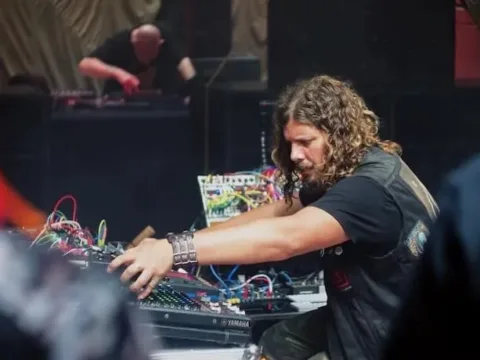
Working as a professional musician, Strange began to branch out to other instruments and genres. “I kind of gave up on composing a few years after undergrad, and just focused on playing music in the scene, which was very active. I played a lot of horn in the beginning, and then played in a band where they asked me to play synthesizer. I was always interested in synthesizers, but I was living paycheck to paycheck, so it was really hard to spend the money on instruments.
“I had this Korg, and started messing around with it, not knowing a lot about the technology. But then once I started getting into computer programs to play around with, that’s kind of how the electronic stuff started … I wanted to really push against the pop conventions more than I was able to and still get gigs.”
The tight knit community of the Twin Cities can be challenging to enter as a newcomer, Strange says. But he ultimately found his creative community via arts advocacy and issue organizing in causes promoting marriage equality and political action.
“There is that opportunity through music to tell the lesser known stories, or at least bring people together so they can tell their own stories — finding a village of artists of multiple disciplines to amplify the voices of the community. I feel like I’ve been really lucky to find a community of artists who are so varied in their disciplines, and learn from them. I think that’s a big influence on who I am as an artist, being in community with these folks, who are also inspiring me through the work they create.”
I CARE IF YOU LISTEN is an editorially-independent program of the American Composers Forum, and is made possible thanks to generous donor and institutional support. You can support the work of ICIYL with a tax-deductible gift to ACF. For more on ACF, visit composersforum.org.