On a spring day in 2022, an uninterrupted hum emanates from the center of a room, as natural as the human voice yet produced by electronic instruments. As I stand in the corner listening to Éliane Radigue’s L’Île re-sonante (2000), I notice every subtle waver and new overtone from this small collection of notes. The sound is as deep as the ocean and as tiny as a single shell left in the sand by a wave receding from the shore. The music requires me to listen carefully and closely. I let it grow from the soles of my feet, through my core, up to the top of my head. I have no idea what time it is or how much time has elapsed, but I can locate myself within the sound, both holding it dear and using it as a connective branch to the others there with me. “I’ve always imagined these sounds to have their own personality,” Radigue once told Frieze Magazine. “After listening to them, at a point it becomes a dialogue with the sounds. All the rest develops naturally when you enter into a process.”
Like the performance that afternoon, Radigue’s entire catalog asks us over and over again to observe change through the act of attentive listening. Her music lives and breathes; it dives headfirst toward the center of a note as it unravels. That afternoon, I walked into her sea of sounds with scuba diving gear so I could stay as long as I wanted. I was on Radigue’s time, which is sound’s time, which is far greater than any one of us.
Radigue passed away in February, leaving behind a practice with immeasurable impact on contemporary composition through her philosophies on music and her collaborative ethos. Her legacy is marked by musical innovation; her body of work, spanning from early electronic pieces to a sprawling web of acoustic collaborations, shapes how we listen alone and together. Born in 1932, Radigue was introduced to music through classical piano lessons; as she aged, she became intrigued by the sound of the world around her, like airplanes and radio static. Her music took several forms over the course of her life, but all of her work shared an impulse to embrace music’s shifting tides.
She first decided she wanted to compose after hearing Pierre Schaeffer on the radio, and she eventually studied with him at Studio d’Essai, the Paris hub for musique concrète. Her time at the studio laid the foundation for her electronic composition practice, which she brought with her when she struck out on her own in the late-60s, a time in which women composers were still often relegated to the margins.
Several important feedback works, composed between 1969-1970, offer an early example of the unbroken sound for which she became known. Radigue was a pioneer of composed drone music, writing pieces that grew from observing how long-held notes unfold over time. As her pieces branch out, new overtones, textures, and timbres emerge; through the act of listening to them, the perception of time and sound becomes warped, distorted, expanded.
Minimalist and spectralist movements were also taking hold across Western composed music in the mid-20th century. Artists embraced looped and elongated structures and sought new ways of listening that encouraged greater presence. In this landscape, Radigue’s music stood out: Her pieces demand close attention from observers and performers alike, unfurling with glacial patience and extreme attention to detail. It is as if she composed from the very center of a tone, going inside of it to excavate its every timbre, texture, and pitch.
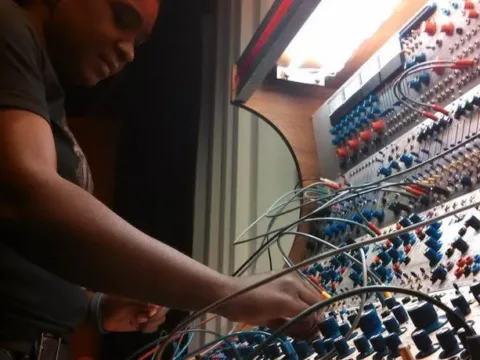
While visiting New York in the ‘70s, Radigue met major figures in the city’s experimental music scene like Rhys Chatham and Laurie Spiegel, with whom she shared studio space. There, she perhaps encountered the most important figure of all: the ARP 2500 modular synthesizer. This instrument, which she named Jules, became the voice of many of her most beloved works, like Trilogie de la Mort (1988-1993), a sprawling, three-part piece rooted in the concept of existential, intermediate states found in The Tibetan Book of the Dead.
Equally important as Radigue’s musical ethos was a creative philosophy rooted in deep collaboration. Historically, composers and performers have existed at a distance, but Radigue, along with contemporaries like Annea Lockwood, sought to develop a language of shared ownership between composer and performer. Radigue’s collaborative pieces were not just hers — they were necessarily shaped by instrumentalists and took on the voice of the person who played it.
In the 2000s, she began OCCAM Ocean, a series of acoustic drone pieces written closely with performers, often through verbal transmission, meticulous conversation, and experimentation with various techniques. It was a new method of working, but something she had always hoped to accomplish. In 2011, she told The Guardian: “It is what I was trying to do with electronic music, but I never succeeded; every piece felt like a compromise between what I wanted to do and what I could achieve.”
Nate Wooley is a New York-based trumpeter and was one of Radigue’s longtime collaborators. In an email, he described her radical approach to collaboration through OCCAM Ocean as “a folk tradition based on avant-garde practices, one that should be passed on from generation to generation.” He also shared how Radigue created a close community through the act of making music together. “She, in a sense, gathered a family to play this music,” he said. “Because there was the ‘transmission’ process to get the music from her to the performer without a written score, she set up the notion that the music could (to me, should) live beyond not only her but all of us.”
Before OCCAM Ocean, one of the first pieces she composed for an acoustic instrument was Naldjorlak (2005), written for the cellist Charles Curtis. In the liner notes for a 2023 album that includes two recordings of the work, Curtis recalled how he and Radigue coexisted to write this piece. They would do their morning routines together in Radigue’s apartment, separately but near, sculpting the piece through detailed conversations. Gradually, the two created a shared world through the language and philosophy of Radigue’s practice. “Working with Éliane is learning to hear as she hears,” Curtis wrote. “To interpret her music is to enter a world not quite like any other, yet still our own, lived world; and to act in it, consciously and responsibly.”
Her first OCCAM piece, which premiered in 2011, was with harpist Rhodri Davies, who had read about Radigue in The Wire and was introduced to her music through a limited CD release of Biogenesis (1973). At the time, he was heavily involved in the subset of London’s improvisation scene where artists were more interested in silence than flashiness. They eventually met through mutual friends and began a decades-long collaborative relationship that extended far beyond the music.
Davies remembers Radigue as familial, and some of his favorite memories surround the time he spent with her and fellow performers. At one point, several of them took a trip to work on a piece in a family home just north of Nice. They spent time making music, of course, but for Davies, he remembers cooking for each other, drinking a Belgian beer, and watching the sunset.
Davies describes Radigue as formidable yet wholly embracing of change. Once she was satisfied with a piece, she let the performer have it completely, relinquishing her control and accepting how her music could take many shapes. “She understood that the piece could grow and change,” he said over Zoom. “There was such a level of trust that once she was happy with what you were doing, then she was happy…It was a very understanding and real life form of composition.”
OCCAM II was written with violinist Silvia Tarozzi in 2012. In a piece for Sound American, Tarozzi recalled Radigue’s unconventional approach to the violin. Instead of referring to its strings by their tuning pitches, she numbered them; the two talked about bowing techniques and sought a way of creating the sound Radigue imagined through the language of Tarozzi’s classical training. The process opened new paths for her. She wrote: “Making music with Éliane [made] me more confident about my creativity. Her example helped me to feel more free to explore my visions.”
The voice and technical skill of each performer is essential to Radigue’s music. Wooley remembers a moment during the creative process in which he tried to play OCCAM X with circular breathing. After he finished, Radigue said it was no longer her music without his breath. He often thinks of that moment, where he realized how symbiotic their relationship needed to be. “There has to be something of the humanity of the player in it for her to feel that it was a true representation of her music,” Wooley said. “To remove the player from it, whether that’s the sound of their breathing or some element of their innate musical aesthetic, would be to do damage to the music she was trying to make with them.”
At its heart, the greatest strength of Radigue’s music is to connect performers and audiences through a shared experience of making and listening. Taking the journey of listening to Radigue’s works and all their tiny changes leaves you with the feeling of truly being alive in the moment. I think back often to hearing L’Île re-sonante in spring 2022. The space teemed with music, but it also was alive with the breath of the people there, even transformed by it. When I stepped outside after the concert, I met someone for the first time who has gone on to become one of my dear friends. What a gift to be united in Radigue’s unbroken drone: beyond and through time, held eternally in the ever-evolving pulse of sound.
I CARE IF YOU LISTEN is an editorially-independent program of the American Composers Forum, and is made possible thanks to generous donor and institutional support. You can support the work of ICIYL with a tax-deductible gift to ACF. For more on ACF, visit composersforum.org.