A self-described anti-disciplinary artist, Dorian Wood seeks to “infect” spaces and ideologies in order to challenge traditions and systems of marginalization. Her work is a creative expression of community, an extension of family, and an ongoing exploration of cultural heritage. But this concept of heritage doesn’t just echo from the past — it moves with fluidity in multiple directions.
Born in 1975 and raised in Los Angeles, her parents immigrated from Costa Rica with Nicaraguan heritage on her mother’s side. As she told me during our recent conversation, “We’ve been LA people, more than anything, for a couple of generations, and yet, we’re all scattered all over the place. I don’t think there’s really any of us left in LA, but I carry LA with me.”
For most of Wood’s childhood, the family moved around the LA area with relative frequency. “We moved a lot,” she said, “but my grandparents were what we considered to be the nucleus of who we were, and they lived just south of Downtown LA.”
Most recently, Wood relocated to Boston, in part due to the ongoing deterioration of affordability in LA — and in order to position her and her husband closer to his family. “It’s been a hard city to sink my roots into, but it’s happening,” she said. “I feel that so much of what my creative life has been has taken me outside of wherever it is I call home. In LA, my roots were already in the ground, but I feel there is a lot of value in just going wherever the love is. Boston’s Puritanical history presents what I believe is a challenge on a contextual level for me, as I have forged a career of arriving at transgression.”
Addressing this kind of challenge catalyzes Wood’s creative impulses, and furthers her mission to oppose and dismantle systems that contribute to the marginalization of people and cultures. She said, “I don’t believe in coincidences. It’s more of a calling: being here in Boston and creating work in response to what is, I feel, a culture of white colonialist gatekeeping, the beckoning for assimilation within that, and how my transgressive little heart is so resistant and so prolific in the framework of that challenge. I feel grateful to have lived my life in such a way that I’m not at the mercy of realizing my visions only where it is that I call home.”
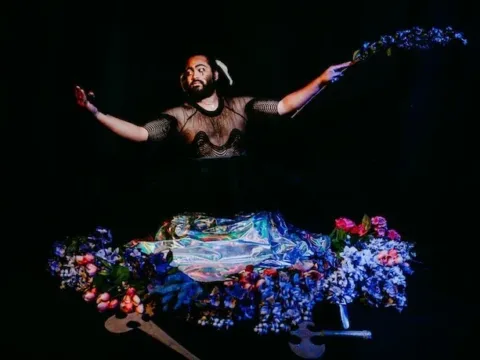
Her recent project Canto de Todes (Spanish for “Song of Everyone”) emphasizes the urgency of folk music as a vessel for social change. Inspired by a lyric of the late Chilean singer and songwriter Violeta Parra, the work began as an immersive, 12-hour touring installation that premiered at the REDCAT in Los Angeles in 2023. The installation is divided into three movements, the first and third being hour-long chamber pieces influenced by folk, popular, and experimental music. The central movement is a 10-hour, pre-recorded piece that unfolds throughout multiple spaces, adaptable to the hosting venue.
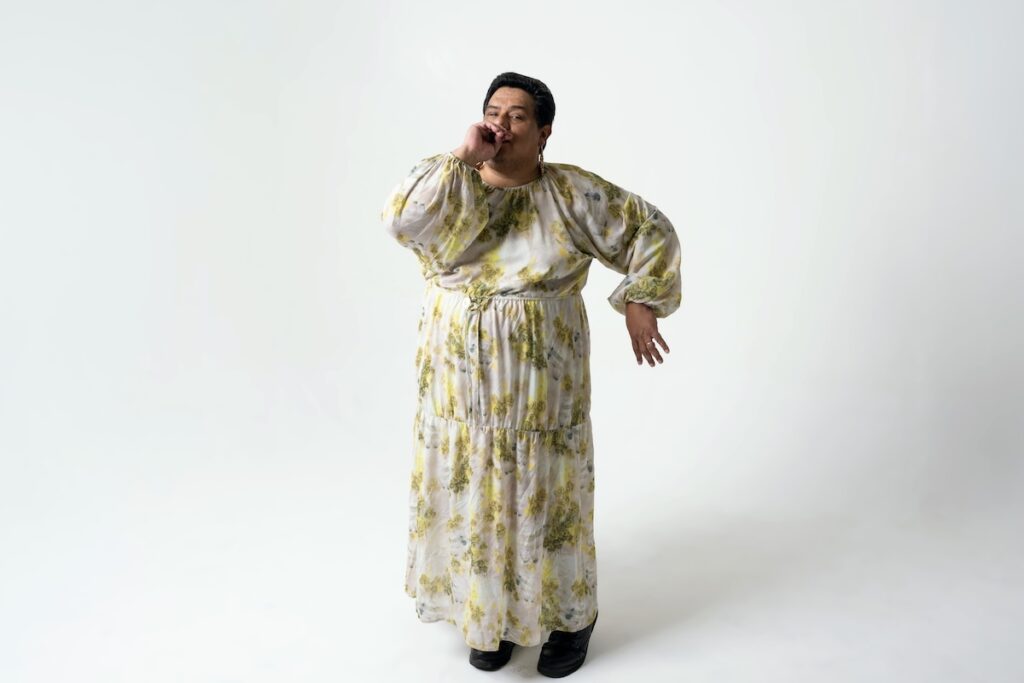
Wood told me, “Present day, we are living that kind of authoritarian panic, and that is where I feel I land on an ancestral focus in what I do, particularly with Canto de Todes. Being queer, being transfemme, I have this whole other wonderful energy to lean into. A lot of it has had to be learned, but also remembered, and with that comes a lot of ancestral trauma, and the necessity to build the tools to keep out those aspects that debilitate the work I feel we are supposed to be doing as ancestors-in-the-making.”
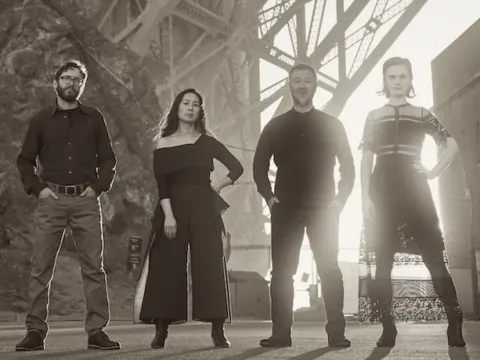
On May 1, New Amsterdam Records will release an album version of Canto de Todes. The recording utilizes a core ensemble of familiar collaborators: guitarist Michael Corwin, and cellists Adrián Cortés, April Guthrie, Christopher Votek, and Emily Elkin. The 70-minute collection of moods and textures establishes its own kind of ancestral lineage emanating from the 12-hour hybrid installation. It offers the work’s varying themes of joy and sorrow as distinct pieces that the listener can carry with them.
“In many songs I grew up listening to, joy and sorrow coexist, and they must,” Wood explained. “I feel that a white colonialist mentality wants us to separate emotions and to diminish ourselves if we fail to experience joy consistently. We realize as we move forward with a global acknowledgement of who we each are, that this conditioning is not meant for any of us.”
“Lirios” opens the album with a repeating, dance-like melody played in unison by the quartet of cellos. Guitarist Michael Corwin adorns the reverent atmosphere with gently descending countermelodies that gradually expand into clusters of chords. A mysterious solo guitar melody continues through “Anonas,” joined by Wood’s characteristically powerful vocals as she sings affirmations of polyamory, mental health, and community mobilization against tyranny. The cellos enter with reassuring warmth as though to suggest everything will be OK.
A standout track, “Nube Negra,” brings together vocals from Wood, Carmina Escobar, and Roco Córdova in a mantra-like, a cappella invocation of motherly energies. As Wood explained, “It was this strange phenomenon that happened in downtown LA, I believe it was in 1983, when a tornado came ripping down the street that my grandparents’ house was on in Downtown LA. My mother kept my sisters and I down on the ground as she looked out the window, and she kept describing a black cloud coming down the middle of the street. All I heard was the house swaying and rumbling and the wind outside. I wanted to see it, but I could only imagine it based on what she was telling me, and she was protecting us from seeing something that could be potentially traumatic. ‘Nube Negra’ is Spanish for ‘black cloud,’ and each of us portrayed either my late aunt, my mother, or my grandmother.”
Other tracks confront familial trauma (“Brown Dove”), plead to the masses to end white indifference (“Honey”), and call for mobilization against gentrifiers, ICE agents, and nationalists (“Girasoles”). Throughout, the music remains somewhat constrained and focused, maintaining a kind of ritualistic, folky quality that expands and contracts in tandem with Wood’s pointed words and passionate vocals.
Both versions of Canto de Todes are meant to provide regenerative spaces for listeners, free of expectation or judgement on how that experience takes shape for them, with neither one being truer than the other. As Wood told me, “I wanted to create a space where you’re not told to tone it down or to behave or to be composed out of respect for the work. I’m here to challenge respectability, and that is something that keeps coming out in everything that I do.”
I CARE IF YOU LISTEN is an editorially-independent program of the American Composers Forum, and is made possible thanks to generous donor and institutional support. You can support the work of ICIYL with a tax-deductible gift to ACF. For more on ACF, visit composersforum.org.