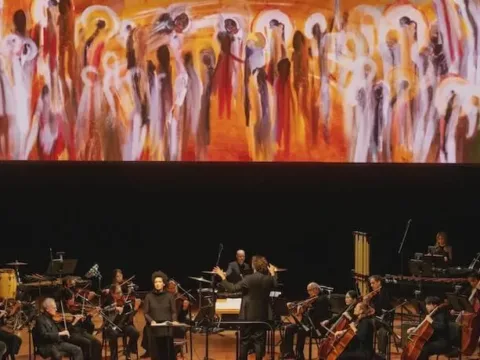
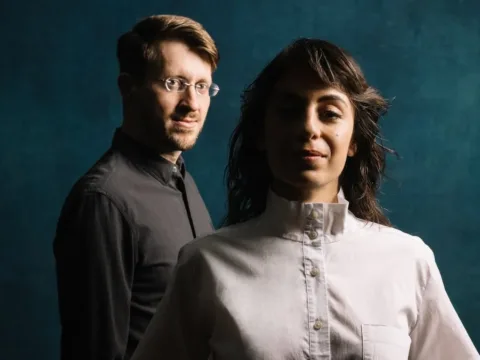
When Glenn Branca’s Symphony No. 13 (“Hallucination City”) for 100 Guitars was first performed at the World Trade Center in June 2001, its soaring overtones flew through the doors and out to the city’s streets. For Reg Bloor, it was a dissonant ring that never ceased; it only grew past the limits of sonic resonance. “I would hear the piece outside, I would hear it coming out of air conditioners, or out of the train, or out of refrigeration units,” said the guitarist and Glenn Branca Ensemble concertmaster over Zoom. “It’s like it’s still in your ears.”
Twenty-five years later, the symphony makes its thunderous return to New York this month at Lincoln Center’s David Geffen Hall. It’s the first time Bloor has revisited the piece since Branca’s passing in 2018; she’ll also step out from the ensemble to serve as conductor, a role she’s never played before.
The work itself is monolithic, a swarm of electric noise raining down from every angle. But this concert is more than just a spectacle of 100 guitars (or 80 guitars, 20 bass guitars, and a drummer, to be exact): this is the story of a community of musicians committed to traveling into the furthest reaches of sound together.
“It’s bigger than the sum of its parts,” Bloor said. “Bringing all these people together seems like a radical act in this day and age.”
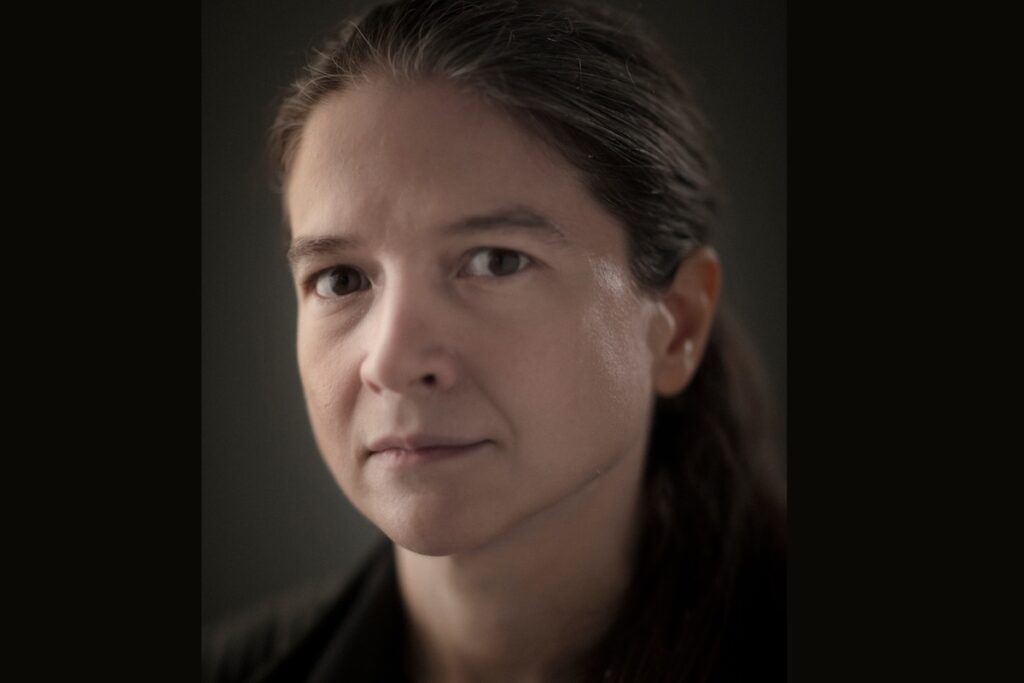
Branca was a force in the Downtown New York music scene and was a pioneer of the “no wave” genre, a type of music that emerged in the late ’70s and upended rock conventions through the use of dissonance, feedback, and heavy resonances. Much of his music involves using the harmonic series to create walls of sound that lead to an immersive, physical listening experience. Early albums like The Ascension pioneered electric guitar resonance created through alternate tunings, while his symphonies expanded the process into even larger possibilities. Members of bands like Sonic Youth played in his group The Glenn Branca Ensemble, while many composers, like Bang on a Can’s Michael Gordon, continue to find inspiration in his work.
Bloor began playing guitar at age 12 and always sought unconventional music. In an interview with Guitar Muse, she recalled being interested in the sounds of a tornado or a piano being toppled over. She attended Berklee College of Music for a couple years, where she learned to see music theory as a history of broken rules (even if that’s not how it was being taught) and gradually developed a virtuosic style known for its incredibly tight, powerful rhythmic and harmonic motion.
Bloor met Branca while she was living in Boston and visiting New York to see shows, and when she moved to the city in 1999, she quickly became a member of The Glenn Branca Ensemble. They began working closely together, and Symphony No. 13 is one of the first pieces that was born from that deep collaboration. It was also the first they made together from start to finish, written in a frenzy over the course of a few weeks. Branca composed the music and Bloor copied it by hand and sent the parts to the musicians by mail.
The first performance took place in the World Trade Center on June 13, 2001, and no one really knew what would happen until the music started. “We didn’t even know if people were going to show up like they said they would,” Bloor said. “And then you walk around the corner and they’re all sitting there with their amps. It was like, oh, thank heaven, it’s gonna work.”
Over the years, Symphony No. 13 grew a sprawling community around it as Branca and Bloor brought the piece all over the world. When the piece would visit a new city, they would seek local musicians to join. People ended up meeting partners and bandmates; families have even played together.
The upcoming performance features a mix of artists who have played the piece before, their friends, those people’s friends, and so on. Bloor hasn’t even met everyone yet, but she always asks for far more people than she needs because she estimates about 15% won’t show up. The main requirement is that they can play guitar and read music. They’ll have two rehearsals this month to put it together, but everyone has already started learning their parts, and Bloor created a Discord server to help them all connect and answer each other’s questions.
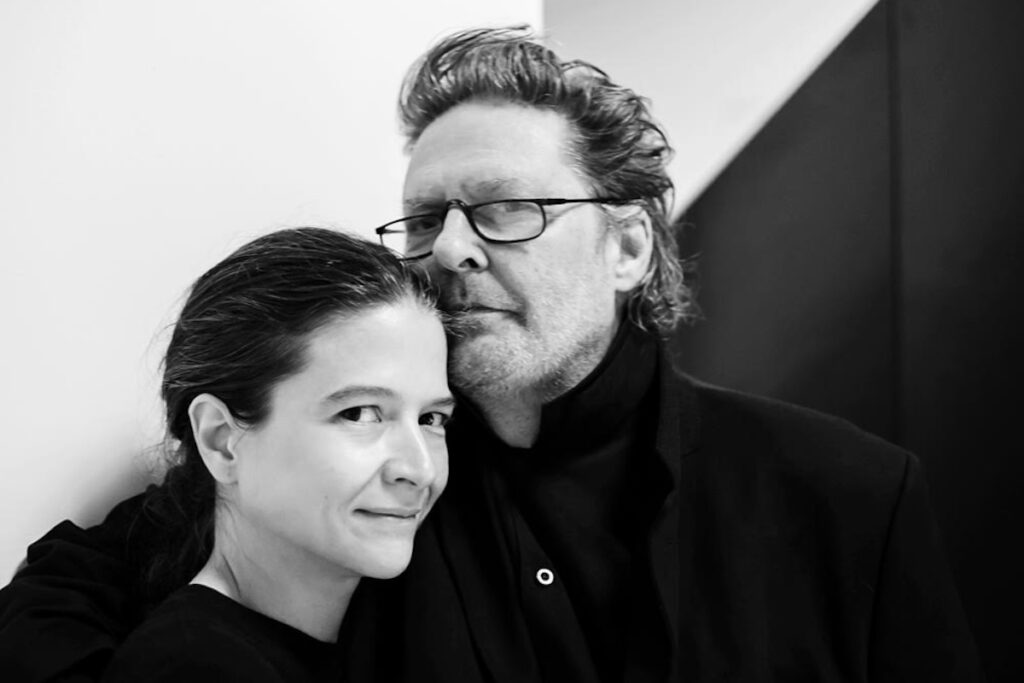
The revival of Symphony No. 13 offers a welcome opportunity for Bloor to come back to Branca’s music, but conducting is a totally new experience for her. As a guitarist, the most important thing is to follow the score and make sure you’re keeping up. The music is loud and all-consuming. But as the conductor, she has a bird’s eye view. “It’s a new challenge,” Bloor said. “Being able to hear all of the parts clearly and how they interact, and being able to see it, is a different experience than being inside of it and trying to concentrate on my part while overhearing the rest of it.”
This is also the first time Branca’s music will be heard at Lincoln Center. “I wish Glenn got to see it,” Bloor said. “It is a little humbling to be standing there in his stead, because he should be the one standing there, but it’s my responsibility now, so I take that seriously.”
Though she will be taking on a new task, Bloor is looking forward to playing Branca’s music again. The first time she returned to his music after his passing was for a fall 2019 celebration of The Third Ascension. “I thought it would make me sad, but it’s the opposite,” she said when reflecting on the show. “I feel at home when I’m playing [his music].” This time, she gets to do it with 100 musicians making the loudest sound they can muster, together. “Even though he’s not here, it feels like he is,” Bloor said.
I CARE IF YOU LISTEN is an editorially-independent program of the American Composers Forum, and is made possible thanks to generous donor and institutional support. You can support the work of ICIYL with a tax-deductible gift to ACF. For more on ACF, visit composersforum.org.