A last-minute venue change brought Chinese Arts Week’s presentation of Du Yun’s The Ocean Etched in the Forest (刻在森林的海) to the compact David Rubenstein Atrium at Lincoln Center. Every seat was filled before the July 24 performance began, with ushers steadily guiding late arrivals toward standing-room sections. Within the audience were a noticeably large number of children and teenagers; a fitting presence for a work that asks listeners to recover a sense of possibility often lost in adulthood.
The Chinese American Pulitzer Prize-winning composer describes the major work as a “reimagining” inspired by the traditions of the Jino people. Living in the rainforests of Yunnan, the Jino have long understood conservation as a way of life, with ecological stewardship woven into their spiritual beliefs and quotidian practice. Their relative isolation suggests a curiosity shaped by circumstances that are radically different from Western capitalist society. These ideas are explored through the eyes of young people, whose dreams remain comparatively unstifled by economic and conformist pressures.
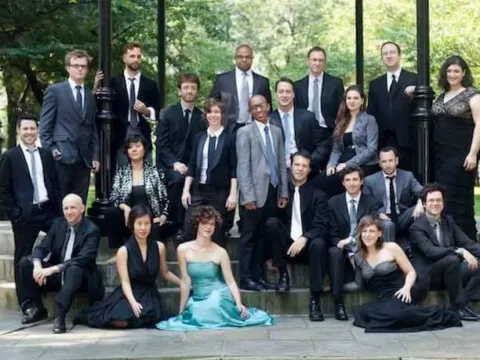
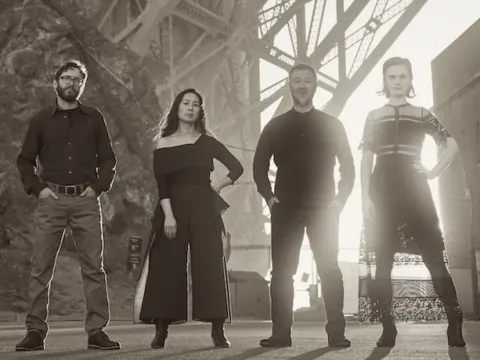
The evening began with a projected video sweeping over densely forested areas and houses nestled along mountain ridges. OK MISS, the part-rock band, part-chamber ensemble directed by Du Yun, established an atmospheric soundscape of sustained electronic drone, breathy flute lines weaving through the canopy, shimmery bowed percussion, and electric guitar dissolving into the texture.
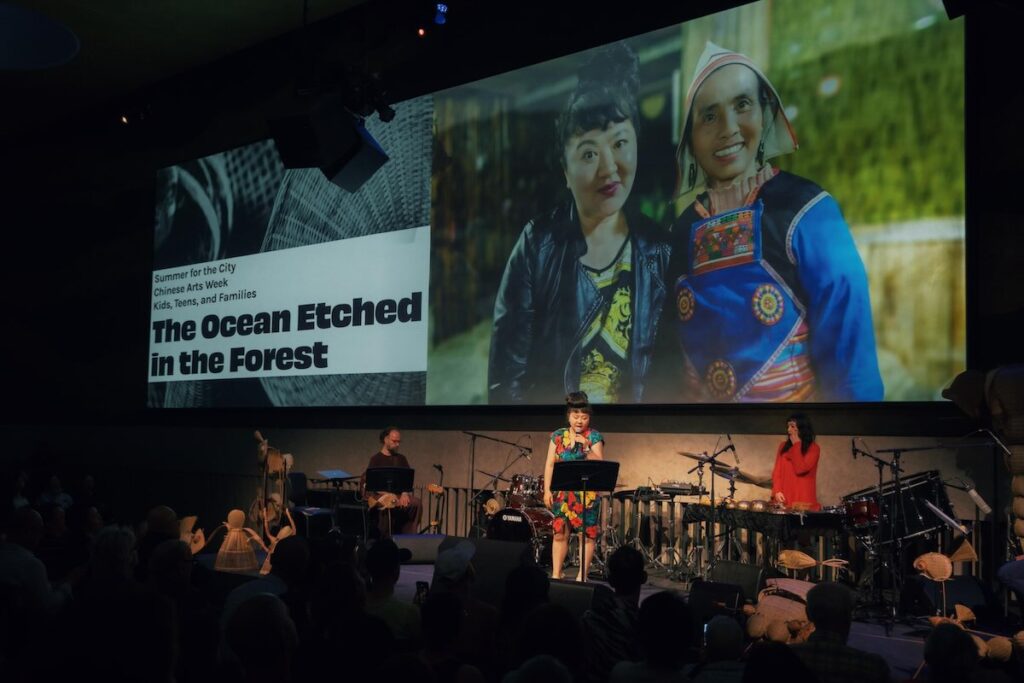
After this immersive intro, Du Yun walked onto stage visibly emotional — her hands trembling, and voice catching at moments — as she recounted the arduous path that brought The Ocean Etched in the Forest (刻在森林的海) to New York. The Jino children who were a critical part of the project had been denied visas three separate times: once in Fall 2025 for the original premiere date, and twice again in the weeks leading up to the rescheduled performance. The children and their families traveled far from their homes in the Badou and Baya villages multiple times for the visa application process, and only one performer made it to Lincoln Center. With this context, the work held a spirit of resistance in the face of impossibility, highlighting the resilience of peoples who seek to define their own collective histories and memories.
The piece moved fluidly between live performance, pre-recorded video, and dialogue between the two realities. Du Yun’s multimedia collaging folded documentary-style footage, ethnomusicological research, and contemporary composition into a cohesive artistic language that also functioned as an act of cultural preservation.
Opening the work, a woman in the forest (Master He, aka He Guiying) sang a luminous folk melody as the musicians on stage accompanied her with a delicate drone. 11-year old Piao Niu (Piao Yunxian) began reciting poetry while the musicians responded with birdcall and sputtering sounds around her. Throughout the work, natural imitation gave way to playful abstraction, the constant movement between tradition and invention a cornerstone of Du Yun’s creative vision.
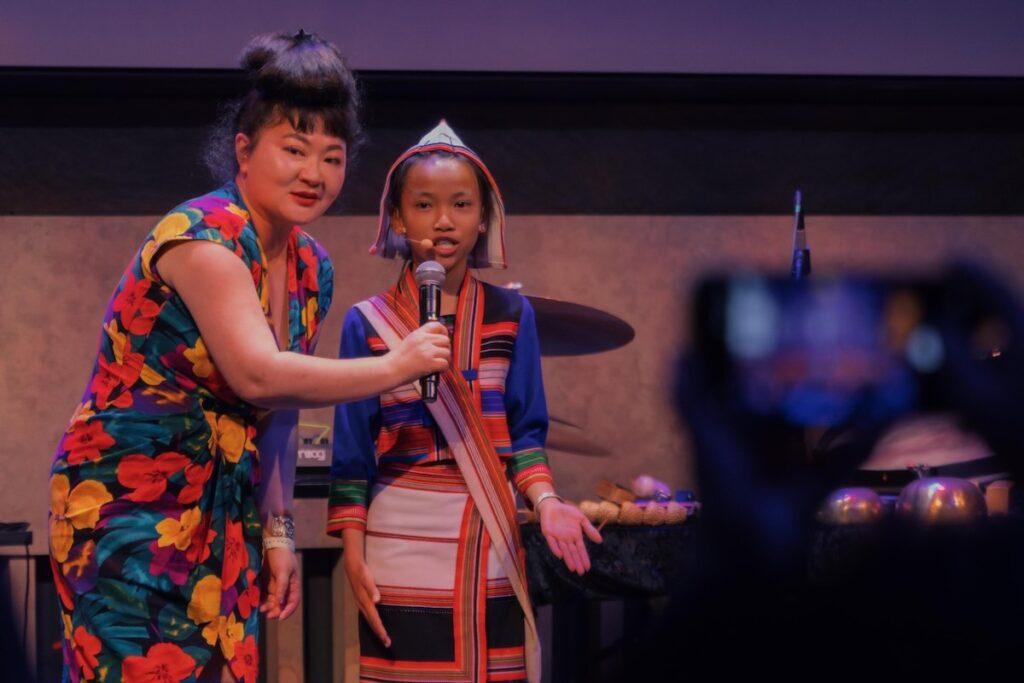
One of the most whimsical bursts of new-music exuberance occurred simultaneously with a video of children animating woven basket animals in a game of make-believe. Du Yun conducted the musicians in their improvisation, eliciting pointillistic responses in short musical fragments. The young girl returned wearing the oversized insect mask shown on the screen behind her to perform the delightfully off-kilter “Flower-Picking Dance.” The music stumbled and lurched, and we laughed at the infectious silliness of the video performance. Laughter could be heard off-camera from the filmmakers, too, collapsing the distance between the realms of presence.
Du Yun’s musical language remained pleasantly expansive throughout the work. One song featured sludgy distortion and pounding drums, with an agile and melodic reed solo overhead. The “Dowry Song” was essentially modern shoegaze with a gorgeous 5/4 melody. During a segment of video animation, OK MISS performed cute hocketing grooves that morphed into washed-out, reverb-soaked guitar.
The collision of vernacular folk traditions, contemporary classical idioms, jazz inflections, and even flashes of doom metal organically emerged from the piece’s restless inquisitiveness and mirrored the conceptual structure of bouncing between past and present, elders and children, ritual and play, sentimentality and humor.
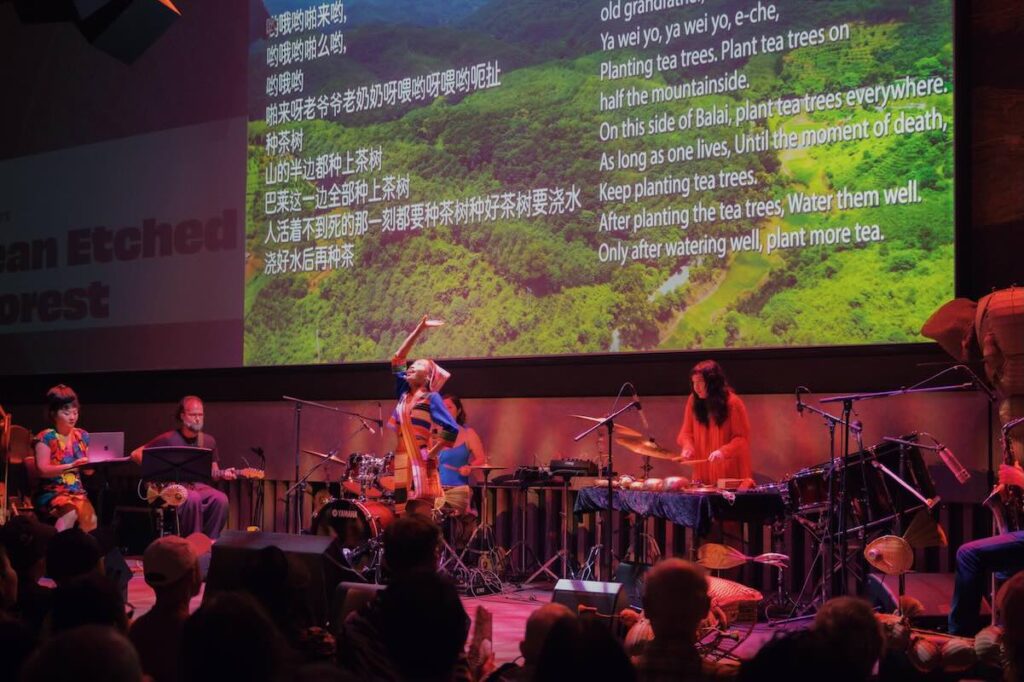
The highlight of the evening came from Piao Niu’s performances of the “Tea Picking Song” and the “Hunting Song.” Wearing a headset microphone, she sang while executing choreography with poise, reminding us of a universal childhood impulse: little girls everywhere love to imagine themselves as popstars. That familiar joy was expressed even through this context, her voice effortlessly soaring above the ensemble. As the tempo accelerated into a frenzy, the music burst apart and evaporated, with Piao Niu diminishing to a whisper as she tiptoed off the stage.
At several points throughout the evening, Piao Niu held up a large woven disc in front of her face. Videos of other children were projected onto the makeshift “screen,” each speaking candidly about their ambitions, families, and traditions they hope to carry forward. Their dreams are both ordinary and profoundly moving: One hopes to become a doctor because their brother can no longer walk. Another wants to teach dance so their heritage will continue through future generations. “I’d like to be a star,” one says. “I’d like to see the ocean.” These tender interludes grounded the production’s ambitious formal ideas in the deeply human hopes of the children at its center. It’s through these dreams of the next generation that better futures are possible.
I CARE IF YOU LISTEN is an editorially-independent program of the American Composers Forum, and is made possible thanks to generous donor and institutional support. You can support the work of ICIYL with a tax-deductible gift to ACF. For more on ACF, visit composersforum.org.