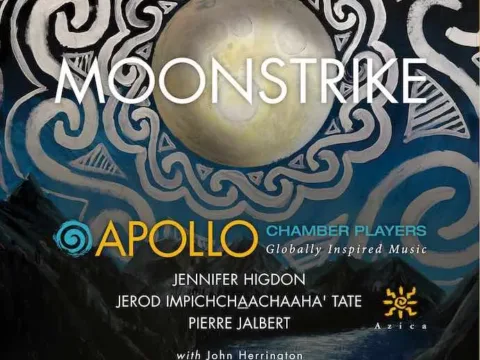
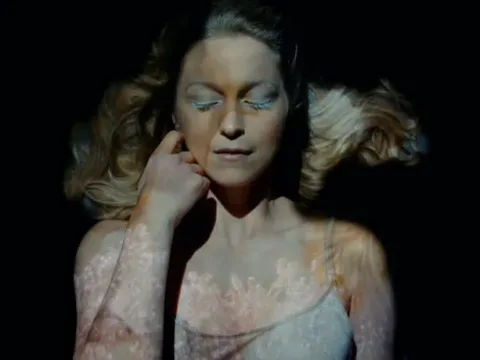
Andrea Clearfield is a composer whose music reaches across histories and artistic boundaries, transforming diverse influences into deeply expressive works. With more than 175 compositions spanning opera, orchestra, choir, chamber music, dance, and multimedia collaboration, her music has been performed widely in the U.S. and abroad. Drawing inspiration from ancient cultures, environmental sustainability, and contemporary identity, Clearfield creates music and frameworks that invite reflection and connection. She is also a pianist, curator, educator — and notably — the founder of Philadelphia’s renowned Szalon concert series.
Founded in 1986, the Szalon brings the 19th-century tradition of salon music into the present. Clearfield invites musicians and ensembles to share brief performances across genres in her living room, facilitating a vibrant space for community and artistic exchange. In April 2020, she shifted gears in response to the Covid-19 pandemic, creating the virtual “Zalon” and extending the decades-old series to audiences online.
On Sept. 27, the now hybrid “Szalon” celebrates its 40th anniversary with a sold-out Philadelphia gathering and free Zoom livestream. Clearfield has curated a dynamic evening spanning classical music, jazz, hip-hop, contemporary styles, and global traditions. The program includes hits like Debussy’s Syrinx and Arabesque No.1, Shostakovich’s Five Pieces for Two Violins, and three Scott Joplin ragtimes arranged by Itzhak Perlman.
Global traditions are central to the evening, as well. Bill Koutsouros and members of ANIMUS perform music melding Greek, Turkish, Latin, and contemporary influences. Chicago-based duo Hun Hazy, featuring Tamir and Naizel Hargana, brings Mongolian traditions to the forefront through throat singing, the tovshuur lute, and morin khuur (or horse-head fiddle). Ginastera’s Impresiones de la Puna, performed by the Primavera Fund Alumni Chamber Ensemble will offer an experience situated somewhere between the Western classical and folk traditions. Together, these performances reflect the expansive musical vocabulary that has defined the Szalon for four decades.
Ahead of the anniversary, we asked Clearfield five questions about her work in curation and community-building.
Congratulations on 40 years of the Szalon! What are your biggest insights as you reflect on where the series started to where it is today?
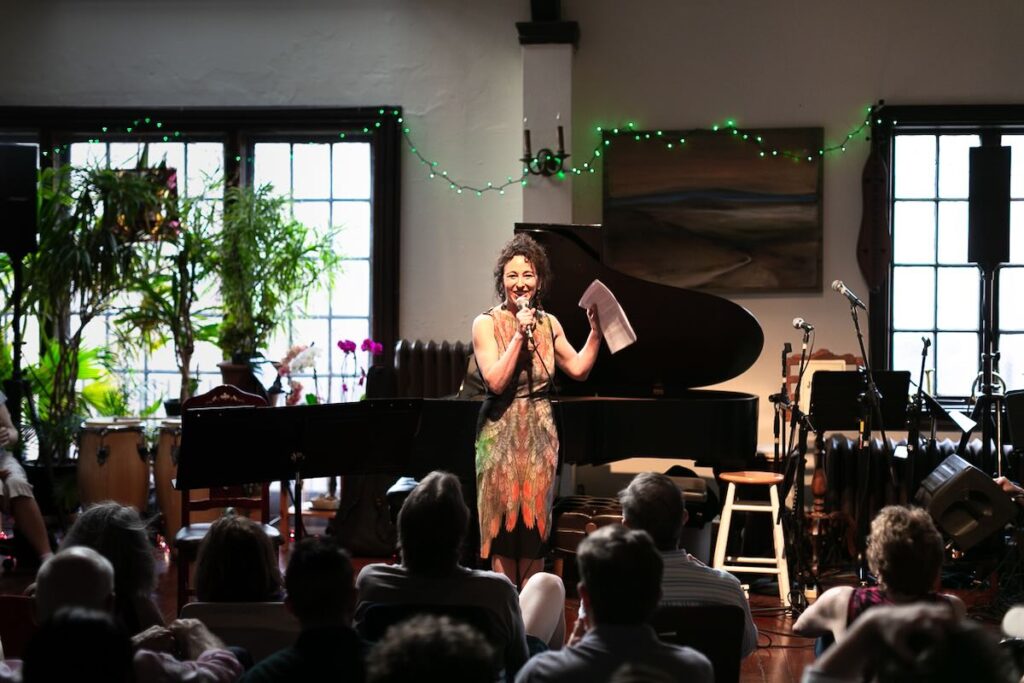
Thank you! When I started the Salon (without the “Z”) in September 1986 in my small T-shaped apartment in Philadelphia (where people sat in the bathtub when there were no more seats), I created a programming format of 10 ensembles, 10 minutes each, spanning classical, contemporary, opera, jazz, world, folk, fusion, and more. Multi-genre programming wasn’t something I could find; it grew out of my own eclectic musical interests as a young composer and pianist, along with an early fascination with the interdisciplinary salons of 19th- and early-20th-century Europe. The diverse programming creates a cross-fertilization of audience and a sense of discovery: people may come for their favorite folk singer and find themselves stirred by a contemporary classical work, a modern dance piece, or an Indonesian gamelan ensemble. I’ve kept the same programming all these years, and am heartened that people still resonate with it, even as times and interests have changed.
In 2003, the Salon found its current space in a large loft of a historic home — with room for dance, multimedia collaborations and choirs as well as expanded seating for a growing audience. New creative possibilities emerged: performers could now use different levels and spaces for a more immersive experience. In 2014, when the house went up for sale, supporters from around the country invested in purchasing the property so the Salon could keep its home. It was truly a miracle. I will never forget what’s possible when people come together around something they value.
During these 40 years, the Szalon has built a devoted audience — over 20,000 attendees and 10,000 performers — continually expanding through the new hybrid model. The team has grown too (a house team plus a local and remote tech team), becoming like a family, all of us volunteering for this labor of love. I’m now thinking about new directions: partnerships, highlighting emerging artists, and commissioning. My biggest insight, however, is an even stronger conviction in the power of community connection through music and other arts, especially now with so much division around us. And as arts institutions are struggling with funding cuts, I’ve come to see these intimate spaces — mine and so many others — pointing toward new ways the arts can be sustained. Salons are on the rise, and it’s wonderful to witness.
After the U.S. government deemed the Covid-19 pandemic to be “over,” many organizations did away with their virtual presentations. Can you share why you continued the hybrid format, and what the impact has been?
When the Salon had to cancel for the first time in 33 years due to the pandemic, I was heartbroken. A friend and music technologist, Adam Vidiksis, offered to help take it online. We wanted to keep the personal quality of the Salon intact so we chose Zoom rather than a view-only platform, with a community welcome, an active chat, a virtual toast, and a Q&A with the audience and performers afterward. In April 2020, we launched this online iteration as the Zalon (Zoom Salon). Musicians and dancers performed live from their homes and studios around the world. It was stimulating, exciting, and deeply healing to connect across the globe. The Q&A became a space for stimulating conversations; artists would share how the pandemic reshaped their work.
As audiences returned in person, I received messages from the online community: please don’t lose us, the Zalon has become our lifeline — a confirmation that the online component needed to continue. So when our technical director Gerardo Razumney designed a streaming-in-and-out hybrid format in 2021, we kept the personal element: in-person performers with in-person audience, remote performers streaming in live from their location, all streamed out. The interactive Zoom elements continued, and the online Q&A took place while the local folks engaged at a reception. That hybrid format became the Szalon — Salon house concert meets Zoom Zalon. The name stuck.
I have long believed that humanity connects through the global language of arts, and the Szalon has grown to reflect that: a classical chamber ensemble performing in my Philadelphia living room, followed by a Nepalese music ensemble streaming live from Kathmandu, nearly 11 time zones ahead, or a cellist performing from the Republic of Georgia in a sauna — the only space available without disturbing anyone at 2am. There’s still a feeling of amazement that this is possible!
The impact has been an expanding community, greater joy and wonder, and a deepened personal mission to keep the Szalon going to help create more compassion, beauty, and connection in the world.
What do you think a living room (or other small, intimate space) can offer that a traditional concert hall cannot?
Unlike a dark formal concert hall where one views performers at a distance, a living room has little separation between performer and listener, and a kind of magic arises. Just a few feet away, at eye level, you can watch a bow arm, notice how a performer breathes, and see an instrument you’ve never encountered in detail. You can hear the most delicate and sensitive phrasing, catch lyrics in a song, observe subtle interaction between ensemble members, and feel, through palpable energy, a wide range of emotions that an artist conveys. Performers can feel the love in the room, inspiring them to give their all. Some tell me that this experience brings them back to the roots of why they became a musician. The dynamic exchange between performer and audience makes attendees feel like active participants, not just observers. Performers address the audience before they play, explain what to listen for in a new piece, or invite participation in a way a formal hall rarely allows.
I think people are hungry for this kind of intimacy. We live in a multisensory world where we’re constantly scrolling, multitasking, losing ourselves in digital noise. I invite people to exhale, drop in, find the grace of being receptive, to remain open to what might be unfamiliar. In this welcoming space, I find that audience members are more apt to receive a new piece of contemporary music that might require a different way of listening. The conversations that follow, at a reception or meal, are precious gems. This shared experience can lead to new insights and understanding, lasting friendships and collaborations.
This trend for intimate spaces isn’t unique to music or to the Szalon. There are so many meaningful and vibrant salons cropping up all over the country, from interdisciplinary, poetry and visual-arts gatherings to craft, book, and thought-leader salons. I think they all fill an important need for authentic human connection.
How has creating and curating the Szalon influenced your own artistic practice? Has the experience of hearing so many different artists and traditions changed the way you think about your own music or collaborations?
I’ve always embraced many styles of music. In younger years I played in chamber groups and rock bands, in new music, experimental, improvisation, and world music ensembles. Collaboration and community were a big part of my upbringing — playing chamber music at home with my parents, inviting friends to play my earliest compositions, writing music while my mother painted in her studio, collaborating with dancers in college.
Curating the Szalon exposes me to a multitude of different artists, styles, and cultural traditions, widening my own ears in the process. It helps satisfy my ongoing curiosity: what other composers are writing, what fresh approaches ensembles are exploring, what fusions are emerging, how interdisciplinary collaboration is evolving, and what different generations are moved to create and perform.
The “We” has become even more important to me over the years. As a composer, I’m more and more drawn to collaboration, particularly writing in operatic and multimedia cantata forms, working as part of a creative team. Building works together can be such a high experience, uncovering possibilities one could not imagine alone. Hearing so many different kinds of music at the Szalon inspires me to pursue new territory in my own work.
My recent premiere, Long Live the Queen (a her-story of drag), a large-scale cantata for soloists, four choirs, and chamber orchestra, is an example: a three-year project with drag artist, librettist, and opera singer Cookie Diorio. The work stretched me stylistically, and the process of building this 90-minute piece together, experimenting, and developing material as a team, was deeply rewarding.
Beyond actually organizing the Szalon, you also advise other curators and do work as an educator. For you, what is the role of mentorship and education in sustaining the next generation of musical communities and presenters?
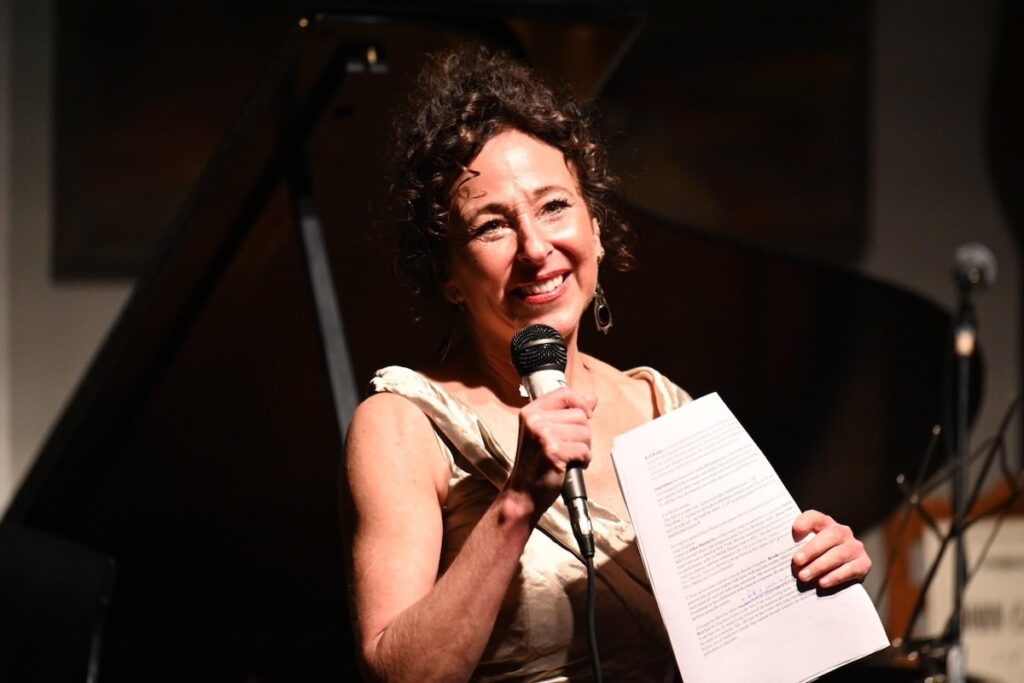
I’m committed to sustaining music’s future and the next generation of musicians and presenters by helping others start salons around the country, training their teams and hosting events, as well as working as a visiting composer. I’ve presented in entrepreneurial programs on salons, and worked with students on how they might create their own — discussing spaces, format, community, and funding. Having the opportunity to assist a next generation in building that infrastructure is inspiring and edifying.
I was fortunate to have a mentor for almost 40 years — composer Margaret Garwood, who believed in me as a young composer and paved the way for many young composers at that time — and I want to do the same for others. I serve on the board of Wildflower Composers, an organization that amplifies young female, transgender, nonbinary, and genderqueer composers. Commissioning and mentoring emerging composers and presenters is a direction I’m pursuing as the Szalon enters its fourth decade. Someday I’ll be glad to pass this legacy on to someone passionate about continuing it — in their own way, in their own space. But probably not for a while.
Szalon’s 40th Anniversary performance is Sunday, Sept. 27 at 7pm EST. You can attend virtually at https://www.zalonarts.org/next-szalon.
I CARE IF YOU LISTEN is an editorially-independent program of the American Composers Forum, and is made possible thanks to generous donor and institutional support. You can support the work of ICIYL with a tax-deductible gift to ACF. For more on ACF, visit composersforum.org.