Weston Olencki is a U.S.-born, Berlin-based musician and composer whose work is fundamentally concerned with the cultural history of instruments and music making. In a recent interview with Talkhouse, Weston speaks to growing up in South Carolina and marching for Drum Corps International, only to later recognize it as a “musical pantomime of imperial battlefield movements.” Their essay “For Instruments” further reflects on their upbringing and challenges the art-world attitude that views “cities as the only places for progress.” Across a growing discography, their work investigates the usage and assumptions around instruments — and the cultural practices that surround music performance across genres.
Their new album, when the great fires were lit on the other side of the ocean (out Sept. 30 via Sweet Wreath/TAK Editions), explores the philosophical, spiritual, and cultural beliefs surrounding the advent of electricity. The collaborative project with TAK Ensemble is the culmination of a deep research process, creating soundscapes that mimic, respond to, or directly incorporate electricity itself.
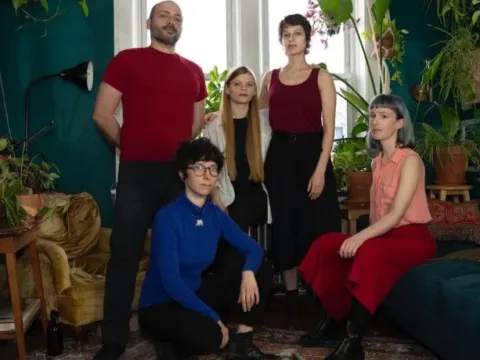
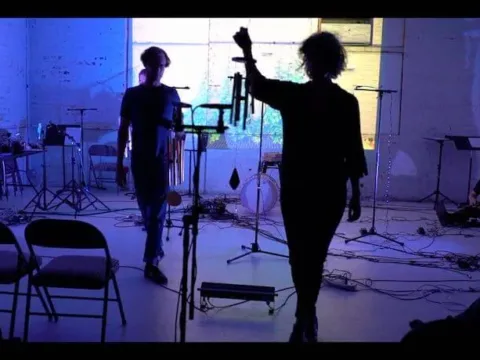
“seven kilometers upriver from Suspension Bridge” begins with an outdoor field recording of river noises and wildlife, lasting almost a minute before pitched percussion, bowed vibraphones, gleaming and tinkling metallic noises enter. Woodwinds creak and drone, mimicking a 60hz ground hum, which eventually takes over the soundscape. This electric hum continues into the next track, “‘An Crithir’, or ‘The Spark’ (… a bhfoghar gotha graineamhuil le mhead an eigin arabih Fiacha …),” an Irish folktune translated by Dylan Kerr. Soprano Charlotte Mundy is at first accompanied by a distant choir of voices, but when the song escalates in emotional intensity, the entire ensemble creates a blistering wall of noise, seemingly blooming from the electric noise that opened the track.
In advance of the album release, we asked Weston five questions about how they integrate research into their artistic practice.
Reflecting on this decidedly collaborative album with TAK Ensemble, how does collaboration fit into your process generally? Do you draw a line between “composer” and “collaborator,” and if so, where do you draw it?
There’ll be some kind of line, but I prefer to not draw it in advance. I’ve found it easier to assess along the way what it is that we want to really make and what that particular music needs to thrive – whether that’s anything from full group authorship to traditional working divisions – and then go from there.
I do feel like, as I’ve gotten older, that I work better in more defined roles (composer, performer, engineer, etc.); but those roles change often and are pretty different from project to project. All that being said, creative input is by nature collaborative (even if some people don’t want to see that labor or give credit to it), and any art is obviously shaped by everyone involved. In the composer role, I just try to read this proverbial room and honestly gauge what aspects of the piece I’m responsible for working out and what should be left open for other folks’ voices.
So for this piece, I was much more of a composer in the traditional sense, notation and all. The piece really is for TAK though – who they are as individual musicians and as a collective unit. In some cases I worked directly with their own creative materials (with consent, of course); others I wrote with their individual stylistic tendencies front of mind. These days with notation, I’m more frequently on the performing side of the music stand. So it was a fun challenge to make a very detailed document but then let it go and have them run with it.
You describe this album as a “part conceptual research obsession.” Do you tend to generate musical ideas alongside your research, or do you let your personal investigations guide the work?
Both, definitely. Some ideas jump out during the research phase and others burn slowly in the background. The most accurate metaphor I’ve found is that inside your brain there is a magnet or a piece of flypaper. You take in many things, form ideas, follow the threads you feel drawn to, and at some point you start to notice patterns and connections between what continues to stick and sprawl internally. Usually somewhere in there is the piece.
I just try to be as porous as I can during this whole process. Sound has been great for externalizing this kind of associative thinking, where one can work with layering and entanglement in such a direct way, weaving together many different threads in time, frequency, or in structural form.
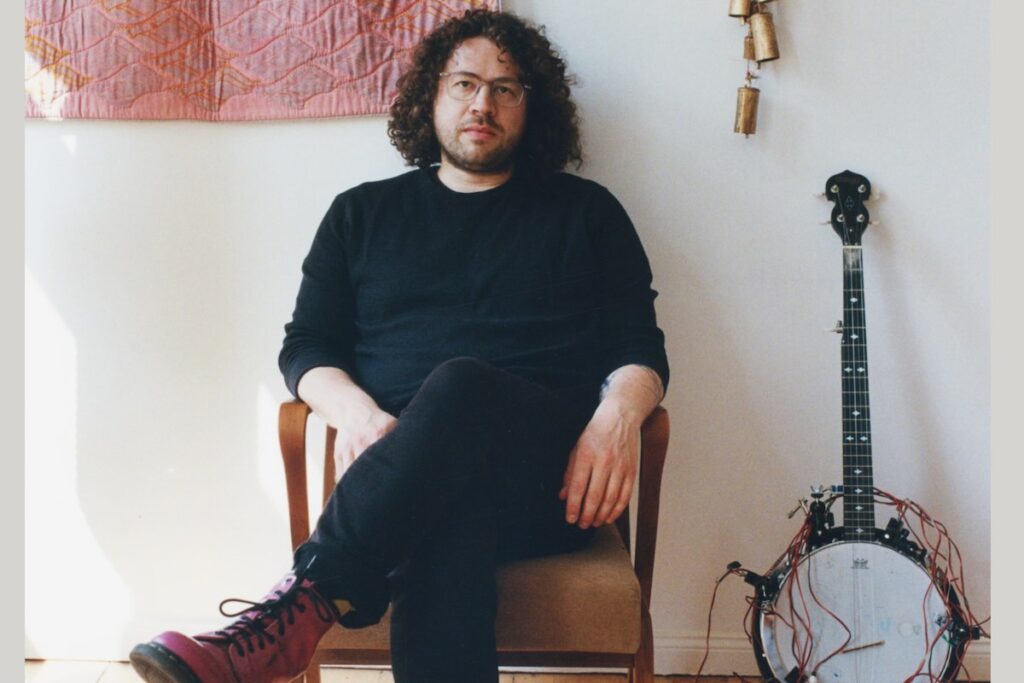
Your 2025 album Broadsides is about the cultural weight of individual instruments, but your new album is inspired by a non-musical research practice. As someone who writes music “with, for, and about instruments,” how do you see when the great fires were lit on the other side of the ocean fitting into the broader arc of your work?
I would still say it’s musical, actually! I work a lot with electronic sound but when I started this piece, I didn’t really understand the context for exactly how we made electrical power into a resource, so the initial seed was reading up on the history of the power grid.
Some musical ideas were pretty immediate, like how a generator’s frequency, phase, and harmonics can be understood from both a scientific and sonic framework. This laid the groundwork for the piece’s ratio-based harmonic language set over to the 60Hz cable hum. From there, my internal magnet was directly more towards the ‘electricity’ part of electronic music: what were the circumstances that occurred so we could even plug something like a synthesizer in and have a ‘history of electronic music’ in the first place?
So, sure, from a broader perspective it’s less musically-oriented. But we’re working with this phenomenon in every synthesized sound: microphone capture, cable hum, playback device, plugin, etc. Finding this kind of depth to such a seemingly common thing as a wall socket was really generative.
In the context of my other work though, this piece actually felt pretty similar to my other recent records and pieces I write straight into software. But great fires was just realized a bit differently in the end through notation, chamber music, and faux academic scholarship.
The vinyl edition of this record comes with an article based on a lecture dated 2054. The Bandcamp page specifies that the album was restored from a digital negative backup in 2074, followed by a reissue in May of 2076. Can you talk about how you’ve designed the materials in this project to simultaneously look to the past and the future?
Normally, very little of my reference material makes it into the piece in an explicit way. But many of my sources for this were so wide-ranging, if not downright fantastical to the point of appearing fictional, that I wanted to try to get more of that context across somehow. Depending on the time period, electrical power, lightning, electromagnetic radiation, what have you almost acted like a surface that people projected their own ideas of the future onto, whether those were utopic, dystopic, empirical, magical, etc.
I became interested in how documentary processes like scholarly writing or archival cataloging impart some sense of “authority” (or at least credibility) to all of these speculative tangents, and in this spirit I wanted to try and invent a few sources of my own. My contrafacta are all rooted in actual history, especially these turbulent decades around the turn of the 20th century. I took advantage of the haziness of historical distance to open some kind of imaginative space between “what could’ve happened” and what actually did.
With the futuristic bent, I just applied that same idea to our present time, playing with the distortion between a current event and its potential movement into historical/archival memory. So for the first performance, I assumed an academic pseudonym to narratively work out a lot of the threads at play. It’s structured as a pre-concert talk given before a retrospective concert in 2054 “re-staging” my own 30 year old piece (actually just the first performance), based on fictionalized musicological research done in the interim by my pseudonym’s academic advisor (also an alter-ego).
A different alter-ego then later transcribed and over-footnoted this lecture as an accompanying study packet for the LP “re-issue” (which is also just downloadable on my website). It’s meta and totally ridiculous, but it felt right to inject some playfulness and absurdity into a medium that’s all too often rigorous and esoteric.
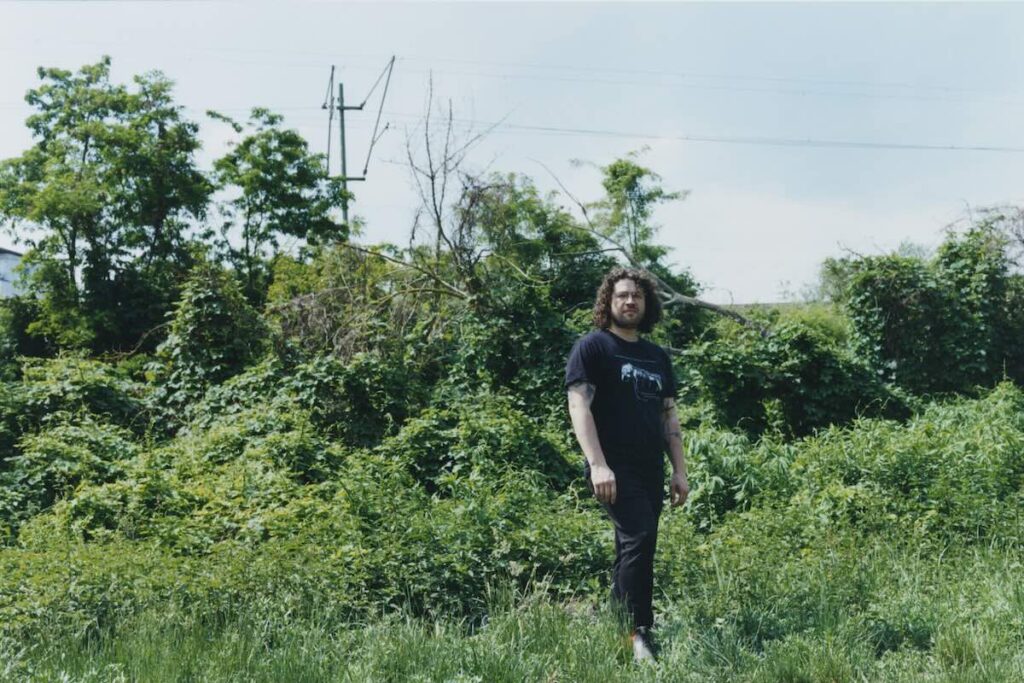
I’m writing these questions shortly after being forced to cancel a performance due to wildfires in the Pacific Northwest, and I’m thinking about how many data centers I drove past as we evacuated. How do you see your music in dialogue with current anxieties about climate change and the use of AI?
I’m sorry to hear of your situation recently, and also fear for this current reality that’s unfolding so quickly. Last time I went to visit my dad, I was also shocked when flying over Charlotte just how many new data centers and warehouses had been built even in the last year since I’d been back there.
I’m not necessarily trying to make work explicitly in response to these huge changes. But definitely my subject matter, value systems, and what choices are personally meaningful or not, are all directly related to what is going on. It’s maybe worth mentioning that prior to 2023, I had been working quite a bit with machine learning, neural synthesis, etc. At the time, it felt like pre-GPT “artificial intelligence” was crude enough to still be kind of useless in an extractive or economic way. It malfunctioned often and even its successful results weren’t very realistic; that glitchy, uncanny error margin had some interesting musical and poetic potential at the time.
With the sudden public rollout of AI-powered surveillance, military targeting, sharpened wealth inequality, and the very real reality of its cancerous ecological and societal effects, I swore it off and wanted no association. But now a few years later, it’s clearly accelerated and here to stay whether we like it or not. Avoiding it or pretending ignorance doesn’t feel possible anymore.
But also making “political art” about or against it is in no way a replacement for actual action and changes in consciousness. I do feel like this resistance can and maybe should also push back on all scales, even in the marginal details of how we live and work.
So, while I’m obviously firmly against the forced rollout of billionaire-backed AI and data centers and the culture around all of it, I’ve been trying to find ways of at least critically acknowledging the monster; parsing its dangers to the actual world on the one dying planet that we have.
I’m still figuring out how to work with it. I’ve been following in particular how these changes are playing out where I grew up in the American South, a place so deeply and visibly scarred by its extractive past. The region has seen booms and busts of speculative, frenzied, and blood-thirsty economies before. These new warehouses or data centers are often being built in exactly the same communities forsaken by previous cycles of resource depletion. It’s been extremely troubling to see how these skeletons resurface again and again in new guises – but also fascinating to learn how people generations before us resisted similar forces that felt just as immanent and overwhelming.
Without being a total doomer, one thing that’s been interesting to track is this expanding sense of planetary scale and global consciousness; how the very local ties into the very global even down in details where we least expect it. There’s a real interconnectedness and solidarity increasingly felt across huge spans of time and/or distance – and over certain boundaries that maybe felt much more unbridgeable a few decades ago.
In terms of artmaking itself, I find it really gross when I see these problems used to justify grifty art-world grasps towards cultural relevance. But these developments will continue to impact us so fundamentally on such a baseline human level that, as we try to continue making sense of the world, I’m curious how it’ll all show up in some way in our art.
I CARE IF YOU LISTEN is an editorially-independent program of the American Composers Forum, and is made possible thanks to generous donor and institutional support. You can support the work of ICIYL with a tax-deductible gift to ACF. For more on ACF, visit composersforum.org.