On their new album Generate Music (XAS Records), PRISM radically reimagines the saxophone quartet as a platform for facilitating cross-cultural artistry and community connections. The ambitious project transforms a visceral museum encounter with anti-Black and antisemitic Nazi iconography into an ecosystem of collaborations between Black and Jewish artists. From this, Generate Music has created a timely, stylistically rich, and utterly profound body of music, poetry, and dialogue.
PRISM’s Matthew Levy and the late Helen Haynes shared a deep friendship and personal connection to Jewish and Black communities in Philadelphia that nourished the project’s visionary curation. Even with a supergroup of performers and internationally renowned composers, the project’s true heart rests in substantial community programming. Reading lists provided context for Black and Jewish American life. Pre- and post-performance talks and panel discussions at Jewish and African American cultural institutions brought questions to communities in Philadelphia. The album release arrives as more than a collection of recordings. It functions as a potent distillation of the project’s lifeforce: community-driven artistry.
The opening tracks set a grand stage for the album’s stylistic terrain, emotional trajectory, and conceptual stakes. In “a makeshift,” Ursula Rucker enters as the elegant embodiment of both the griot and the cantor, intoning a litany of spiritual values and cultural practices shared in Black and Jewish traditions; PRISM flows through chorale melodies connecting stoically optimistic unisons and tense chord clusters. David Krakauer’s “The Unknown Common Ancestor” initially finds soloists hard-panned across the mix: Krakauer riffing on Klezmer clarinet, David Gilmore comping electric guitar, and Matthew Levy and Taimur Sullivan boisterously grooving in hip-hop/jazz. Alluding to Krakauer’s fusion project Abraham Inc., funk becomes a culturally heterogeneous meeting place as the ensemble joins Levy’s melody to surround the listener.
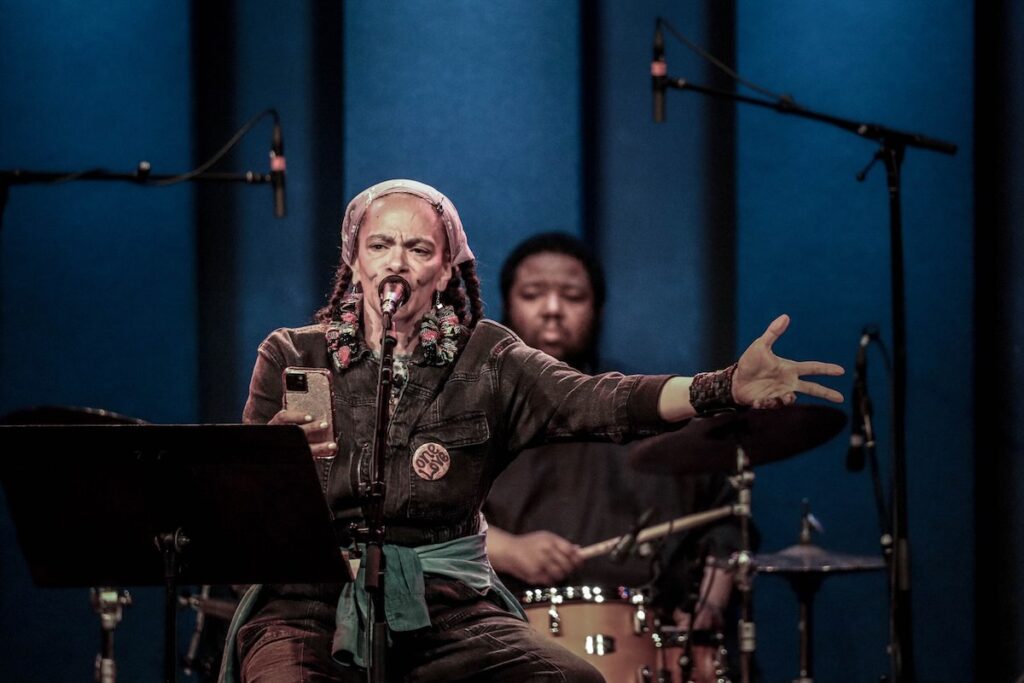
Fred Wesley’s “Requiem for AJ” steers the ensemble through a melancholic funk groove mourning the death of his friend while remembering political solidarity between Black and Jewish communities. Rucker recounts the deaths of Andrew Goodman, Michael Henry Schwerner, and James Chaney in 1964 during Mississippi’s Freedom Summer to underscore the slow pace of change, exasperatedly concluding: “Will you even care?” The ensemble responds to Rucker’s provocation with solos propelling towards conscious action: Gilmore stays cool while delivering fiery electric guitar runs, Roger Reuben’s bass lines dance with political vigor, and Tyshawn Sorey fuses angular percussive riffs with driving purpose.
Sorey’s “Untitled Composition for Saxophone Quartet, Guitar, and Double Bass” abruptly shifts the mood to an abstract timbral exploration, pausing the album’s momentum toward music as a clear panacea. The program note invites audiences to make their own meaning from the slowly unfurling dissonances and flickering harmonic clusters. The piece opens up space for divergent reflections: a rebuttal to fascist disdain for modernist aesthetics, an homage to experimental aesthetics in Black and Jewish communities, or a space for tensions to unravel ever so slightly.
The next tracks poignantly model how artistic exchange can process unresolved personal grief, loss, and anger within communities. Rucker’s “Let Us Gather & Go Together, Can We” is an emotional response to the murder of her older brother Ricardo Angelo Rucker by a Jewish pharmacist in 1985. Rucker’s observations embrace bracing contradictions: a fiery poetic voice couldn’t quench rage; her mother’s anger taught her to forgive; mothering sons allowed her to mourn loss. The accompanying free-form improvisations support her testimony, enacting her call to redirect individual experiences of systemic injustice from divisive hate to communal healing. Matthew Levy’s “Lament” extends this sentiment, rearranging music and emotions composed in grief following his father’s death into an empathetic offering of soaring saxophone and stirring string melodies.
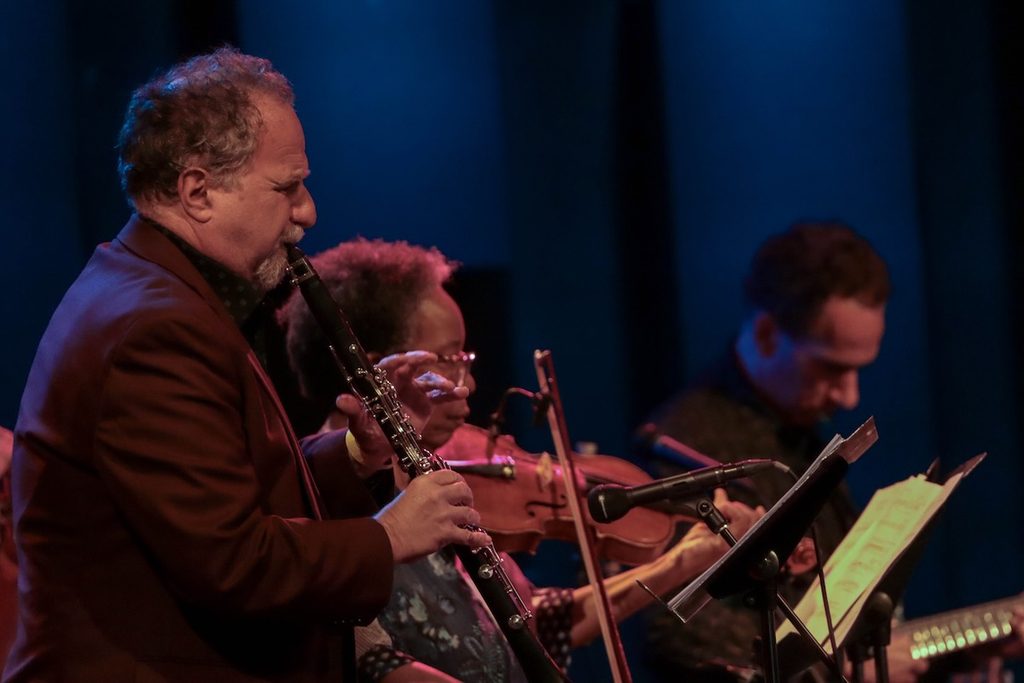
Pieces by composer-performers from Philadelphia offer equally nuanced perspectives on the connections between Black and Jewish traditions in the city. On “Convergence,” fourth-generation Ukrainian Klezmer musician Susan Watts juxtaposes a mournful doina (a plaintive traditional lament) with hard-driving grooves that propel klezmer riffs into a psychedelic stratosphere. Later, Watts’ heartfelt performance of her own Yiddish arrangement of “Lift Every Voice and Sing” cultivates solidarity in complementary spiritual traditions of struggle and song.
Diane Monroe’s “Ironies” finds traditions already fused through her grandparents’ omnivorous musical taste and participation in Black synagogues and churches. A swirling improvisation conjures a storm, spanning spiritual drumming and gospel songs to wailing cantorial and blues cries. In the second half, Monroe’s dazzling, polystylistic violin playing generously connects divergent funk styles and soloists echoing Rucker’s poetic cry for new types of spiritual kindness.
The final tracks offer unflinching reflections on the meaning of Zion within Black and Jewish diasporas. Yotam Haber’s “commotio cordis” finds tension in the promise of Zion in the wake of the October 7th attacks and ensuing conflict in Gaza. Wanderings through blinding tone clusters and briefly emerging melodies find the peace of a promised home ruptured, while abstracted West African bell patterns and Rucker’s fragmented poetry create an uneasy tether. Myra Melford’s “When the No Way Stops Short of the Somehow” soberly animates Erika Hunt’s poem tracing how myopic interpretations of Zion can violently betray its promise of “peace and plenty for every neighbor and stranger.” Hunt’s call to “wake up” shakes the ensemble into a final cacophonous echo.
Generate Music plunges into a multivalent space, wading through the intricacies and tensions shaping the intersections of Black and Jewish life. The remarkable project facilitates deep study — not in the academic sense, but in the ways that it provides day-to-day frameworks for the interpersonal dimensions of systemic discrimination and community history. The brilliant performances on the album offer moving (and grooving) ways of thinking, feeling, and being in the world together. Taken in whole, the project offers a necessary and artistically compelling approach to culturally responsive creative work as dialogic and generative.
I CARE IF YOU LISTEN is an editorially-independent program of the American Composers Forum, and is made possible thanks to generous donor and institutional support. You can support the work of ICIYL with a tax-deductible gift to ACF. For more on ACF, visit composersforum.org.