Noise improvisation: the craft of experimenting with sound, sculpting a world for the listener to inhabit. Through the act of layering contrasting textures, blasting sound at a high volume, or embracing dissonant harmonies, noise often roots itself in the body and then transports it through the act of listening.
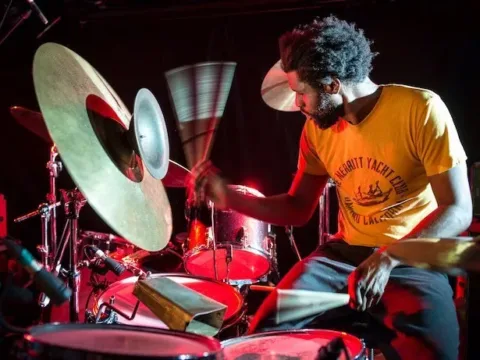
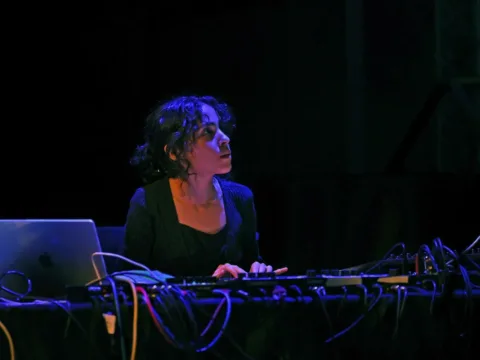
On Sept. 13 at Roulette, two sets offered different modes of immersion. Leo Chang melded eerie electronic music and choreography in a reimagination of the Korean sangmonori dance, while Raven Chacon, Tashi Dorji, and Alex Zhang Hungtai improvised a thunderous set that channeled fervor, mystery, rage, and release. Both explored the contours of sound as it whipped across the room, layering multitudes of sharp-edged pitches and rounded drones into detailed sculptures that consumed the venue. The concert hall became not just a space to sit, but a living organism swayed by the music’s subterranean force.
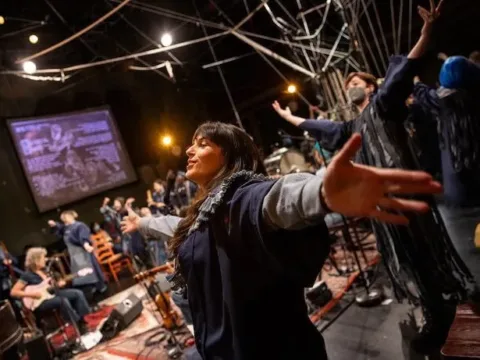
Chang, a Korean-born, New York-based sound artist, showcased his hand-built instruments that blend Korean folk practices with electronic music. At the center of his set was his jeonmonori, a combination feedback hat and amplified gong instrument that reimagines the sangmonori tradition. Traditionally, sangmonori performers don hats with a long ribbon and bob their heads in a unified, swirling dance. Chang’s instrument replaces the ribbon with a microphone, and his circular motions unleash rippling feedback and soaring overtones.
To make this music, Chang took the stage with his jeonmonori, standing between two small gongs and behind his laptop. His set began softly — so quietly, in fact, it was hard to tell when it started, until a teal spotlight shone from the ceiling and the house lights dimmed to black, inviting us into a cocoon-like world. A deep ring encircled the hall as Chang gradually built a lattice of murmurs and piercing static.
At one point, he smashed a gong until the clanging became overwhelming; at another he played a prepared piano that sounded as if it were underwater. But the set’s pinnacle came when Chang donned the jeonmonori hat. He grasped its hanging microphone and held it against each of the small gongs, pulling it closer and further to make a sharp, metallic noise; he let go of the rope and swung it in circles and against the floor, which created a steady stream of crispy feedback. In these moments, Chang’s hypnotic music filled the hall to the brim.

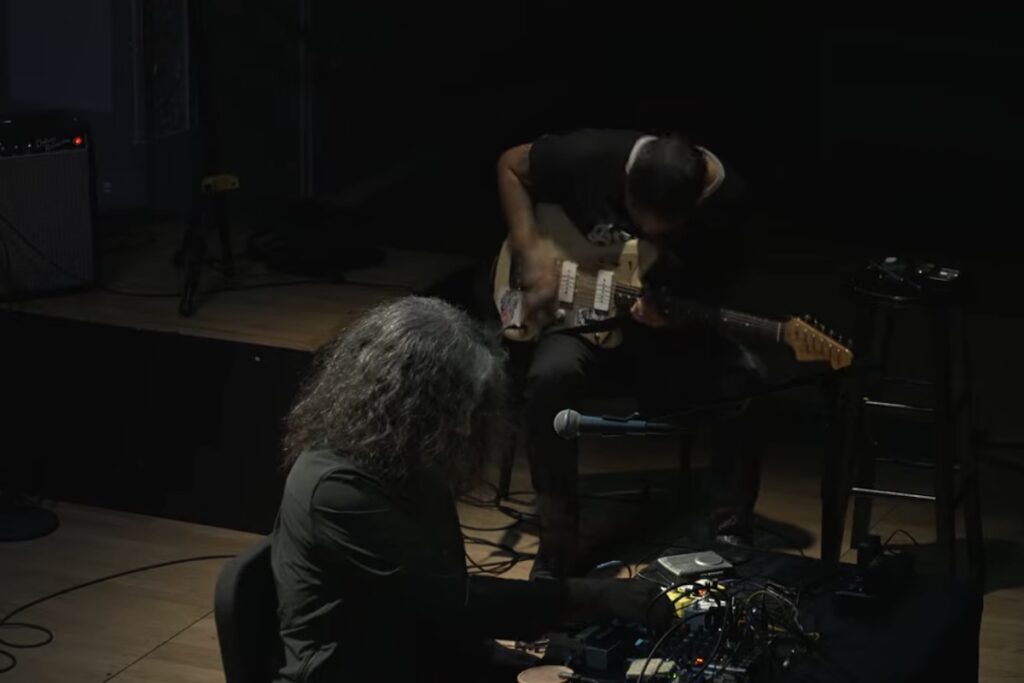
Chacon, Dorji, and Hungtai’s set was similarly mesmerizing, but forged an intense world out of amplified instruments set ablaze. This was an all-star group of musicians, each of whom brought a polished but different noise practice to the stage. Chacon’s spatially focused electronics formed a tumultuous underbelly for the music; Dorji’s bristling electric guitar strums channeled the sheer force of his instrument; and Hungtai’s rippling trumpet riffs and roaring vocals reflected it all back outward. Though their music had the strength to shatter the walls, it remained highly detailed, each part sculpted with meticulous attention to melody, texture, and timbre. This had a dual effect: the music served as both an improvisatory experiment and a full-body experience.
The improvisation began with a low-end rumble, as if a storm was brewing in the distance. A rolling wave of electric guitar chords with frayed, bluesy trumpet layered on top pulled the storm closer to the room. And then, the first lightning struck a few miles away. Every piece collapsed into the others, razing down the delicate structure they had built.
From the rubble, another song emerged, this time with a low-end pulse and a gusty wind that swirled around the room like stardust. The set flip-flopped between fiery energy and hollowed-out quietness, and the apex came when the guitar emerged like a comet, blazing across the palette of electronics as Hungtai screamed into the microphone. In that moment their music offered pure release, a storm whose rain had finally reached the ground.
And then, it dissipated into a wisp of air. The inside of Roulette returned to its natural din, shedding the pummeling electronics that had become its foundation just seconds before. In the minutes the music was there, alive, it was as if we had traveled somewhere else entirely, entering a new space born from the smoke of overtones and slathered in reverb. This is the power of noise: to reshape us from the waves of ever-evolving sound.
I CARE IF YOU LISTEN is an editorially-independent program of the American Composers Forum, and is made possible thanks to generous donor and institutional support. You can support the work of ICIYL with a tax-deductible gift to ACF. For more on ACF, visit composersforum.org.