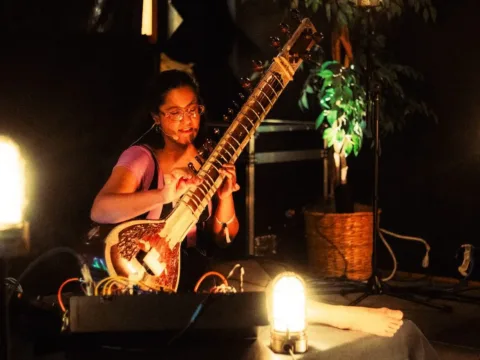
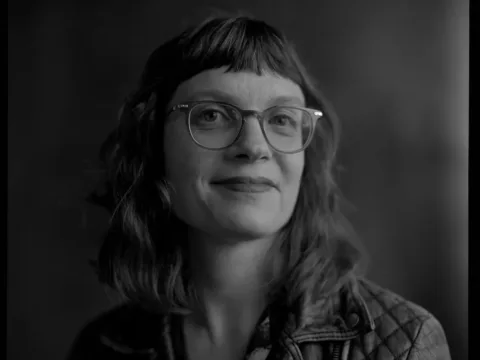
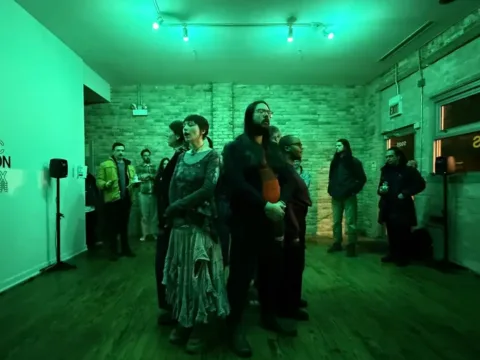
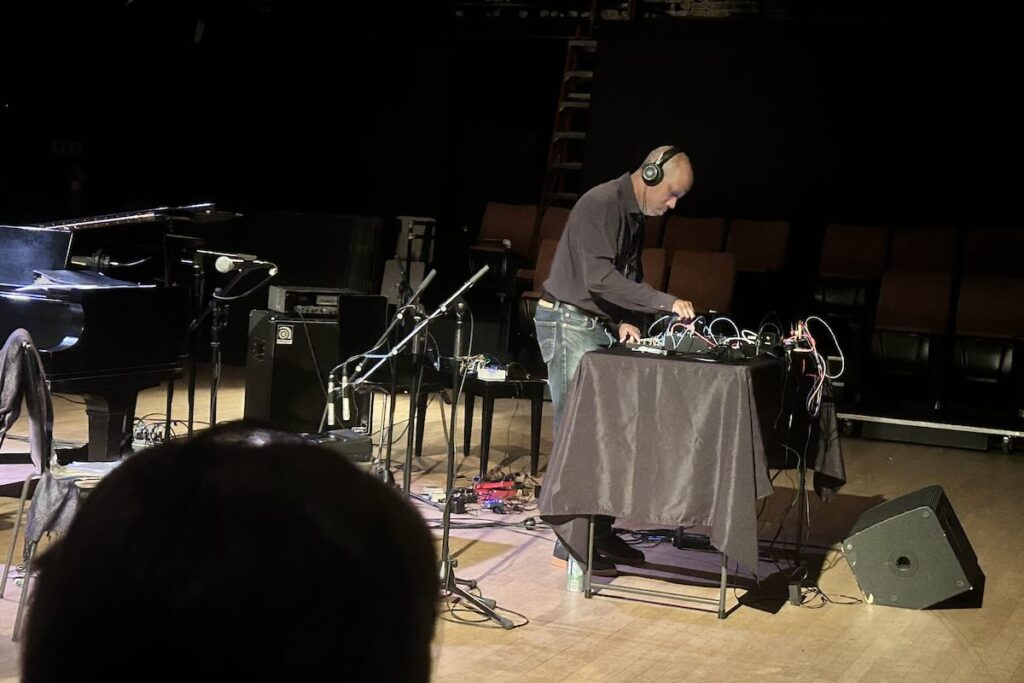
On a cloudless, crisp Saturday afternoon, a crowd of more than a hundred people are huddled in the back garden of Experimental Sound Studio, a nonprofit devoted to Chicago’s creative music scene. ESS is celebrating 40 years of existence today; its co-founder, sound artist Lou Mallozzi, performs a free-wheeling duo set with composer Carl Stone using three turntables and live-processed electronics. Additional musicians whose work ESS has championed over the years are either performing, DJing, or milling about its Edgewater HQ.
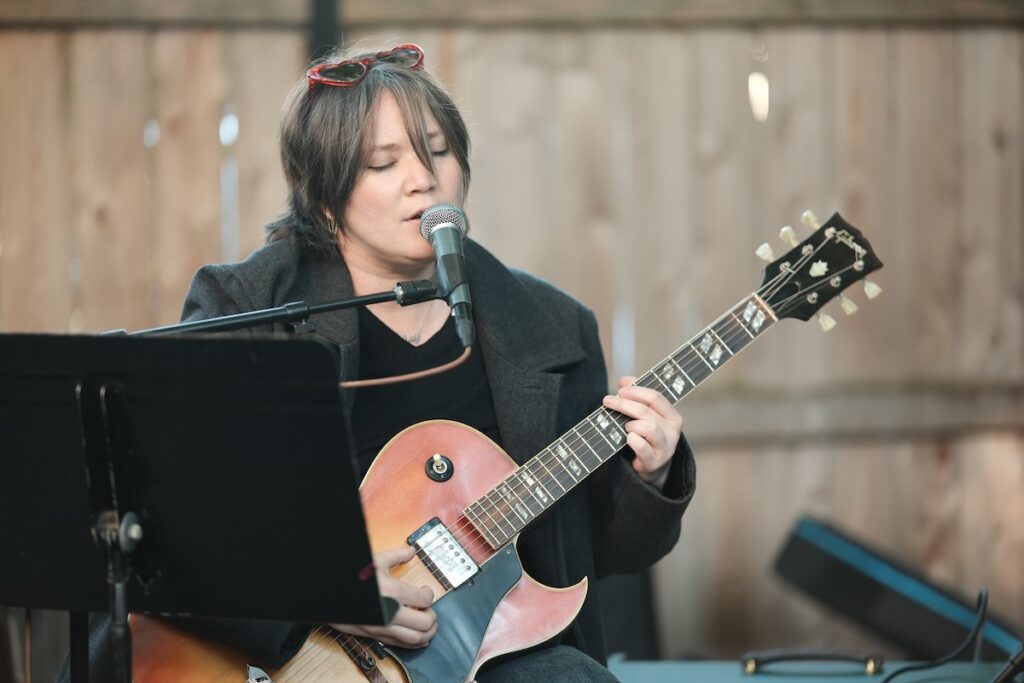
Later, singer-songwriter and improviser Wendy Eisenberg tunes up their guitar for a solo set. But it’s not their guitar, they hasten to admit. Steve Marquette, a Chicago-based improviser, lent Eisenberg his guitar so they didn’t have to brave TSA with their instrument.
“This is a uniquely humane place to play,” Eisenberg says, with a serene smile.
Eisenberg could be talking about ESS itself, or Chicago as a whole. The city’s many musical communities have been lauded for their inclusiveness and lack of cliqueyness compared to other major cities. The avant-garde and creative scenes are no exception. To paraphrase a friend: “You’re welcome as long as you act right.”
After Eisenberg’s set on Oct. 17 — four days before today’s surprise release of Wweennddyy Eeiisseennbbeerrgg — I’d go on to experience eight more hours of music in three venues across Chicago’s North Side and suburbs. They represent just a sliver of the scene, but speak to its interconnectedness and range.
Wheels up: It’s time for stop two.
From ESS, I head north to Evanston, the suburb directly north of Chicago, for a concert by the Chicago Chamber Choir. Though the choir is largely young, the audience filling the church pews is not: I’m younger than the average attendee by a decade or two.
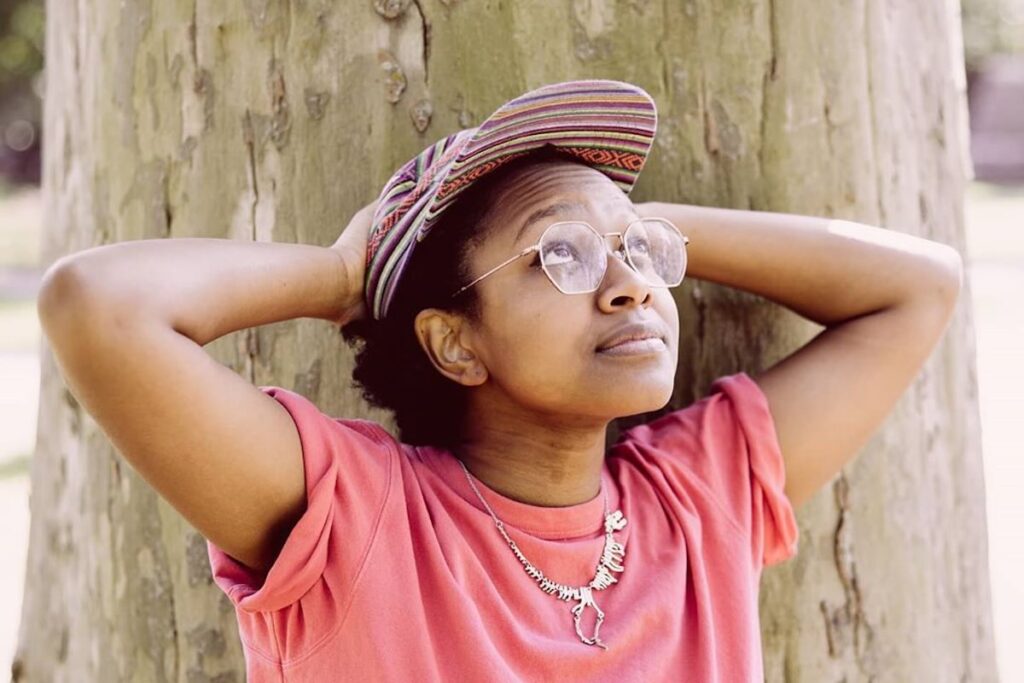
This concert caught my eye because of one piece threaded through the program: Ayanna Woods’ Infinite Body. The Chicago-born and -based Woods is one of the most talented choral composers on the circuit, writing for massed voices in striking and ever-new ways. (Some may know Woods’ sister, singer-songwriter and poet Jamila Woods. Clearly, musical talent runs in the family.)
In recent years, Woods has become a darling of the celebrated contemporary music choir The Crossing, who commissioned and recorded Infinite Body. Woods wrote the four-movement work in 2023, the year after a concussion reoriented her relationship to work and sound. One movement riffs on dreaded questions from that time: “So, what do you do? … So, what are you working on?”
Woods’ writing is ingenious as ever in Infinite Body. The first movement begins with haunting oscillations, cut through by the rich, focused straight tones of alto Eden Hensel. The chirpy second movement satirizes unthinking productivity, before contorting into something more sinister. Over the course of the fourth movement, a consistent, glowing hum brightens into an ecstatic chord, impossibly luminous — like staring into the face of the sun.
I arrived as an Ayanna Woods fan, but I left an equally ardent fan of the Chicago Chamber Choir, under the elegant hand of director Christopher Windle. It’s rare to hear a volunteer chorus who dotes upon matters of tone and ensemble, and this performance outclassed some professional choirs in the city. They’re idiomatically flexible, too, roving from stylish Tallis and Bach to a “Precious Lord” of big-hearted abandon.
An hour and a half later, I’m at Constellation, Chicago’s first port-of-call for avant-garde music. By now, throngs of people are usually slouching around the bar in the black box venue’s anteroom, cradling cheap beer and heady cocktails. But as a folded paper sign on the bar apologetically explains, a staffing snafu means the bar is closed for the evening.
The bar will open tonight, eventually, thanks to a superhero assist by Nolan Chin, one of the local musicians who keeps Constellation and its sister venue, Hungry Brain, running. Led by drummer Mike Reed, the team is also behind the new Sound & Gravity Festival, which doubles as a fundraiser for Constellation.
One such musician-staffer is headlining tonight: Alyssa Martinez, who makes poetry and visual art under the name A.Martinez. For six years now, she’s collaborated with composer and bassoonist Katherine Young, once a Chicagoan herself. Along with pianist Elena Cholakova and experimental filmmaker Masha Vlasova — two collaborators from Young’s new home in Atlanta — they premiere Porpidia crustulata and Other Digressions, a sparse and contemplative four-movement work for piano, electronics, and video. The piece explores their shared fascination with lichen — an organism that inspires a composition off Young’s new album BIOMES, released exactly a month before the Constellation show.
But I’m more gripped by the opening set featuring Norman Long, a South Side–based sound artist. Very much in keeping with the ecological theme, Long’s work is rooted in field recordings, some of which were taken in habitats in and around Chicago. (In fact, Long sits on the board of the Midwest Society for Acoustic Ecology with another ESS co-founder, Eric Leonardson.) Chicago’s motto is urbs in horto — “city in a garden” — but it’s easy to forget just how much nature is actually at residents’ fingertips.
Like Mallozzi and Stone’s ESS set earlier in the day, Long warped familiar sounds until they turned uncanny. Early on, earthy, night-bug sounds became an ambiently percussive layer, like a rain stick. Later, piercing crashes like thunderclaps shattered the quietude — a reminder of nature’s bigness, of its fierce unpredictability.
It was a soundworld I caught myself longing to live in. But aren’t we already, if we listen generously enough?
If you’re trying to find the Green Mill in Uptown, follow the flappers. Some people make a pilgrimage to this jazz club in costume, inspired by its history as a favored haunt of gangster Al Capone. When I show up, there’s six of them huddled outside: feathered headbands, tasseled dresses, a little drunk. “It’s cash-only,” one of them slurringly warns me.
If you ask me, a jazz club that has managed to stick around a hundred years — through Prohibition, an ever-changing neighborhood, and a recent ownership change — has more than earned the right to be cash-only. Unlike other clubs in the city, tourists and music buffs alike hold the Mill in equal esteem. So do 20-somethings seeking a sophisticated place to bring a date, or clamoring for a late-night watering hole: The bar recently brought back its red-eye weekend hours, staying open until 4 a.m.
But, as first-timers learn the hard way, the Mill still considers itself a bona fide listening room. Talk during the music, and you will be shushed, whether by one of the managers or a waiter weaving through the crowd with trays of drinks.
The Mill is still packed when I walk in at 11 p.m., just in time for the third set of Matt Ulery’s Nonet. An omnivorous bassist and composer, Ulery is celebrating the release of Nonet Now, featuring the same personnel onstage. (And in case this story has not yet convinced you that Chicago’s creative music scene is a village, the album was recorded at Constellation by — guess who — Nolan Chin.)
Nearly all of Ulery’s nonet compositions have a coasting, easygoing lyricism. When things get too samey, pianist Julius Tucker dives into the tunes’ untroubled waters and splashes around. His solos are angular, harmonically daring, and stupefying in their brilliance.
On Saturday — well, Sunday by now — Ulery played a bass solo at the top of the last number. A wave of shhhs fanned out around the club. It took me a few seconds to register that they were coming not from Green Mill employees but other patrons. The kids who had stumbled in after a few drinks were now leaning forward, clinging to Ulery’s every last note.
A uniquely humane city? I’d say so.
I CARE IF YOU LISTEN is an editorially-independent program of the American Composers Forum, and is made possible thanks to generous donor and institutional support. You can support the work of ICIYL with a tax-deductible gift to ACF. For more on ACF, visit composersforum.org.