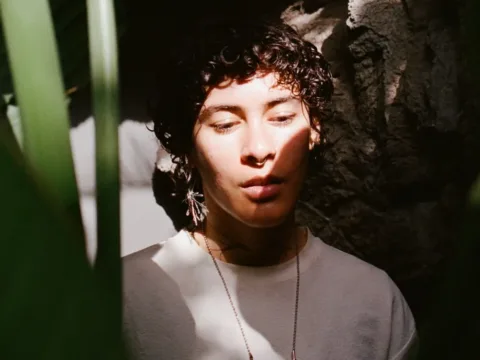
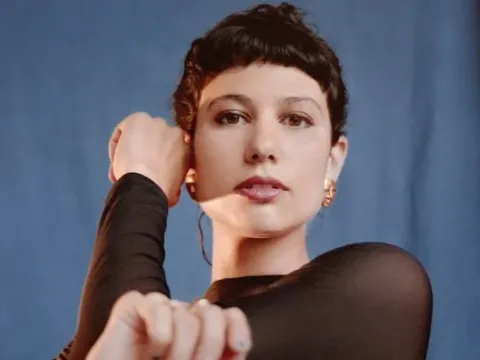
Taja Cheek is a Brooklyn-based multi-instrumentalist, composer, and curator who makes music as L’Rain. Over four albums — L’Rain (2017), Fatigue (2021), I Killed Your Dog (2023), and fata morgana (2026) — she has built a singular musical world that draws from R&B, noise, punk, soul, and experimental sound collage. Her music reflects a restlessness in form, able to flit between fragments, feeling, and memory.
L’Rain tracks are built from looping and layered samples, shifting textures, and sudden bursts of improvisation. Intricate arrangements are balanced with a willingness to let go. Cheek has described this aesthetic as “approaching songness,” a way of working with the notion of a song without being bound by its conventions. Her voice is central to this process as it moves between lyrics and soundscape, shifting her vocals into otherworldly ephemera.
Across her work, she returns to themes of grief, memory, renewal, and the instability of the self, and transformation is explored as an ongoing project. Her latest album fata morgana (Mexican Summer) extends these inquiries into new sonic territory while revisiting many of the questions that have shaped her work.
This openness also extends to Cheek’s work as a curator. Having worked on MoMA PS1’s “Warm Up” and Creative Time programming, she now works with Performance Space supporting artists and creating contexts for work that push beyond established forms. Across both music and curation, she makes room for experimentation, uncertainty, and unexpected connections that emerge when people are given the freedom to follow their curiosity.
We spoke with Cheek about the making of fata morgana, the generative possibilities of collaboration, and what comes after the end of a creative cycle.
Congratulations on fata morgana! What felt most challenging about making this record, and what was the most rewarding discovery you made along the way?
I appreciate you, thank you. I honestly felt a bit of a spiritual block in this process: it continually feels difficult to create when the weight of the world is so immensely heavy. And that heaviness feels impossible to fully reckon with, let alone change. I am a part of the world and the world is a part of me, always, but this record in particular is a product of my disconnection to mainstream culture in this moment. I’m wondering how to navigate an industry that deprioritizes my work and personhood, instigated by a culture that transforms kernels of bigotry into global webs of violence. That’s a difficult thing to navigate both logistically and spiritually.
So, I moved slowly through the process of creating the record. But somewhere along the way, as I found my way through the fog, I realized that it’s a big milestone for me to create my fourth record. I never expected anyone to listen or care; I started this project for myself and myself alone. But it’s been a little over a decade now. I’ve developed a style and a real body of work. There are people that care about this project, and I care about them. At the beginning I was just putting one foot in front of the other, but now I can see the forest through the trees.
The visual world of the album feels as expansive as the music itself, from the photography and videos to the design and “bootleg merch car” on the first night of your NYC tour. How did you approach translating the album’s ideas into something tangible?
It felt important to me to try to exist in the “real world” as much as possible. I don’t think utilizing technology, video, or even succumbing to social media has to mean neglecting gatherings in physical space, making connections with people in those spaces, and generally fostering community. This is something I hope to continue into the future, and the arc of the industry seems to be bending this way, no matter what big tech and AI giants want to sway people into believing.
Everything in L’Rain world starts with a joke, or an audacious “wrong” idea that we make “right.” It starts with fun and absurdity and then gets refined in the process of making. That’s true of the music and the visual world that the music exists within.
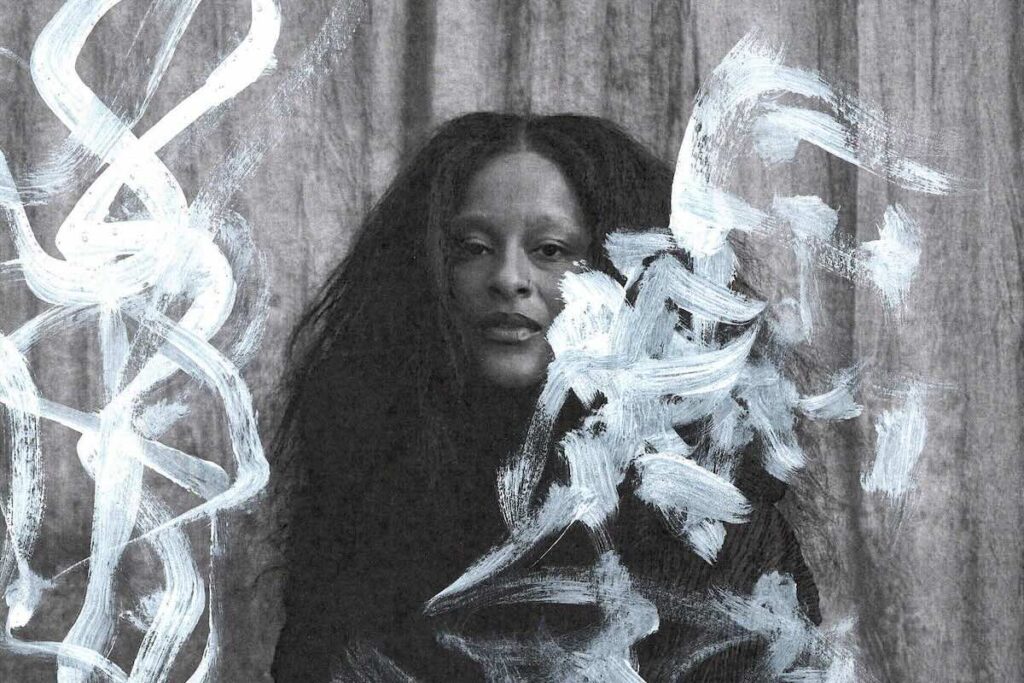
Across your work, you’ve collaborated with musicians from a wide range of backgrounds – what makes a collaboration meaningful to you, and how do you balance bringing your own ideas to these projects?
The L’Rain project is a spectrum between me and we. But ultimately, I’m the boss. I write the music, I play as many of the instruments as I’m able to, and I’m particular about every step of the process.
But, I do try to build in moments of collaboration within that hierarchical structure. In the studio when I work with musicians, I bring them in for very specific elements for the most part. But sequencing is a highly collaborative and particular process. I always bring in another artist to help stitch together the songs into an album, heavily guided by me and my studio co-producers – Andrew Lappin and Ben Chapoteau-Katz.
The live show is also highly collaborative. I think of the album as the urtext, and the live show is a more open and fluid interpretation of the work. I purposefully invite in musicians that have strong points of view, and they trust me enough to give a piece of themselves to the show. That collaboration and trust is the entirety of the show: we don’t use computers or backing tracks so every inspired gesture on stage is connected to a sound you hear.
Collaboration is really complex and challenging. I think a part of my purpose on this earth is to work my way through it.
Your work as a curator and your musical practice both challenge conventions and create space for experimentation. How does your curatorial work inform the way you make music?
For many years, I tried to keep these worlds as separate as possible – often going to extreme lengths, to my own detriment. But I’m slowly letting go of these boundaries. My curatorial impulses and musical predilections are water from the same well. What always surfaces is a commitment to world-building, surprise and wonder, genre and discipline blending, among other things.
Now that you’ve completed the four-part album project you began in 2017, you’ve effectively closed a massive creative chapter. Does finishing this arc feel like a clean slate for L’Rain, or will you keep building up from here?
I didn’t know what would eventually develop when I started this project. I talk a lot about fata morgana being the end of an era, and define these four albums as a “quadrilogy” but the truth is, right now, I don’t really know. The uncertainty feels exciting and terrifying but moreover it feels right. I would imagine it’s both a clean state and a place from which to build, a beginning and an ending.
I CARE IF YOU LISTEN is an editorially-independent program of the American Composers Forum, and is made possible thanks to generous donor and institutional support. You can support the work of ICIYL with a tax-deductible gift to ACF. For more on ACF, visit composersforum.org.