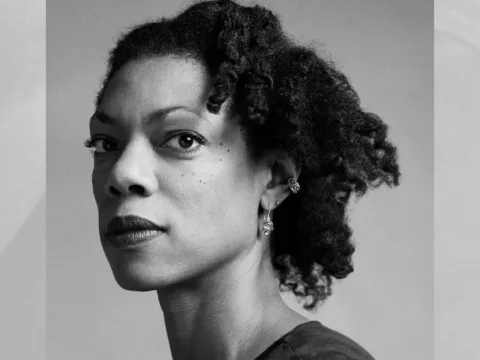
Cara Hagan is an artist in disciplinary flux. A dancer, theater-maker, sound-designer, and writer, she moves between forms without feeling compelled to settle into any one of them.
Her father was a musician who kept his drumset in the basement beneath her bedroom. “It was a regular backdrop to my life,” she recalled during our recent Zoom interview. Though she doesn’t identify as a musician herself, music and art-making have always been part of her surroundings. She was encouraged to be creative growing up — but it was movement and storytelling that most captivated her. “When I was a kid, I just always wanted to be in motion. I always wanted to be making up stories.”
Their creative instincts have long been rooted in the body. In their youth, they studied at a dance institute under Cheryl Wilkins-Mitchell, one of the only studios in the area owned and operated by a Black woman — and filled with Black and brown girls. That early experience of inclusive artistic community became an important facet of how Hagan understands creative practice: a shepherding of relationships, exchange, and shared imagination.
The ritual of process and a collaborative spirit are the most important aspects of her work — she often discovers the piece through research and experimentation as guided by liberatory and improvisatory practices. “How I approach each project depends on what it is that I’m working on. I don’t consider myself to be hemmed in by a specific genre,” she says.
Her recent work reflects that openness: she created the solo physical theater work Mama Piranha in 2025; the award-winning short film Cut Me Summa Dat Noise (2024); and a site-specific work were we birds? for the 90th American Dance Festival in 2023. Across these different modes, the connective tissue is less a particular aesthetic than a commitment to process.
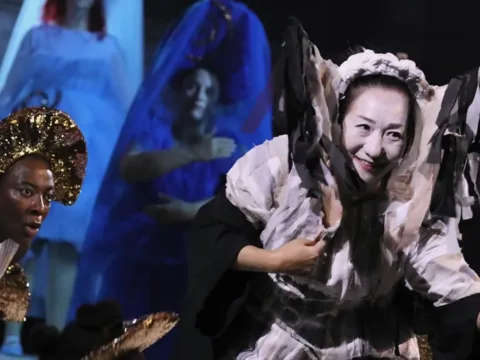
That sensibility is central to Mine to Keep, which draws from Black American folklore and the West African traditions that have influenced it. In this new devised physical theater work that premieres at JACK Arts on Nov. 20-22, Hagan turns to Black American mythologies to explore “what happens when what has been buried refuses to stay buried, and what has been taken longs to be reunited with its rightful owner.” Blending movement, theater, sound, puppetry, and storytelling, the production considers dispossession as both a physical and spiritual experience.

For Hagan, the stories we inherit are perpetual: they shift between generations, carrying histories and convening new meanings along the way. These histories connect in many ways, a major one being the impact and aftermath of the transatlantic slave trade.
Mine to Keep moves between two historical periods separated by a century: Reconstruction and the Civil Rights movement. Rather than treating history as a linear progression, Hagan uses these temporal modalities to reflect the nonlinear experience of living within systems that continually divests people from their time, autonomy, and sense of self. White supremacy, patriarchy, and capitalism are among the structures that inform the work’s exploration of what is taken, what survives, and what might be reclaimed.
The production also considers how collective fears shape political unrest, and how imagined threats can become entangled with the realities people actually face. Hagan is interested in the dissonance between the dangers that dominate public imagination and the violence unfolding in plain sight. While anxieties about immigration, for example, can be projected as an existential threat, school shootings and other forms of immediate violence continue to devastate communities, she explains. For Hagan, this gap between projection and reality raises questions about whose fears are validated, whose suffering is overlooked, and what happens when a society prepares for catastrophized outcomes while failing to confront the harm already occurring.
Horror becomes a useful lens through which to examine societal fears at different points in history and how they reveal the structures of power beneath the surface. Following WWII, fears around nuclear devastation and socialist infiltration led to the common horror tropes of alien invasions and mad science gone wrong. The 80s saw a rise in slasher films as the American public grew distrustful of the Reagan administration’s ability to protect the image of suburban safety.
When discussing today’s sociocultural climate, Hagan points to contemporary fears emerging around the erosion of personal autonomy. With AI, surveillance, and the disappearance of privacy, she observes that “our innermost corners are not our corners anymore.” The concerns expressed in Mine to Keep are both historical and immediate, tracing how the anxieties of one era echo into another.
Folklore offers Hagan a way to navigate these questions through figures that exist between worlds. Inspired by Èṣù Ẹlẹ́gbára and Anansi the Spider, Mine to Keep draws on the trickster tradition. There are figures who outsmart those in power and unsettle established order to help others withstand seemingly impossible circumstances. Animals and otherworldly entities become spiritual guides, standing between the living world and the next. Hagan themselves play the griot — a large non-human entity and a storyteller who stewards these narratives.

Joining Hagan are dramaturg Rodrigo Pocidônio, who helped shape the narrative architecture; JACK artistic director Amen Igbinosun, who performs as John/The Headless Haint; and movement artists Elinor Kleber Diggs and Maurice Ivy, who communicate their characters’ stories through movement and little spoken text. Three singers — Ash Stallard, Chloe Robinson, and Nailah Jappah — appear in the recorded soundscape by Hagan, their voices woven into the production’s sonic landscape.
The worldbuilding is achieved through an array of theatrical elements. The color gold appears through the set and costume designs as a symbol for longing. Thunderstorms move through the sound design, along with layers of harmony and dissonance that reflect the underlying tensions of the characters’ choices. Shadow puppetry provides exposition and carries different parts of the story, while also allowing the collaborators to approach the representation of Black death with care. “We wanted to be intentional with interpreting Black death on stage,” Hagan clarifies.
Though Hagan established the conceptual framework, she describes the piece as a shared act of discovery. “It’s physical theater: there’s text, there’s movement, there’s puppetry. While I have created the sandbox and the parameters, all of the cast were invited to share ideas. We play together.” Her work, she says, depends on building relationships and “relying on our collaborative powers to create something that wouldn’t have been created unless those very people were in the room.”
This philosophy extends beyond the stage. With 19 years of teaching experience, including five at The New School where she currently serves as Associate Professor and Program Director of the MFA Contemporary Theater Performance program, Hagan places play at the center of their educational practice. “Nothing is ever going to be perfect, but I think what you gain in each process is the opportunity to keep practicing building the world that you want to live in.”
That practice feels particularly urgent to her amid what she describes as an epidemic of loneliness. As communal gathering places disappear — increasingly displaced by commercial interests and becoming more mediated by devices — meaningful human connection seems to be shrinking. Rehearsal offers a counterpoint. Being in a room with collaborators, we get to practice the kind of connection that fuels community.
Through Mine to Keep, Hagan and her collaborators create a space where collective memory can be revisited, buried fears are brought into view, and the possibility of reclamation exists. The making of this work offers a reminder that the world we hope to inhabit can be built through the ways we come together.
I CARE IF YOU LISTEN is an editorially-independent program of the American Composers Forum, and is made possible thanks to generous donor and institutional support. You can support the work of ICIYL with a tax-deductible gift to ACF. For more on ACF, visit composersforum.org.